
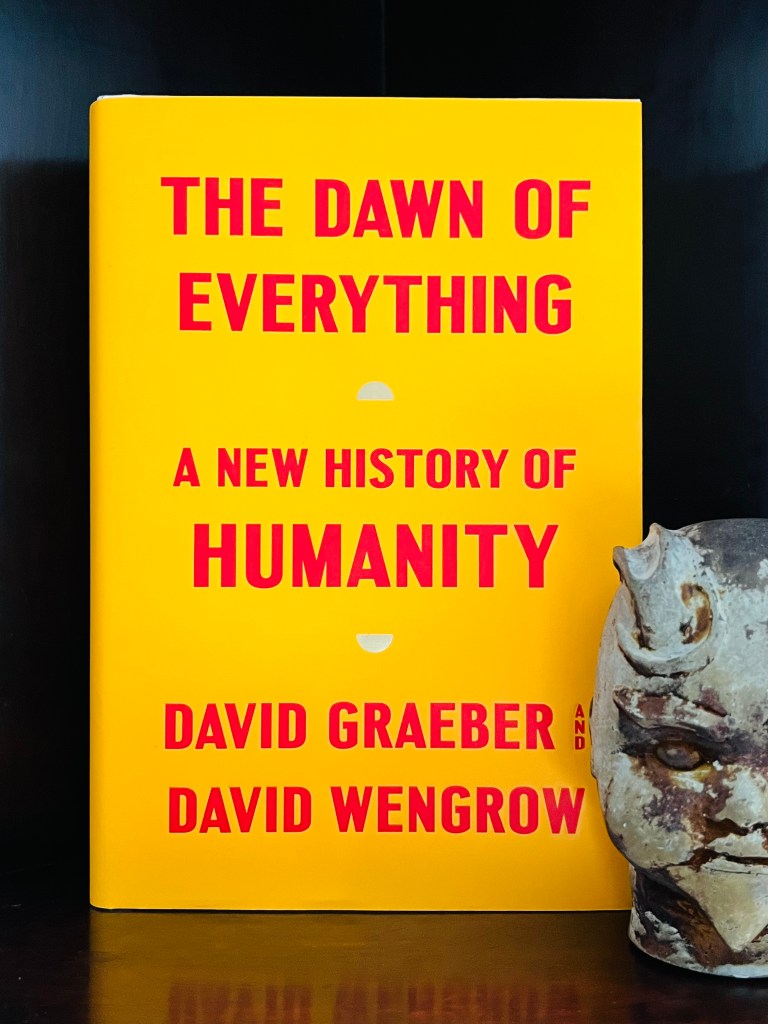
A New History of Humanity
By David Graeber and David Wengrow
There is a certain kind of book – it may appear in any number of genres – which exists to ask a single question: do we really know what we think we know? Whatever the subject, these books share a moral viewpoint: namely, that we are obligated, in the face of our certain beliefs, to question the very substrate upon which they are founded. They are anti-canonical. They exist to problematize the things which we take for granted in whatever sphere they choose.
I love this kind of book. I love them. The truth is, I have never really been sure that I know anything at all about anything at all. I am obsessed with the idea that my beliefs are grounded in myth and error. I have spent my life peering around me for my own blindspots.
So, whatever the subject, I am drawn to these books. I don’t find them unsettling; rather, I find them exhilarating. I am thrilled to think that I have been laboring under a delusion, crippled by bad information or wrong analysis. I find this idea, that maybe we are wrong about everything, to be freeing. Because, if we are wrong about everything, than anything is possible.
‘The Dawn of Everything’ is a book about whether we know what we think we know about human pre-history. It was co-written over ten years by two friends, the archaeologist David Wengrow (at University College London) and the late anthropologist David Graeber (of the London School of Economics). According to the introduction, the two men began the book as a sort of thought-exercise, a conversation between them to express their frustration with certain dogma in their respective fields.
Now, you may not think you know anything about human pre-history – I certainly didn’t think I knew much. But the truth is, we have all been marinated in an idea of how social evolution works, an idea which is so ubiquitous that you probably don’t think of it as theory so much as common sense.
I certainly have. If you had asked me how “civilization” developed, I probably would have said something like: once, we were little bands of apes. Then we formed bigger bands; at some point, at different times in different places, those bigger bands started cohering into tribes; tribes became chiefdoms, large stable settlements of socially complex, pre-agricultural humans.
Then, wham, agriculture happened, ushering in kingdoms, private property, bureaucracy, specialization, written language, you name it. All the things which, to 21st-century humanity, characterize “civilization”.

Agriculture allowed rulers to feed standing armies and local police forces. Warfare, once a matter of local tribes raiding each other for whatever they could carry, became a profession, and conquest, subjugation, genocide, and colonialism were all born. Lifespans shortened, human health declined. Professional police forces were able to enforce private property, and economic classes, with all their attendant religious and bureaucratic supports, appeared. Agriculture enabled the development of all the means of persecuting each other now at our disposal: caste, bondage, debt, prison.
Wengrow and Graeber, frankly, don’t buy any of that. In ‘The Dawn of Everything’, they present a survey of human pre-historical civilizations which challenge every stage of this putative developmental trajectory. The humanity that they describe is more various, more diverse, less linear and more complicated than could possibly fit into that dogma. Some societies, they argue, developed bureaucracy without agriculture. Some developed agriculture without bureaucracy. Some pre-agricultural groups had kings; some agricultural societies seem to have abandoned agriculture and returned wholesale to hunting and foraging. There is, they say, no “progressive” trajectory to how human social complexity evolves, and we are wrong when we consider smaller groups to be less complex than larger ones. Human society, they argue, has been as diverse, complicated, and non-linear as humans themselves.
I have absolutely no idea whether or not this true, and I don’t care.

Which is not to say that Graeber and Wengrow aren’t persuasive – they absolutely are. For what is, essentially, a survey textbook of human evolution, ‘The Dawn of Everything’ is incredibly readable: lucid, clear, brisk. I was persuaded, certainly, but books are usually persuasive within their own covers. Of course they are: they have unchallenged dominion in that space, complete control of the arguments, the narrative flow, and, most importantly, the evidence presented. It takes time to know whether a book is right, and it takes interest: you need to be willing to go out and look for other arguments, and I have not yet had time to do that.
But it doesn’t matter, to me, whether Graeber and Wengrow were correct about any one specific thing they said – the truth is, I will never have the expertise to say. But the exercise is a good one; the challenging of orthodoxy almost always has value.
There are a lot of things of substance and value to discuss in ‘The Dawn of Everything’, things that have to do with society and freedom and the human condition, but that is a discussion for a smarter blog. I am, as usual, less interested in the objective truth of the matter than I am in the fun of imagining that everything I have been taught is wrong.
I hope it is (wrong, I mean). I think, in general, we would be a better species if we let go of certain ideas of advancement, of complexity as a moral trait rather than an arbitrary one. But, mostly, I hope we’ve all been wrong all the time because it’s fun to be wrong. It gives you a chance to see the world fresh again, to start over from first principles and try out different ideas. If the development of our own cultures is totally different than we thought, then perhaps our cultures don’t mean what we think they mean. Maybe we have many more options that we supposed. Maybe nothing was destined, everything was improvised. Maybe, everything can change.
 The Bibliolater
“The Dawn of Everything” is a biased disingenuous account of human history (www.persuasion.community/p/a-flawed-history-of-humanity ) that spreads fake hope (the authors of “The Dawn” claim human history has not “progressed” in stages, or linearly, and must not end in inequality and hierarchy as with our current system… so there’s hope for us now that it could get different/better again). As a result of this fake hope porn it has been widely praised. It conveniently serves the profoundly sick industrialized world of fakes and criminals. The book’s dishonest fake grandiose title shows already that this work is a FOR-PROFIT, instead a FOR-TRUTH, endeavour geared at the (ignorant gullible) masses.
Fact is human history has “progressed” by and large in linear stages, especially since the dawn of agriculture (www.focaalblog.com/2021/12/22/chris-knight-wrong-about-almost-everything ). The book’s alleged major “fundamental” insight is “the ultimate, hidden truth of the world is that it is something that we make, and could just as easily make differently” (the first part of that statement is hardly a great insight because a perceptive child can recognize that) YET fails to answer why we do NOT make it differently than it is now if we, supposedly can make it “EASILY” different, why we’ve been “stuck” in this destructive system for a very long time. THAT is really where “the ultimate, hidden truth” is buried and the answer is… it is because of the enduring hegemony of “The 2 Married Pink Elephants In The Historical Room” (www.rolf-hefti.com/covid-19-coronavirus.html ) which the fake hope-giving authors of “The Dawn” entirely ignore naturally (no one can write a legitimate human history without understanding the nature of humans)
A good example that one of the authors, Graeber, has no real idea what world we’ve been living in and about the nature of humans is his last brief article on Covid where his ignorance shines bright already at the title of his article, “After the Pandemic, We Can’t Go Back to Sleep.” Apparently he doesn’t know that most people WANT to be asleep, and that they’ve been wanting that for thousands of years (and that’s not the only ignorant notion in the title) — see last cited source above. Yet he (and his partner) is the sort of person who thinks he can teach you something authentically truthful about human history and whom you should be trusting along those terms. Ridiculous!
“The Dawn” is just another fantasy, or ideology, cloaked in a hue of cherry-picked “science,” served lucratively to the gullible ignorant underclasses who crave myths and fairy tales.
“The evil, fake book of anthropology, “The Dawn of Everything,” … just so happened to be the most marketed anthropology book ever. Hmmmmm.” — Unknown
LikeLike