

By Alexandre Dumas
Translated by Jacqueline Rogers
All posts contain spoilers.
 This book is badly named.
For starters, it is not about a man in an iron mask. A man fitting that description makes a brief appearance, but he is largely peripheral to the plot of this book.
Also, ‘plot’ is perhaps too strong a word for the structure of this novel. If a plot is a central story which involves and therefore justifies the characters and which resolves in a climax, then this book lacks one.
 This is partly because ‘The Man in the Iron Mask

This novel opens in the Bastille with Aramis, who is meeting with Philippe, a young man who had been imprisoned eight years earlier but committed no crime. Aramis, now the Bishop of Vannes, tells this young man that he is the secret and identical twin brother of King Louis XIV of France, imprisoned and doomed for his resemblance to the King and, crucially, for his equal claim to the throne of France.
Aramis proposes to spring this young man and replace Louis. Philippe understandably agrees, and, with very little effort, Aramis effects the miraculous escape. The King is at Vaux for a party thrown by his minister Fouquet. There, the switch is accomplished with no trouble whatsoever, via a bed which can be levered down through the floor into a cave (sure, of course). Louis is sent to the Bastille; his brother put on the throne, no one the wiser.
So far, this will all be at least somewhat familiar to anyone who has seen the movies. But, now, things take an odd turn, pacing-wise. Aramis tells Fouquet his plan; Fouquet is appalled, loyal to the old King, he rushes to the Bastille, frees Louis, and reveals the imposter. Louis comes face to face with his brother, quails, and orders him banished to an island prison and locked in an iron mask. D’Artagnan himself bears the prisoner thus.
You are now about 50% of the way through the novel. If you are like me, you will spend the rest of the book waiting for D’Artagnan to realize that he has chosen wrong, supported a wicked king, and finish what Aramis started.
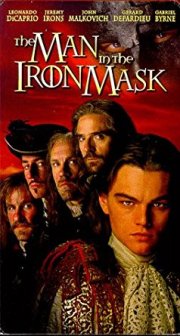
You will wait in vain. The rest of the novel will be spent following the four musketeers to their deaths, both dismal and heroic. Nothing more will be heard of the imposter King after his fresh imprisonment; he will presumably spend the rest of his wretched life in the iron mask. It is weird, and anti-climactic, and, frankly, sort of pointless.
Perhaps the least satisfying part, from a narrative point of view, is the character of Louis himself. I longed for him to be a villain, but he wasn’t – he was merely a king. He has moments of juvenile, petty vindictiveness, but he also has moments of strength, maturity, and mercy, and is eventually reconciled even with Aramis, who had him imprisoned overnight in the Bastille.
All this ambivalence of plotting would be easier to bear if ‘The Man in the Iron Mask
“You intend to look after me, then?”
“Yes, monseigneur; I do, upon my honor.”
“Upon your honor? Ah! that is quite another thing. So I am to be arrested in my own house!”
“Do not say such a thing.”
“On the contrary, I will proclaim it aloud.”
“If you do so, I shall be compelled to request you to be silent.”
“Very good! Violence toward me, and in my own house, too!”
“We do not seem to understand each other at all. Stay a moment; there is a chessboard there; let us play, please, monseigneur.”
“Monsieur D’Artagnan, I am in disgrace, then?” (p. 161
)
And these are meant to be normal conversations – this is everyday discourse. The whole book is like this!
Things are made even less clear by the fact that all the major characters (except the King) have about eight names. Aramis, for example, is the Bishop of Vannes, Monsieur d’Herblay, and the General of the Jesuits. Add to this that they all refer to each other not by their names but as Monsieur and you’ll see that much of the dialogue is incoherent.
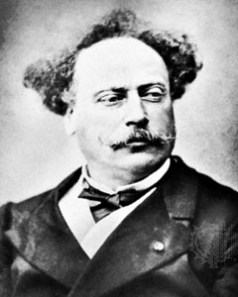
One does begin to suspect that Dumas is being paid by the word – nothing that could be said in ten words is said in fewer than a hundred, and there are entire sub-plots which are no more than cul-de-sacs, and therefore completely unnecessary (and, as with Moliere and the artists’ house, completely unintelligible).
But, of course, amidst all these words, it is almost a statistical inevitability that there would be moments of sublimity, and there are certain high emotions which are, perhaps, best expressed in fruity, Baroque French. Take, for example, the moment when Athos bids farewell to Raoul, his son, forever:
“Athos sat on the mole, stunned, deaf, abandoned. Every instant took from him one of the features, one of the shades of the pale face of his son. With his arms hanging down, his eyes fixed, his mouth open, he remained one with Raoul – in one same look, in one same thought, in one same stupor. The sea, by degrees, carried away boats and faces, until men were nothing but dots; loves, nothing but memories.” (p. 285
For some authors, these lovely moments are worth bad plot. And it may be that Dumas in his stronger books is also worth it. I really enjoyed ‘The Count of Monte Cristo

 I know that I’m not supposed to admit this, but I don’t like ‘
 ‘.
‘. ‘. Dryden dedicated
  of ‘The Aeneid’ to “those Readers who have discernment enough to prefer Virgil before any other Poet in the Latine Tongue”.
 I hadn’t read an English translation of ‘The Aeneid’ since high school, and I’d been wondering whether, perhaps, my initial aversion to it was a maturity problem, whether ‘The Aeneid’ is something only adults enjoy, like drinking espresso or discussing property values. It’s not uncommon for me to find that, upon re-reading, I really like authors or books I loathed when I was younger, and I hoped that ‘The Aeneid’ might be one of these.
 ‘ and ‘
 ‘. It really shouldn’t be: it has a different author, writing from within a different civilization, in a different language. The comparison is particularly invidious when it comes to main characters: Achilles and Odysseus are much richer and more complex than Aeneas, who is ever-noble, ever-handsome, ever-brave, ever-pious, and ever-victorious. All his misfortune is the result of the personal animus of the goddess Juno, who doesn’t dislike him per se, but all Trojans (since Paris dissed her way long ago); he is essentially a victim of divine racism. But he himself is personally flawless and so narratively dull.

 ‘, Charles Dickens))
 The Bibliolater