Mexican Gothic

By Silvia Moreno-Garcia

ALL POSTS CONTAIN SPOILERS

I’ve been excited to read ‘Mexican Gothic‘ for months now. I first heard about it from an agglomeration of New York Times reviews of horror novels:

“While the book draws inspiration from Gothic classics like “Rebecca” and “Jane Eyre” — there is a spunky female protagonist and an ancient house filled with disturbing secrets — its archly intelligent tone and insightful writing make “Mexican Gothic” an original escape to an eerie world.

In 1950s Mexico, Noemí Taboada, the daughter of a wealthy industrialist, is sent by her father to help her cousin, Catalina Doyle, whose impetuous marriage has landed her in High Place, a moldering mansion perched in the “steep and abrupt landscape” of El Triunfo.

Noemí, who prefers parties and fashionable dresses to the staid Anglophile Doyle family, finds her cousin much changed. While the family doctor claims Catalina suffers from tuberculosis, she doesn’t have any of the usual symptoms. Indeed, she claims that the walls tell her secrets, a dreamy delusion Noemí soon comes to experience firsthand. In her attempts to help Catalina, Noemí is pulled into a frightening ancestral legacy that has ripped the Doyle family apart.”

Doesn’t that sound great? I bought the book basically immediately after reading that and have been saving it for a treat.

I would have been a lot less keen if I had known it was about mushrooms.

Literally: mushrooms. The “frightening ancestral legacy that has ripped the Doyle family apart” is that, generations ago, their patriarch Howard allowed himself to be infested with a fungus that gives him an unnaturally long lifespan and the ability to control people’s minds – you know, one of those cannibalistic immortality hive-mind fungi – and he’s been terrorizing the locals ever since.

And, look, we’ve talked a lot about premises here, but mostly we’ve talked about bad executions of great premises, wasted premises (which really frost me). We haven’t spent a lot of time talking about shitty premises, for the simple reason that I try to avoid reading books with shitty premises because they are almost impossible to pull off.

When I was in high school, my best friend and I loved horror movies. However, in our opinion, most horror movies fall apart at the end – all the energy and suspense that has been built up during the course of the movie sort of fizzles out when it comes time to look at the monster head-on. My friend, who was sort of a genius about stuff like this, framed the problem of the monster-reveal perfectly. She said, “Look, you basically have two choices if you want your movie to be scary. You either devote a lot of time and effort into making your monster really scary to look at, a la ‘Alien’. Or you never show your monster, and it just drags people into sewers off-camera or whatever. But you can’t show a monster and have it be disappointing – if you do that, you lose everyone.”

I’ve applied that rule ever since, and what has become clear over my many years of consuming horror is this: the skills required to build suspense and the skills required to imagine something genuinely terrifying are totally different skills. It’s amazing how many horror plots (movies and books) fall flat when the monster is revealed – the authors of those stories spend a lot of time and effort building up suspense, only to then unveil a monster that wasn’t worth all the fuss they made about it. It’s also probably why many of the really convincing horror stories reveal a human monster at the end – we are already genuinely terrifying.

So, if I routinely find aliens and vampires and zombies disappointing, you can imagine how I feel about a fungus. And it’s not that I hated ‘Mexican Gothic‘, or thought it was a bad book – it’s just that there is something anticlimactic about finding out that the creepy voice coming from the walls is a mushroom!

And I admire Moreno-Garcia for trying (and not in a patronizing, “A for Effort, Silvia” kind of way). It takes courage to say to yourself, “I’m going to write ‘Rebecca’, but with a mind-controlling fungus”. And just because, in my opinion, ‘Mexican Gothic‘ doesn’t succeed doesn’t mean that it’s her fault that it doesn’t. The reason I object to fungus-as-enemy is that I don’t think it could have worked. Moreno-Garcia is a pretty talented novelist, I suspect. But she picked a real lemon of a plot – I honestly can’t think of a novelist I believe could have made this work.

Silvia Moreno-Garcia

But that’s not a good reason not to try. It’s easy for me to say, “There’s a reason you can’t think of a single successful horror story where mushrooms are the villains”, but there wouldn’t be, would there, until someone wrote one. All good plots must have a debut, and maybe you don’t know until you try. The next great scary story is waiting somewhere, and someone is going to have to take the risk to tell it.

But it’s not this one. In my opinion, mushrooms don’t make good villains. And my objections aren’t about plausibility – I think people who object to horror stories on the basis of realism ought to be slapped. On the contrary, the plot of ‘Mexican Gothic’ is much more plausible than it is interesting.

And it’s not that mushrooms aren’t interesting – I know that fungi are considered by many to be among the most interesting organisms around. I am in no way disparaging mushrooms, but I think maybe Moreno-Garcia was trying to have two things at once: a villain, and a neat plot mechanic. Fungi are bizarre, and a really creepy story might have been told about a terrible fungal epidemic. But mushrooms aren’t moral – they aren’t wicked. Villains, though, are. And by hybridizing her mushrooms and her villain, Moreno-Garcia squandered her ability to use either to full effect: to have us shudder at the terrible ingenuity of the natural world, or to rally against evil. The mix doesn’t work – it should have been one or the other.

The truth that my friend framed so well all those years ago is that very few things are scary when you can see them clearly. Fear needs darkness – when the bright, clear light of explanation shines on them, when you can take their measure with your own eyes, they usually cease to be frightening.

And this is true of actually scary things, like zombies – fungus didn’t stand a chance, really.

Middlemarch

By George Eliot

ALL POSTS CONTAIN SPOILERS

It’s always stressful when you fail to love a Great Book. One always embarks upon a classic with high hopes, expecting to be enriched. You hold in your hands a work that has been vouched for by Culture as possessing extraordinary merit. You hoped, when you began, to one day participate in unanimity: “Oh, yes”, you imagined saying at cocktail parties in the future, “of course I have read ‘Ulysses’ – haven’t you? Oh, but you must! It’s a masterpiece!’ But you have failed to arrive at this imagined destination; the book has not taken you where you hoped. It’s disappointing, of course, but, more, it’s disconcerting: you know something is askew, and the consensus critical opinion suggests that it is you.

Most of us probably handle this personal failure to perform by staying silent when the works in question are discussed. Better to have no opinion than a opinion which is manifestly wrong, which might single you out as a philistine. It is therefore impossible to know how many Great Works are leaving people cold on a regular basis – maybe no one actually likes ‘Ulysses’. As long as the threat of intellectual opprobrium hangs over dissent, there is the risk that people will pretend to like things they don’t in order to avoid looking stupid.

All of which is my way of bracing myself to admit something that I have kept hidden for a long time: I don’t like ‘Middlemarch‘.

I know that I’m supposed to love ‘Middlemarch’ – everyone loves ‘Middlemarch’, especially literature-minded women. Bookish women seem to love ‘Middlemarch’ to an almost improbable degree – the ubiquity of ‘Middlemarch’ appreciation is rivaled, in my opinion, only by love of ‘Pride and Prejudice’.

But I’m a bookish woman, and I have never loved ‘Middlemarch’.

This fact makes me feel so insecure that I have, in fact, read ‘Middlemarch’ four separate times in the past twenty years. I’ve never once liked it, but I keep reading it because everyone else loves it and I’m trying to figure out what I’m missing. Compounding my difficulty is the fact that I find it singularly unmemorable; I forget what happened in ‘Middlemarch’ about fifteen minutes after finishing the book, which means that, not only can I not understand why other people like it, I can’t remember why I didn’t.

But I have just finished my fourth attempt on ‘Middlemarch’, and, in the last few moments before the plot leaves me again, let me try to parse my disappointment.

All criticism should begin with a compliment. Let me state the obvious: ‘Middlemarch’ is beautifully written. My copy positively bristles with sticky notes from all the passages that I’ve marked.

“To know intense joy without a strong bodily frame, one must have an enthusiastic soul. Mr Casaubon had never had a strong bodily frame, and his soul was sensitive without being enthusiastic: it was too languid to thrill out of self-consciousness into passionate delight; it went on fluttering in the swampy ground where it was hatched, thinking of its wings and never flying.” (p. 266)

“Even much stronger mortals than Fred Vincy hold half their rectitude in the mind of the being they love best.” (p. 229)

“Will was not without his intentions to be always generous, but our tongues are little triggers which have usually been pulled before general intentions can be brought to bear.” (p. 349).

Not only is this language lovely, the insights are well-observed, almost profound. That I am in the presence of a great mind as I wade yet again through this book is obvious to me – Eliot is a magnificent writer. I have absolutely no quarrel with her prose – this is not where my relationship with ‘Middlemarch’ is foundering.

The difficulty is this: I loathe every single one of her characters, and I don’t care at all about what happens to any of them. For what it’s worth, I am aware that this is the shallowest possible level of analysis. Characters in novels aren’t your friends – it is not their responsibility to be likable to you. Many great novels are written about terrible people. The idea that the merit of a book is how much you root for the characters, or how much you see yourself in them, how much you connect with their situation, is, in my opinion, sophomoric garbage, weak thinking for weak minds.

That approach to novels offends me because it doesn’t even apply to life. The virtues of mankind are various: people may be brilliant, or funny, or brave, or kind. They may be all of these things, and without being at all likable. We often root for people we wouldn’t like. Plenty of people have accomplished great things, lived interesting lives, without being the sort of person you personally relate to. It often happens that fascinating lives are lived by weak, repellent, or wicked people. Novels, which are essentially just stories about people, shouldn’t be held to a narrower standard than people themselves.

But, in my defense, I don’t loathe the characters in ‘Middlemarch‘ because they are weak, repellent, or wicked – they aren’t, especially. They are merely unremarkable. In all likelihood, I wouldn’t loathe them in real life at all. I only loathe them because I feel I am being forced to admire them. I resent them because I feel I am being forced by consensus opinion to read an 800-page book about them. Again.

The plain truth is that I don’t understand why people love this book, but I have a sneaking suspicion that loving ”Middlemarch”, rather like hating ‘Middlemarch’, is all about Dorothea. I don’t think anyone loves ‘Middlemarch’ for Fred Vincy, or for Will Ladislaw. Dorothea is fulcrum upon which the novel turns – it is Dorothea upon whom readers pin their attachment, in whom readers endeavor to see themselves.

Certainly, Dorothea is the obstacle which I myself cannot get past. Much of my irritation with her, I think, stems from my sense that I am supposed to like her, my sense that George Eliot liked her. She’s not drawn as a perfect character, but her flaws, stated clearly in Eliot’s beautiful, precise prose, are unconvincingly virtuous. They have the aspect of Trojan flaws: putatively added to give realism and depth, but actually draped across a character to flatter them. They feel disingenuous, the novelistic equivalent of being asked your weaknesses in a job interview and saying, “I care too much about my work.”

George Eliot tells us that Dorothea is idealistic, lofty in aspiration and naive in execution, and earnest to a fault, as befits a person pure of heart. But that is not who I see. The character I see is an unperspicacious and pretentious woman who cultivates virtue in order to satisfy her own vanity. And while I think it is entirely possible to love a vain and unintelligent character, I think it is very difficult to love a vain and unintelligent character whose author doesn’t see her that way.

As I write that out, it suddenly occurs to me that it is the problem: my objection to ‘Middlemarch’ isn’t that I don’t like the characters (very few books are peopled by characters I actually like). The problem is that I don’t like them, but George Eliot does.

Perhaps it’s impossible to really love a book when you substantively disagree with the author about her own characters – I don’t know. But it is certainly the problem here: George Eliot is charmed by her ‘Middlemarch’ characters, and I am not.

A story needs to justify itself to readers. All stories are acts of persuasion: the readers are offering their time; the story must therefore provide a continued justification for that time. Different kinds of stories provide different justifications. Action heroes aren’t well-developed characters because they don’t need to be: no one is there to watch them grow and mature. Hero’s journeys have opposite requirements: if the hero doesn’t justify the story, nothing will. Likewise, when a character is meant to be disliked, the story is built to accommodate that repulsion, either by making the repellent character compelling in some way, or by punishing them in a way that the reader will find satisfying.

‘Middlemarch’ is a hero’s journey: good and lovable, though imperfect, people experience tribulation, learn and grow, and then are recompensed with happiness. The virtuous are rewarded; sinners are punished. But I don’t find Eliot’s heroes heroic – I find them stultifying, and that doesn’t work. When the hero fails to capture your interest, all the apparatus of their journey becomes burdensome, and you, as a reader, resent it.

Or at least I do. And I know that it’s my problem. Everyone else seems to find Dorothea enchanting, worth journeying with – I’m clearly the exception. And I wish it weren’t so. I’m not one of those people who feel superior when they dislike something popular. On the contrary, I feel anxious and unsettled, as though I were missing something obvious.

I wish I loved ”Middlemarch‘; I have certainly tried to. I don’t resent the effort I’ve put in: I believe it is our obligation to better ourselves for the sake of great literature, to try to become the readers we want to be. I’ve failed with ‘Middlemarch’, but that’s OK. Perhaps we are defined as much by our failures as readers as we are by our successes. The books that we don’t love can teach us just as much about ourselves as the books we do. And, often, greatness in a work of literature is less about how much you enjoy reading it than it is about how intensely you feel to need grapple with it.

Measured that way, ‘Middlemarch’ is certainly a great work of literature to me. Though I have never loved it, I have also never been able to make my peace with not loving it. On the contrary, I come back to it again and again looking for resolution. And maybe, one day, I will love ‘Middlemarch’. Somehow, I doubt that I have read it for the last time.

Djinn Patrol On the Purple Line

By Deepa Anaparra

ALL POSTS CONTAIN SPOILERS

So, one of the things that happens when you read a lot (like, a lot) is that you start to get a feel for stories.

Storytelling is like any well-developed art form: it has a sort of syntax all its own, with signifiers and allusions and conventions which become more and more familiar the more time you spend immersed in the medium.

Let me give you an example: you’re watching a horror movie. There are some teenagers, some are boys, some are girls. One of the girls is hot, blonde, and a little, er, wild. The group of teenagers all enter the haunted house/abandoned asylum/house of mirrors, and shortly thereafter the blonde girl sneaks off with a boy to screw around.

In that moment, you 100% know she’s going to die, horribly, very soon. Everyone knows she’s going to die, horribly, very soon, because that blonde girl isn’t actually a character – she’s a trope. She’s a signifier, a syntactical element, placed there in reference to a tradition (repulsive, reductive, misogynistic though it may be), placed there to orient you within the framework not of this specific story, but within all stories.

That’s a particularly unsubtle example, I know, but stories are filled with elements like this, and when you live, as I do, in stories, they become a second language. Familiarity with this language allows you to grasp, quickly, the dense web of references that most stories reside within, and, often, it can tell you, like Chekov’s Gun, what is going to happen long before it actually does.

If you get good at this language, you can often predict with eerie precision what’s going to happen in a book or movie. And, as in the case of our Slutty Blonde above, the more stereotyped a story is, the easier it is to spot the future coming.

I’m good at this language, and I’m rarely wrong about how a story ends, which is both fun and slightly boring.

Djinn Patrol on the Purple Line‘ positively bristles with signifiers. It’s incredibly obvious what kind of story it’s going be: everything about this book, the title, the cover art, the premise, promise you a funny, poignant, humane romp.

Djinn Patrol on the Purple Line‘ is the story of Jai. Jai is nine years old, and lives with his mother, father, and older sister in a sprawling Indian slum. Jai is undistinguished by any particular talent, he daydreams through school, lacks his sister’s athletic talent or his parents’ work ethic. But Jai nourishes a secret dream of being a television detective, and when children of the slum start disappearing, he decides he’s exactly the right person to solve the case, albeit with the help of his two best friends Pari and Faiz (and an adopted slum dog named Samosa).

A funny, poignant, humane romp, right?

The novel is written primarily in Jai’s voice. Or, to put it another way, it’s written in the voice of a nine year old boy. This device is usually extremely irritating, but Anaparra really pulls it off, and Jai is mostly a wonderful narrator: detailed, whimsical, bewildered, and funny. Really funny, actually – Anaparra captures very well the slightly misaligned certainty with which children interpret their world, the way that they come to very particular conclusions which are often a little askew, but reasonable based on the info they have. The workings of the world as seen through Jai’s eyes are arbitrary, magical, hilarious. Hilarious, at least, until, suddenly, they aren’t.

You know that old saw, that good literature shows, and doesn’t tell? Well, the dirty little secret is that almost everyone tells, at least a little. It makes sense – it must be nearly irresistible for authors to tell. Imagine it: you write this whole book, construct characters and metaphors and conflict and catharsis and you, presumably, do it for a reason – how can you resist pushing your audience in the right interpretive direction? Even just hinting at them what lesson they are meant to draw from your work?

Deepa Anaparra

Anaparra doesn’t tell, at all – she just describes. And she doesn’t provide catharsis, either, and it is perhaps this, more than anything, which takes her story and changes it into something else, a story I absolutely didn’t see coming. The deliberate lack of catharsis is, I think, exactly why she worked so hard to make ‘Djinn Patrol‘ look like a completely different kind of book than it is – it’s why she worked so hard to disguise it as a light-hearted mystery romp. Because mystery romps always, always get endings.

Think about it this way: imagine this premise (misfit detectives) in another setting. Imagine it, say, in a quaint English village in the 1930s – you’ve got Jeeves and Wooster. Or in a working-class Indiana neighborhood in the 1980’s – you’ve got ‘Stranger Things’. Or ‘Harriet the Spy’ or ‘The Adventures of Alex Mack’ or Hercule Poirot or Veronica Mars or any of the dozens and dozens of stories of unlikely people running circles around the actual police. This is one of the most beloved genres of stories that humans tell, and we know exactly how it’s supposed to end.

But ‘Djinn Patrol’ doesn’t end the way we expect it to – it doesn’t end at all. And that’s because what all the wacky detective stories you’ve ever read have had in common was this: the lives that they described were valued. But the lives of Jai and his friends (and his parents and his friends’ parents) aren’t valued, not by society at large. And so it’s not that their stories don’t end: all stories end. It’s that no one cares enough about them to figure out what the end is, and to tell it.

Djinn Patrol on the Purple Line‘ is NOT a funny, poignant, humane romp, NOT a zany, misfit detective novel. It’s actually a crushing demonstration of the disposability of human life, of how little human society values the lives of the poor, even if the lives in question belong to children.

I have come away loving this book, and not just because it surprised me. What I loved more is the way it manages to deliver a brutal message completely without pedantry. There is power in the juxtaposition that Anaparra sets up here: tropes badly misapplied, the total refusal to release her readers into the familiarity of an ending they expect. It’s breathtaking, it really is, and I know that sounds unlikely – I had this one pegged a beach read, too. But it’s not, and it’s so clever how she pulls it off. By denying you, her reader, the comfort of a resolution, she is showing you what the lives of her characters really lack: sufficient value, in the eyes of their fellow human beings, to get an ending.

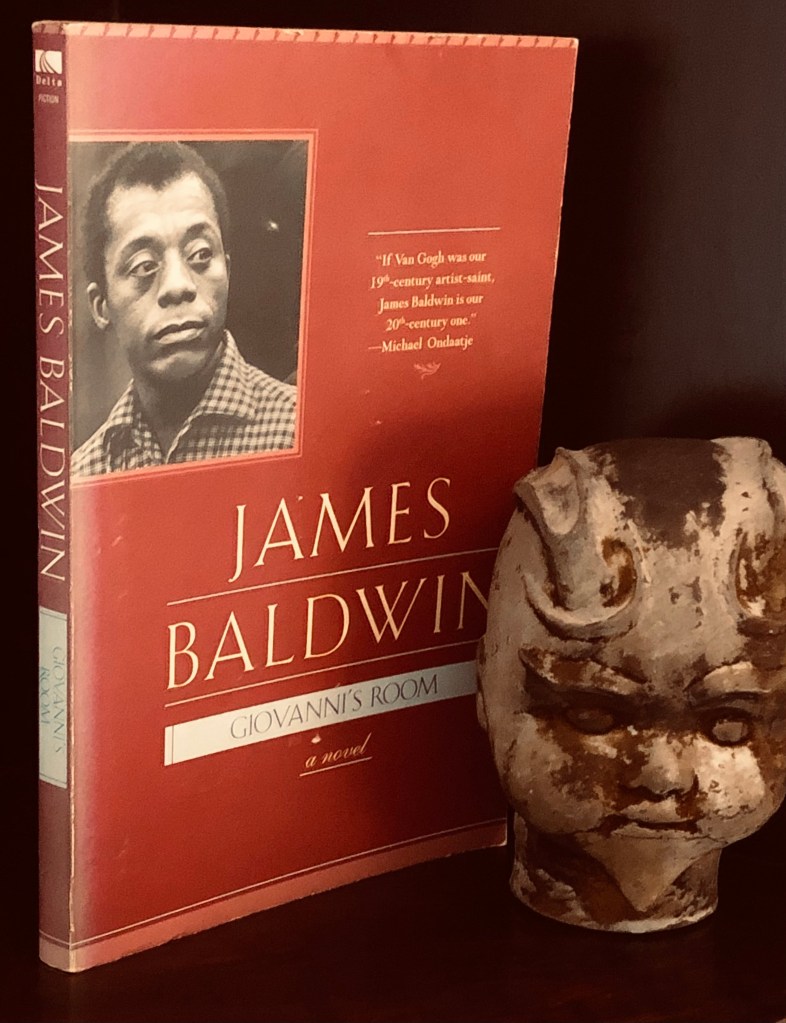
Giovanni’s Room

By James Baldwin

ALL POSTS CONTAIN SPOILERS

Years ago, a handsome young man, with whom I had never had sex of any kind, told me that our relationship reminded him of ‘Giovanni’s Room‘*. When I asked, “Which of us is Giovanni?” he said, “You are.”

(*I still haven’t had sex of any kind with him.)

Giovanni’s Room‘ is a novel by James Baldwin, who is probably the best American writer who has ever lived. It’s a story about two men who fall in love in Paris: David, an American, who is waiting for his fiancée to return from her travels, and Giovanni, an Italian bartender. They spend a summer living in Giovanni’s decrepit room, where David’s crisis of identity deepens as Giovanni comes more and more dependent on him. When David leaves Giovanni and returns to his fiancée, Giovanni has a slow-motion breakdown, which will eventually culminate in his imprisonment and execution.

It’s a beautiful novel, but I was offended by the comparison, because Giovanni is many things I do not find myself to be: he is clingy, passionate, romantic, melodramatic, and a drunk. According to my personal value system, it’s basically better to be a murderer than to be clingy and emotional, and so I deeply resented the implication that I was the Giovanni in any relationship. On the contrary, I have spent most of my relationships feeling very much like David: interior, ambivalent, cold, held back from normal human intimacy by profound self-loathing. I have held the comparison against that young man for almost twenty years now.

But I reread ‘Giovanni’s Room‘ the other day, and I see now that, in my outrage, I misunderstood what it is really about. I suppose I thought that it was about how destructive passion can be, about how a nature, consumed with love and without other ballast to steady it, could spin off into madness. I was fooled by the oldest trick in literature: I was paying attention the wrong character. I thought that ‘Giovanni’s Room’ was about Giovanni.

‘Giovanni’s Room’ is about David. It isn’t a novel about passion, or madness – it’s a novel about alienation, about the destruction of the possibility of love by hatred. David, who has spent his life in full flight from his very self, hates himself so completely that the love of other people, which he needs like water, feels like chains to him.

Baldwin doesn’t explicitly frame David’s self-loathing as internalized homophobia, and, though that is clearly part of it, I do not think he intended that David’s condition be that simple. David has been warped by a feeling that certain of his longings are “wrong”, yes, but he is also economically, culturally, and familially alienated as well. He is lost, trapped being a person he despises and unable to break free.

What David comes to know, what I have also come to know and the reason that I identified so strongly with David when I first read ‘Giovanni’s Room‘, is that, when we truly hate ourselves, we are unable to sincerely love anyone else. And when you are incapable of loving other people, the love they offer you will always feel like a hair shirt: irritating, painful, constricting, external. You will seek it out – you are lonely, after all – but when you receive it, you will immediately feel straight-jacketed and embarrassed by it. The people who love you are so earnest, so intense, that it is difficult to look them in the eye. David flinches from Giovanni (I flinched from Giovanni) not because Giovanni is so extra, but because Giovanni is whole-hearted and David, who’s own heart is consumed by hating himself, is mortified by that.

James Baldwin

Like most truly great books, ‘Giovanni’s Room‘ is even more beautiful upon rereading. I have always found James Baldwin breathtaking, one of those authors who make me feel that reading their words is a privilege. He has always possessed a special insight into human suffering, no less clear-eyed because it is merciful, and he has the writerly power to express his insights with devastating effectiveness. And I discovered, upon rereading, that Baldwin tells us exactly what it means to be Giovanni:

“Perhaps, everyone has a garden of Eden, I don’t know; but they have scarcely seen their garden before they see the flaming sword. Then, perhaps, life only offers the choice of remembering the garden or forgetting it. Either, or: it takes strength to remember, it takes another kind of strength to forget, it takes a hero to do both. People who remember court madness through pain, the pain of the perpetually recurring death of their innocence; people who forget court another kind of madness, the madness of the denial of pain and the hatred of innocence; and the world is mostly divided between madmen who remember and madmen who forget. Heroes are rare.” (p. 25)

Giovanni goes mad through remembering; David goes mad through forgetting.

It’s funny, getting older. I was furious when that young man told me I reminded him of Giovanni, but I know now that he wasn’t insulting me at all. Quite the contrary, I believe he knew, young as we were, what Baldwin knew: that it is better, in the end, to be Giovanni, because Giovanni at least knows his own heart. David knows nothing.

I also know that, sadly, that young man was wrong about me. I am not Giovanni – I am David, I always have been.

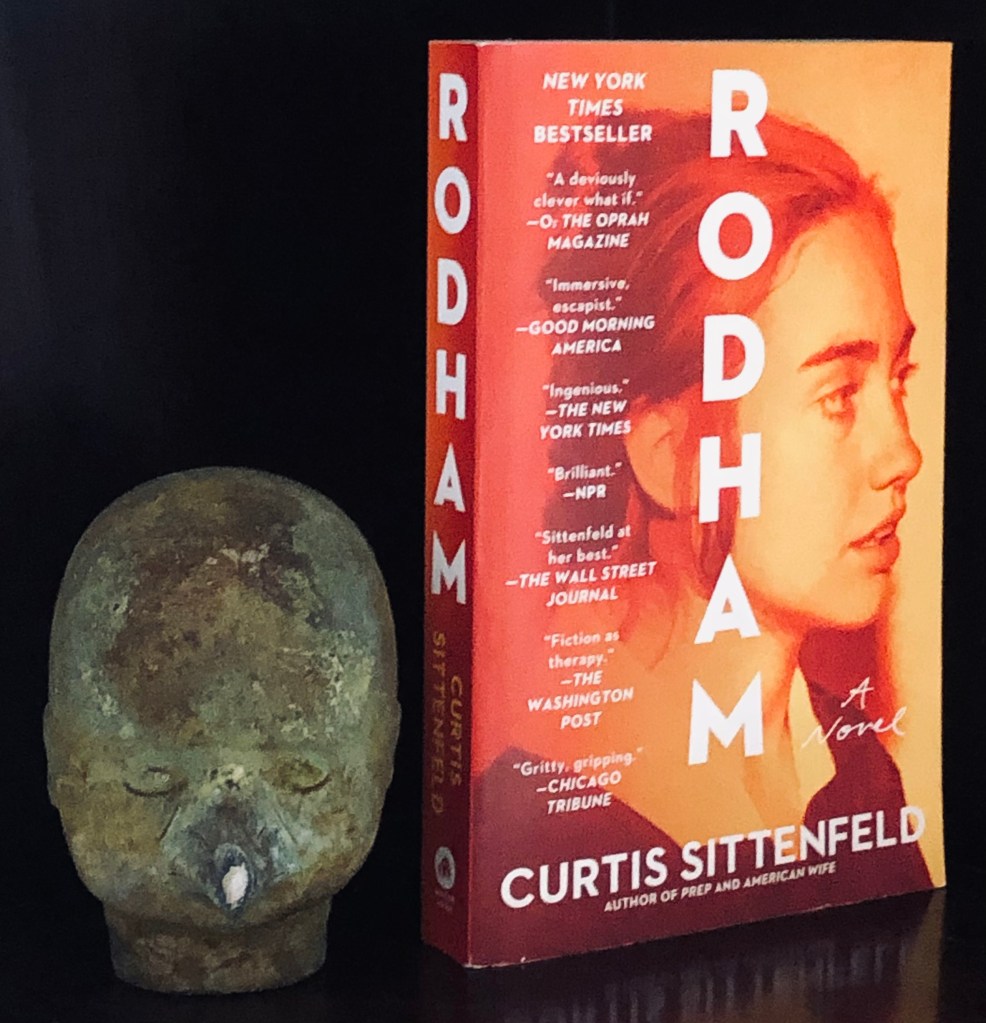
Rodham

By Curtis Sittenfeld

All Posts Contain Spoilers

I’ve wanted to read ‘Rodham‘ since I learned it existed. I don’t know why I did – it belongs to a category of novels with which I generally have very little patience: the historical novel. I love history, and when I read it, I like knowing whether or not what I’m reading actually happened. Novels obscure that: they present real histories clothed in fiction, and readers (at least this one) can’t always tell the truth.

Rodham‘, though, is a little different. It’s an alternative history, a kind of novel for which I have even less patience. The only thing less likely to get you at the truth than a historical novel is a historical novel about a version of history which didn’t actually happen.

But I’ve been curious about ‘Rodham‘ for years. It’s such a ballsy thing to do, to write a novel about a living person, and about Hillary Clinton in particular, who will surely be remembered as one of the most polarizing and complicated political figures of our time.

Hillary Rodham and Bill Clinton met at Yale Law School (in real life). They dated, and moved to Arkansas together to pursue his political ambitions. The first two times he asked her to marry him, she declined. The third time, she accepted. The premise of ‘Rodham’ is, simply, ‘what if she hadn’t?’

I wonder what Sittenfeld wanted to accomplish here. A description of the premise (‘What if Hillary Clinton had never married Bill Clinton?) promises a different novel than the one I have just finished. I suppose that ‘Rodham‘ was meant to answer a wish of Sittenfeld’s to know what Hillary’s life might have been like if Bill Clinton wasn’t the star of it. Unfortunately, Bill Clinton is also the star of ‘Rodham’, just from a more distant vantage.

Alternative fictions must start from a truthful premise, an anchor, from which they then wander off into speculation. The truth to which ‘Rodham‘ anchors itself is that Bill Clinton is the love of Hillary Clinton’s life. Though she leaves him in ‘Rodham’, because he is (both in our reality and in Sittenfeld’s, a philandering rapist), Hillary loves and misses him until well into her sixties. He is the sun around which her imagination revolves for almost the entirety of her adult life.

Which is kind of a bummer, honestly. I was so curious about this novel because I am interested in this idea: Hillary Clinton, more than almost any woman of political ambition that I can think of, is defined by her marriage. It’s not super heartening to think that, if we didn’t marry the great men we might have married, we might accomplish great things ourselves but we wouldn’t ever really get over them.

It might have been less of a bummer if Sittenfeld had given Hillary Clinton more dimension in fiction than her actual public persona suggests. One of the eternal ‘truths’ about Clinton is that she possesses no emotional warmth, that she is a cold, odd, calculating creature of pure ambition: planning her whole life for political attainment, not equipped with the normal spectrum of human feeling.

Curtis Sittenfeld

Sittenfeld basically accepts this unfortunate premise. Her Hillary is odd, and sort of cold. She accepts cruelty, betrayal, heartbreak, grave personal insult, without a normal human recoil. Sittenfeld doesn’t do a great job in persuading her readers that there are hidden depths to Hillary Rodham, and that’s a shame, because I suspect that there are.

Also, ‘Rodham‘ is a little too cute. Throughout her novel, Sittenfeld sprinkles events that happened in real life, weirdly specific ones. Her reasons for doing this are obvious: she wants us to understand that some things are inevitable, some dynamics and personalities will emerge no matter the path we choose, and fair enough. But I do not believe, for example, that if Hillary and Bill had not married and Bill Clinton had not become President of the United States, that Donald Trump would have ended up making his exact “Hispanics are rapists” speech, word for word, in 2016, albeit in a totally different context. And I do not believe that Bill Clinton’s supporters would end up chanting about Clinton, “Shut her up! Shut her up!”. I see what Sittenfeld is trying to do, but it’s too much, at least for me.

Ultimately, ‘Rodham‘ is, (perhaps inevitably), a novel about sexism. The interaction between Hillary and the public in 2016, the curious clashing of her personality, her history, her gender, and the prejudices and expectations of the public on both sides of the political spectrum, was dismaying and painful to a great many women. I completely understand why Sittenfeld might have felt the need to explore that experience in this way, and, essentially, I agree with her conclusions: it does seem to me that some things are inevitable in any timeline, and it does seem to me that we carry our characters with us, and that they inform our destiny at least as much as our destiny shapes them.

But I do wish, if Curtis Sittenfeld was going to go all out for Hillary, that she had given her a little more: more depth, more heart, and more independence. And, perhaps, that she had made her slightly less virtuous? It is precisely the impression (illusion?) of impervious, unemotional, competent control that so many people find alienating about Clinton (besides, of course, the fact of her having a brain AND a vagina) – might it not have been worth interrogating that a little? Trying to find some more complexity in her?

I don’t know. ‘Rodham‘ disappointed me, but perhaps I am being unfair. It’s hard to judge a book without knowing its purpose – maybe ‘Rodham’ was never intended to seriously illuminate the woman behind the persona, or interrogate feminism, or punish the wicked in fiction. Maybe it was only meant to be a weird little mental exercise. However, I think it could have been a great deal more, and I’m sad it wasn’t.

Doxology

By Nell Zink

All Posts Contain Spoilers

Can a pointless book be good?

Anyone who has read this blog with any regularity knows I’m obsessed with this question. To declare that, in order to be considered a work of value, a book must have some larger metaphysical or moral point is, essentially, to disqualify almost every work of horror, or fantasy, or romance from being ‘good’ (of course, most of them aren’t good, but very few books are good in any genre). Just as literary genres have their own conventions and codes, might they not also have their own standards, their own definitions, of success and failure? And mightn’t one of those standards be, simply, that they entertain?

I don’t think that many people would argue with me that, for example, ‘Jaws’ (a favorite test case of mine) is a great story. But it’s a great story because it is original and compelling, not because it makes any grand arguments – the shark doesn’t stand for anything, it’s not a comment on capitalism, or the patriarchy, or climate change. Its goals are to be fun and scary, and because sharks are intrinsically fun and scary, it succeeds in its goals. Therefore, it is a good book, in my opinion.

Applying that standard (“Does it entertain?”) to genre novels is pretty uncontroversial; however, when it is applied to realist literature, things become a little more complicated. We tend to have higher epistemological standards for realist literature; we expect those stories to do more than entertain. We expect them to instruct.

But I would like to advocate for the good literary novel which merely entertains, a la ‘Jaws’. It doesn’t make sense to me that we have simpler standards for books with wizards than we do for books about ordinary people. Perhaps the more we, the readers, resemble the protagonists, the more we require instruction: no point about reading about ourselves if we aren’t going to be bettered by it.

But ordinary people can be just as strange and compelling as elves, and not every story needs a moral. I’m advocating for this category, The Good, Pointless Book, and I’m submitting ‘Doxology‘ as an example.

Doxology‘ is about three friends who become a family. Pam and Joe meet in New York City in the nineties. Joe has William’s Syndrome; Pam is a punkish runaway. When they meet Daniel, a transplant from a religious Mid-Western family, the three decide to form a band. Joe is the singer song-writer, Pam the guitarist, Daniel the manager.

However, Daniel and Pam start sleeping together, and Pam is soon pregnant with a little girl she will name Flora. She and Daniel marry, while Joe unexpectedly becomes famous. On 9/11, as Pam and Daniel take their young daughter and flee the city, Joe overdoses on heroin. The family is traumatized, but their lives roll forward: Flora grows up, Pam and Daniel creep into middle-age.

Doxology‘ is really the story of Flora’s young life. She’s totally normal for an unusual kid: she’s smart, stupid, needy, independent. Her parents are cooler and stranger than normal parents, but her life isn’t therefore any more exotic. Aside from being babysat by a rockstar, she lives the life of a Gen-Z: raised by millennials, growing up under the cloud of climate change, idealism deeply challenged by the election of Donald Trump when she is barely out of a college, post-AIDS, post-Great Recession, lost.

And ‘Doxology‘ isn’t going to add anything to your understanding of Gen-Z, especially if you’ve ever seen a TikTok. If there is a greater meaning, I missed it. It’s merely, I think, a quick jaunt with a member of the latest adult generation.

Nell Zink

But it was a fun read, more of a zany ride than High Art. The action is fast-paced. Serious emotional developments are announced only in oblique comments, coded asides. Entire conversations are conducted with a sort of skipping meta-wittiness that makes ‘The West Wing’ look like ‘See Spot Run’:

“So, if I’m not the father, who is?”

“Aaron’s ready to accept responsibility,” she said.

“He’s a fucking socialist who wants to take responsibility for the whole planet. Can he tie his own shoes? Did you check?…It’s my baby,” Bull went on. “Or at least I’m adopting him. If biological-father-boy wants to make it an open adoption, let him try.”

“You don’t need me, if it’s a baby you want,” she said. “Have your own baby. You can afford a surrogate.”

“I guess for you Millenials that’s just one kind of sex work, but FYI, I’d rather be raped by an animal than exploit a woman of color like she’s a piece of meat. I love you, Flora, you fecund slut. I’ve got stuff to finish up here, but I’ll be home in an hour.” (p.366)

I am a millennial, and I have lived in New York City, and I have never, ever, heard a human talk like this. It’s completely unconvincing, but, again, I think that’s beside the point. It’s kind of fun (in an irritating way) to read an entire book about people who talk like this. It’s fun to read a pseudo-absurd thought experiment about millennial parenting. It’s fun to read about events of my own lifetime happening to fictional avatars. I didn’t learn anything, but I enjoyed it, and I guess I just fundamentally believe that that’s a good enough reason to recommend a book.

The Brief and Frightening Reign of Phil

By George Saunders

ALL POSTS CONTAIN SPOILERS

“”I’ll tell you something else about which I’ve been lately thinking!” he bellowed in a suddenly stentorian voice. “I’ve been thinking about how God the Almighty gave us this beautiful sprawling land as a reward for how wonderful we are. We’re big, we’re energetic, we’re generous, which is reflected in all our myths, which are so very populated with large high-energy folks who give away all they have! If we have a National Virtue, it is that we are generous, if we have a National Defect, it is that we are too generous! Is it our fault that these little jerks have such a small crappy land? I think not! God Almighty gave them that small crappy land for reasons of his own. It is not my place start cross-examining God Almighty, asking why he gave them such a small crappy land, my place is to simply enjoy and protect the big bountiful land God Almighty gave us!”

Suddenly Phil didn’t seem like quite so much of a nobody to the other Outer Hornerites. What kind of nobody was so vehement, and used to many confusing phrases with so much certainty, and was so completely accurate about how wonderful and generous and under-appreciated they were?” (p. 10)

In 2005, George Saunders published a thin little novella called ‘The Brief and Frightening Reign of Phil‘. At the time, I thought its plot was charmingly weird:

The nation of Inner Horner is so small that it can only hold one of the six inhabitants of Inner Horner at a time. While they wait for their turn to occupy their nation, the citizens of Inner Horner occupy the Short Term Residency Zone of Outer Horner, the nation which total surrounds theirs. One day, however, a piece of Inner Horner crumbles, sending the momentary occupant of Inner Horner tumbling across the border into Outer Horner.

Unfortunately for the Inner Hornerites, this incursion is witnessed by Phil, a citizen of Outer Horner. Phil was once madly in love with a citizen of Inner Horner, Carol, and her rejection has made him bitter. Phil uses the sudden toppling of an inner Hornerite into his country to whip his fellow citizens into a nationalistic frenzy. He will co-opt the Outer Horner Militia and use them to terrorize, extort, and eventually disassemble the Inner Hornerites.

When I read ‘The Brief and Frightening Reign of Phil‘ for the first time, in 2006 or 2007, I thought it was strange and dismal and funny. I love George Saunders, I love his whole vibe. I love his worldview, his dark, sad humanity. I love his sense of humor. I’ve loved George Saunders since the first short story of his I’ve ever read.

And I loved ‘The Brief and Frightening Reign of Phil’, when I read it in 2006 or 2007. I thought it was the best thing he’d ever written.

But I read it again the other day, now, this year, 2016, not 2006 or 2007, and it isn’t funny now.

The Brief and Frightening Reign of Phil‘ is about the damage that a sadistic, brittle demagogue can do to a vulnerable population. It’s about how a cowardly population will cow-tow and appease that demagogue as long as he tells them that they are the best people on earth. About how they will overlook and excuse any cruelty towards people that they believe are different from them.

It’s not funny anymore.

This is yet another way that books are like people: you can lose them. Sometimes they turn into jerks as they age; sometimes you just grow apart. Things that you thought were hilarious when you were younger, stop being funny. Things that blew your mind the first time you heard them, turn out to commonplace. That’s pretty normal.

But that isn’t what happened here. ‘The Brief and Frightening Reign of Phil‘ didn’t age badly – we didn’t outgrow each other. The world changed between 2006 and 2016: specifically, the line between ‘plausible’ and ‘absurd’ moved dramatically. And so my relationship with fiction premised on the absurd changed as well.

What I realized when I reread it this week is that ‘The Brief and Frightening Reign of Phil‘ was only absurd in its details; its emotional message is completely realistic. People are small-minded, provincial, and cruel. We do display a near-total lack of empathy when we are confronted of the suffering of someone we have decided isn’t like us. It is possible to build a cultural movement premised on the degradation of other people. It is possible for that movement to gain traction in your country. It is possible for that movement to take over the government.

I think I assumed that, because some of ‘The Brief and Frightening Reign of Phil‘ was fiction, all of it was. That assumption was stupid and totally unwarranted on my part, but nevertheless: I think that I relaxed into the surrealist detail, allowed the weirdness to give me emotional distance.

George Saunders

I understood that ‘The Brief and Frightening Reign of Phil’ was a parable, I understood that there was a moral point being made. I just figured, I think, that it was an exaggerated moral point. I assumed it was hyperbolic, satirical.

It isn’t though, not in 2016. It’s a deadly serious moral point wrapped in silliness. It’s not funny.

It makes me sad, either way. There aren’t so many beloved, brilliant, absurdist little parables that I can afford to lose one. It’s sort of awful to have ‘The Brief and Frightening Reign of Phil‘ ruined for me by the changing of the world.

I wonder how Saunders himself feels about ‘The Brief and Frightening Reign of Phil’ now. I wonder whether he has startled himself with how prescient he was. I wonder whether he knew he was writing an almost literal prophesy, the future of my country and his.

I bet he isn’t surprised at all.

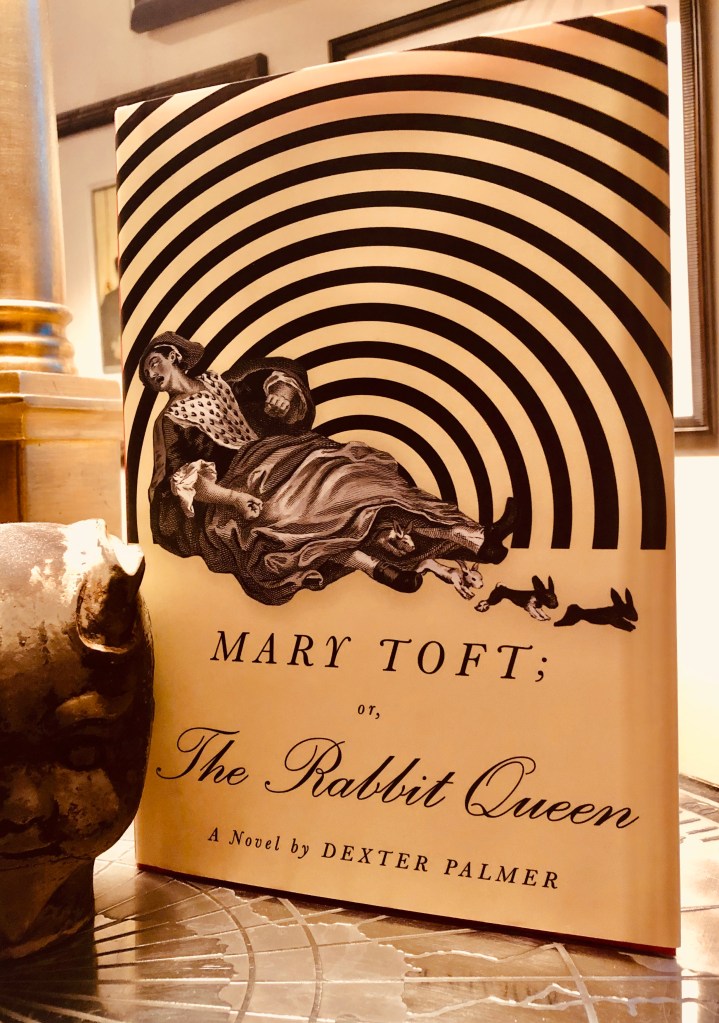
Mary Toft

Or, The Rabbit Queen

By Dexter Palmer

ALL POSTS CONTAIN SPOILERS

Well, holy shit.

Books surprise me all the time, for good and for ill. However, it rarely takes me half a book’s length to notice how good it is – I’m usually (not always) quicker on the uptake than that.

In my defense, books don’t usually want to hide their own goodness from you. It’s risky, after all: most people are willing to put a bad book down and walk away. Most books want to grab you immediately with their quality and keep a throttle-hold on you until the end, even past the end: for the exact length of time it takes for you to buy copies of them for everyone you know for Christmas.

So discretion turns out to be a rare quality in a book. It does happen, though, that a book comes along that has the skill to hide itself from you, distracting you so completely with scenery or plot that you fail to notice that it is excellent until it’s too late.

***

Mary Toft was a real person, a Surrey woman who, in 1726, orchestrated a hoax in which she convinced several reputable surgeons that she was giving birth to rabbits. Dexter Palmer has written a novel about this true story, told mainly from the point of view of Zachary, the fourteen-year-old apprentice of John Howard, the local surgeon who first encounters Mary.

I think that part of the reason that it took me so long to figure out that ‘Mary Toft; or, The Rabbit Queen‘ is magnificent is that it is, deliberately and aggressively, revolting. Out of the goodness of my heart, I’ll spare you the nasty shock I received, as an example: I bet you assumed, when I wrote that Mary Toft was “giving birth to rabbits”, that the rabbits where alive. I bet you assumed that they were intact.

I did, much to my regret. Mary’s rabbits are not alive: in order to effect the hoax, the rabbits had to be killed, cut into pieces, and inserted into Mary’s womb, whence they were extracted by credulous surgeons. It is absolutely disgusting, and the first time John Howard birthed a rabbit’s head and a string of intestine from Mary Toft, I was knocked flat on my ass: literary skill was the furthest thing from my mind.

I was intended to be, I bet. Dexter Palmer is clever, and he is making a point. ‘Mary Toft‘ is a novel about truth and belief, about the difference between them, about why we believe the things that we believe. About why we are so persuaded by the evidence of our eyes, and what it is, exactly, our eyes find persuasive.

There aren’t many novels written about medical anomalies, and for reasons which, I think, are sound: they are difficult to read about, if you live in an age in which they are scarce. But they have not always been scarce, they are part of our common humanity, and Dexter Palmer requires that we see them because, if we can’t see them, we will not understand the world in which Mary Toft lived, we won’t understand why she did what she did, or how she was able to get away with it.

The medical consensus in the society into which Mary is born is that birth defects are the fault of mothers: impurities in their thoughts, sins which lie on their consciences, act to turn the children in their wombs from the path of normal development. If a mother spends her pregnancy thinking unwomanly thoughts, she risks the health of her child.

Dexter Palmer is writing about a world in which the war between science and religion is much younger than it is in ours. Medical anomalies, illnesses which cause malformations in the human form, are the sites of the most pitched battles of these wars. Why would an omniscient God allow babies to be born twisted, sick, in pain?

The answer is, of course, sin: God visits illness on those who deserve it. If you are sick, if you are born with an illness, if you develop one over the course of your life, then you must have deserved it. Why would God allow illness to strike you unless you did something wrong? The wretched, those in pain, suffer because they should, and if you are lucky, healthy, rich, you must therefore be good.

It’s important to understand this mindset because, without understanding it, it will be difficult to understand the cruelty with which the inhabitants of this world treat each other:

“Lord M- winked. “Humanity, Zachary. At any time in the history the earth there is exactly enough humanity to go around for each human to have one full share of it, to entitle himself to say that he is better than an animal because he walks on two legs, and sings, and invents money…But if I am very, very rich, and you are not so rich: well, then I,” Lord M- said, his hand on his heart, “can take some of yours…This is the last thing that money is good for, once you have as much as I do – to make myself more human, which regrettably but necessarily entails making you less human, by contrast.” (p. 235)

***

I didn’t notice how good ‘Mary Toft‘ was until about half of the way through.

I know that doesn’t sound like a compliment, but it is. People often talk about books getting a slow start, or taking a while to get going: this is emphatically not what happened with ‘Mary Toft‘.

What happened is, essentially, shock-and-awe. Dexter Palmer spends the first hundred pages of the novel knocking you around with grotesqueries, using the brutality of 18th century medicine to soften you up. By the time Palmer is ready to teach you something, you’ve forgotten that you’re reading the sort of the novel that might offer a moral lesson – you’re too busy trying NOT to imagine what it would be like to shove bits of a rabbit up your own vagina.

Which means that the moral lesson, which is lovely and brutal at the same time, has landed on you before you know it was launched.

Dexter Palmer

I suspect that this surprise-attack quality is exactly why a book would trouble to downplay its literary quality. Readers are like anyone else: they don’t like being preached at. When they see a lecture coming, they brace, ready their eyes for rolling. Those lectures are held at a critical distance

But when you are shattered and confused, transfixed by a woman pulling rabbit skulls out of her cooch, you are permeable; your critical faculties are shot all to hell.

Which is Palmer’s point: when your senses are overwhelmed, you are easier to trick. When you are struggling to understand something impossible, you are credulous, and vulnerable to someone with an agenda: to a sham religion, to a medical quack, or to a novelist who is trying to teach you about human kindness.

I lovedMary Toft‘. The writing is lovely, not in an ostentatious, “Look Ma I Got My MFA” prose-y kind of way – it is merely simple, effective, and graceful. It is surprising, and clever, and sad, and humane, and at times even funny. And, as an added bonus, it’s about the weirdest novelistic subject I’ve encountered in a while. It’s going to take a long time for some of the images contained in this book to shake out of my imagination. But I think it’s OK to have them there – I think they’re teaching me something.

Drive Your Plow Over the Bones of the Dead

By Olga Tokarczuk

ALL POSTS CONTAIN SPOILERS

“The fact that we don’t know what’s going to happen in the future is a terrible mistake in the programming of the world. It should be fixed at the first opportunity.” (p. 271)

There is a tricky kind of novel, rare and hard to pull off: the Novel of Dubious Guilt, First Person. ‘The Turn of the Screw‘ is this kind of novel; ‘Gone Girl‘ is this kind of novel; ‘His Bloody Project‘ is this kind of novel.

In novels of this kind, a protagonist, speaking directly to the reader, relates a series of events in which they are implicated without revealing the extent of their involvement. Usually, but not always, it is a murder. The trick of it is: the reader must not be able to discern whether or not their narrator is guilty or innocent. They must not be able to trust the narrative, even as they invest in it by reading further. They must keep always before them the possibility either that the narrator is lying, or that the narrator is mad.

It’s hard to pull this off. If you make a narrator too cagey, if they act suspicious to their reader, their guilt will become apparent. But too much information, or obvious psychosis, also destroys the ambiguity, and once a reader has “figured out” what really happened, the effect is ruined.

Shame on me, I had never heard of Olga Tokarczuk. This really isn’t forgivable – one of her previous novels, ‘Flights‘, won the Man Booker International Prize, and she herself won the Nobel Prize for Literature in 2018. But I had never heard of her: I picked up ‘Drive Your Plow Over the Bones of the Dead‘ solely because I found the title irresistible, and I have a sneaking suspicion that it is going to end up being the best book I read this year.

Janina Duszejko lives in rural Poland, near the Czech border. She is a teacher, an aging astrology enthusiast, an intense lover of animals. She has only a few friends, but she is known in her community: she cares for the summer dachas of the city people during the hard winters, and she has frequent confrontations with the local hunters. In her free time, she and her friend Dizzy translate Blake into Polish; she pores over the star charts of everyone she meets, a side project she has to prove her theory that the moment of a person’s birth contains, complete and unchangeable, the moment of their death. She had two dogs, her little girls, but they went missing the year before and she has never been able to find them.

One night in the middle of the winter, her neighbor Oddball comes to her house in the middle of the night to tell her that their mutual neighbor Bigfoot has died. He has choked on a bone from a deer that he poached, a habit for which Janina loathes him. As Oddball and Janina make the body decent for the police, Janina looks for Bigfoot’s papers – she wants to know his birthday, to draw his chart and add his death to her charts. She finds a photograph which shocks her; she does not tell us what is in it, but it sparks a series of events which leads to the deaths of four more men.

Over the next year, prominent men in the community begin to die in suspicious circumstances. The commandant of police falls down a well. A priest burns down in his own church. A fur farmer is found in an animal trap. The only thing that the men have in common: they were all hunters. Deer tracks are found near one body – fox tracks near another. Rumors begin to swirl around the community: the animals are taking their revenge.

Janina is a spectacular narrator: smart and observant and sad and sly and barking mad all at the same time. Tokarczuk, even in translation, is a beautiful writer, and this is prose like I’ve never quite encountered before. It’s a blend of real weirdness, humor, loneliness and wile. It’s pathos and bathos and rage.

“Spring is just a short interlude, after which the mighty armies of death advance; they’re already besieging the city walls. We live in a state of siege. If one takes a close look at each fragment of a moment, one might choke with terror. Within our bodies disintegration inexorably advances; soon we shall fall sick and die. Our loved ones will leave us, the memory of them will dissolve them in the tumult; nothing will remain. Just a few clothes in the wardrobe and someone in a photograph, no longer recognized. The most precious memories will dissipate. Everything will sink into darkness and vanish.” (p. 124)

Janina’s focus, her obsession, is animals. She has made what appears to be a small imaginative leap, but one which makes a permanent, wrathful outsider of her: she believes that animals are the moral equals of people. That they have souls, intelligences, if not identical to ours, like enough to warrant protections equal to the ones we offer each other. She views humans who kill, cage, or eat animals with the same revulsion you would feel for an unrepentant murderer. To a cannibal.

Olga Tokarczuk

“So I spoke, using wise words…

“”You’ll say it’s just one Boar,” I continued. “But what about the deluge of butchered meat that falls on our cities day by day like never-ending, apocalyptic rain? This rain heralds slaughter, disease, collective madness, the obfuscation and contamination of the Mind. For no human heart is capable of bearing so much pain. The whole, complex human psyche has evolved to prevent Man from understanding what he is really seeing. To stop the truth from reaching him by wrapping it in illusion, in idle chatter. The world is a prison of suffering, so constructed that in order to survive one must inflict pain on others…What sort of world is this? Someone’s body is made into shoes, into meatballs, sausages, a bedside rug, someone’s bones are boiled to make broth…Shoes, sofas, a shoulder bag made of someone’s belly, keeping warm with someone else’s fur, eating someone’s body, cutting it into bits and frying it in oil…Can it really be true? Is this nightmare really happening? This mass killing, cruel, impassive, automatic, without any pangs of conscience, without the slightest pause for thought, though plenty of thought is applied to ingenious philosophies and theologies. What sort of world is this, where killing and pain are the norm?” (p. 107)

Because Janina is so single-minded, ‘Drive Your Plow Over the Bones of the Dead‘ isn’t a true mystery. By the “reveal”, you have a pretty good sense of what’s going on, but, at that point, you’ve come far enough with Janina that you are thoroughly on her side.

The trick of those mystery narrators, those Did-I-Or-Didn’t-I novels, is how do you sympathize with narrator who might be a murderer? ‘Drive Your Plow Over the Bones of the Dead‘ is a neat twist on this: how do you sympathize with a narrator when you are both murderers, she in your eyes, you in hers? Can the charm of her prose, the righteousness of her cause, the clarity of her vision, bring you along with her, make you a kind of accomplice?

The answer is yes, emphatically yes. Janina is as winning a narrator as I have encountered in years; ‘Drive Your Plow Over the Bones of the Dead‘ is a great love. A book this good, the first thing I do is buy something else by the author. ‘Flights‘ won Tokarczuk a Man Booker – I’ll start with that. Books this good are rare – when you find them, follow them.