Conversations with Friends

By Sally Rooney

ALL POSTS CONTAIN SPOILERS

One of my small narcissisms: I disdain book fads.

Every year, there are It books, authors the literary cognoscenti have their panties all twisted up about, the new novel that the New York Review of Books declares a Must Read, that every independent bookstore has on it’s Staff Recommendations table (in hardcover), whose author Terry Gross just interviewed last week.

I try to avoid these books.

It’s not that I think they’re all bad books, not at all. Many of them are celebrated quite appropriately (you can count me, for example, among the legions of frothing Elena Ferrante fans).

However, they aren’t all great: some are merely well-publicized. Some are highly experimental, a novel written in all questions, or a novel in one long sentence (these are real things*, and I’ve actually read and loved one of them). Some are more timely than good. Some are fine, but no one will, or should, remember them in five years.

*’The Interrogative Mood‘, Padgett Powell; ‘Ducks, Newburyport‘, by Lucy Ellman

I’m a snob for the Literary Canon – we’ve talked about this before – and, the truth is, if I spent my time reading every contemporary novel that Michiko Kakutani thought I needed to, I wouldn’t have time to read anything else. So I like to give a book twenty years or so, see how it ages, see whether it’s a flash in the pan or whether anyone remembers it a decade later.

But I make exceptions, for all sorts of valid or stupid reasons. Sometimes a book comes recommended by someone I trust; sometimes it catches my eye; sometimes I have already learned to love the author, or the author keeps being compared to someone else I love (careful with this one – it pretty much never turns out the way you want it to).
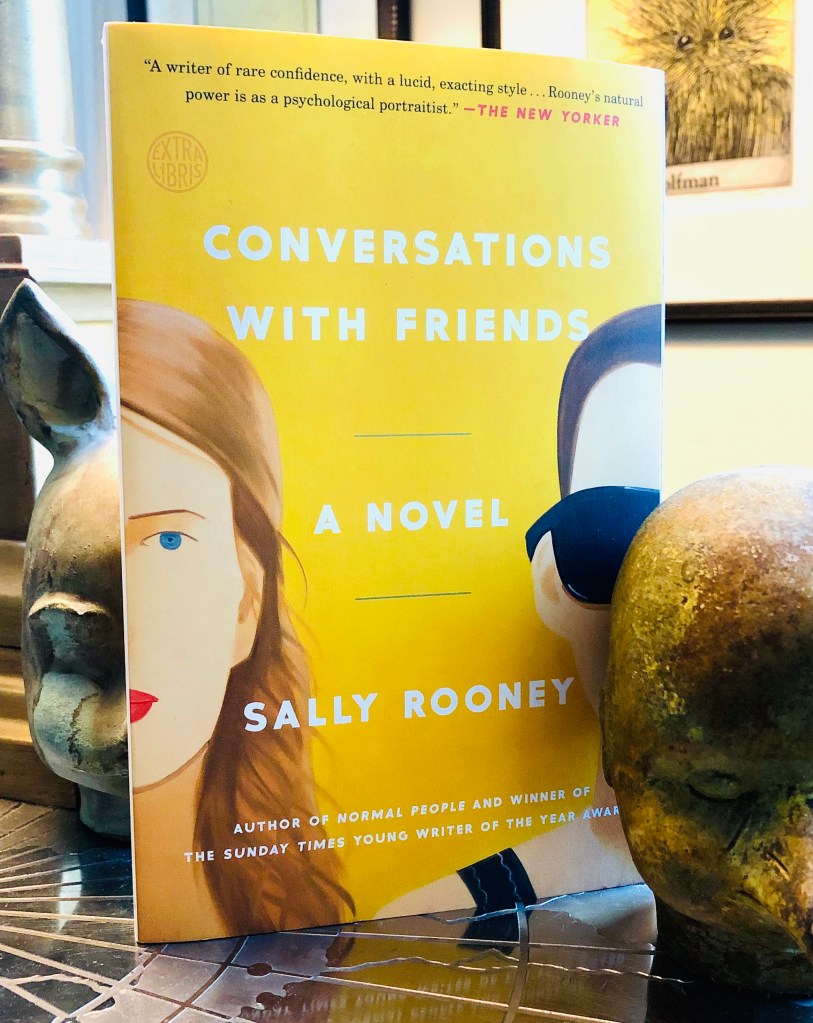
And, a few weeks ago, I was going through my old New Yorkers and came across a review of ‘Conversations with Friends‘, a fad book from 2017 that I had successfully avoided. But this review (by Alexandra Schwartz) was called, ‘A New Kind of Adultery Novel‘. I didn’t read the review – I didn’t need to. I’m kind of a creepy little pervert, and there was absolutely no chance I wasn’t going to read a New Kind of Adultery Novel. So this week I read ‘Conversations with Friends’.

Frances and Bobbi went to school together. They dated, and then they broke up, and now they are best friends, college students in Dublin, where they perform spoken-word poetry together. Bobbi is beautiful and outlandish and charismatic. Frances is our narrator, plain and severe, quiet and cerebral. She is a socialist and poet, a bisexual who believes that love has been co-opted by capitalism to wring unpaid labor out of mothers.

One night, the two friends are approached after a show by Melissa, an established artist and photographer. As they begin to get to know her, it becomes clear that, like many people, Melissa prefers Bobbi, and Frances, a little defensively, strikes up a friendship with Melissa’s husband, Nick. Nick is a actor who is semi-famous, handsome and much smarter and more sardonic than he appears. As Frances and Nick begin an affair, the relationship between the four adults becomes more and more complicated until it begins to threaten even the love Bobbi and Frances have for each other.

People went kind of bonkers about ‘Conversations with Friends‘. I myself had multiple girlfriends tell me that I had to read it (that way that people do that makes you want to hit them). And I think I know why, even if I do not perhaps share the wildness of the enthusiasm.

Rooney has a way of writing, a plainness of presentation, which is nearly unique and very effective. This is a little what people are reacting to when they talk about the revolution that Hemingway’s prose represented: the way the spareness of the prose, the lack of adornment, left the reader nowhere to hide.

But Hemingway wasn’t writing about the intricate interiors of human relationships – Rooney is, and so the effect is very different. When people write about feelings, even the feelings of fictional characters, they tend to explicitly frame them as feelings, to soften their reality, to layer them away from fact: “I felt as though…”; “He acted like I was…”; “It was as though I had been…”. We lard our feelings with metaphors and analogies, which are illustrative, but also distancing. Even as we contemplate the feeling, we are imagining something else.

Rooney doesn’t do this. She doesn’t invest in the emotional reality of her characters so much as she simply states it as reality and moves on. She doesn’t interpret or elaborate. Because her prose so fundamentally inhabits the experience of her protagonist, when she does employ similes, they have the effect of turning back inwards, into the mind of Frances.

“Certain elements of my relationship with Nick had changed since he told Melissa we were together. I sent him sentimental texts during daytime hours and he called me when he was drunk to tell me nice things about my personality. The sex itself was similar, but afterward was different. Instead of feeling tranquil, I felt oddly defenseless, like an animal playing dead. It was as though Nick could reach through the soft cloud of my skin and take whatever was inside me, like my lungs or other internal organs, and I wouldn’t try to stop him. When I described this to him he said he felt the same, but he was sleepy and he might not really have been listening.” (p. 232)
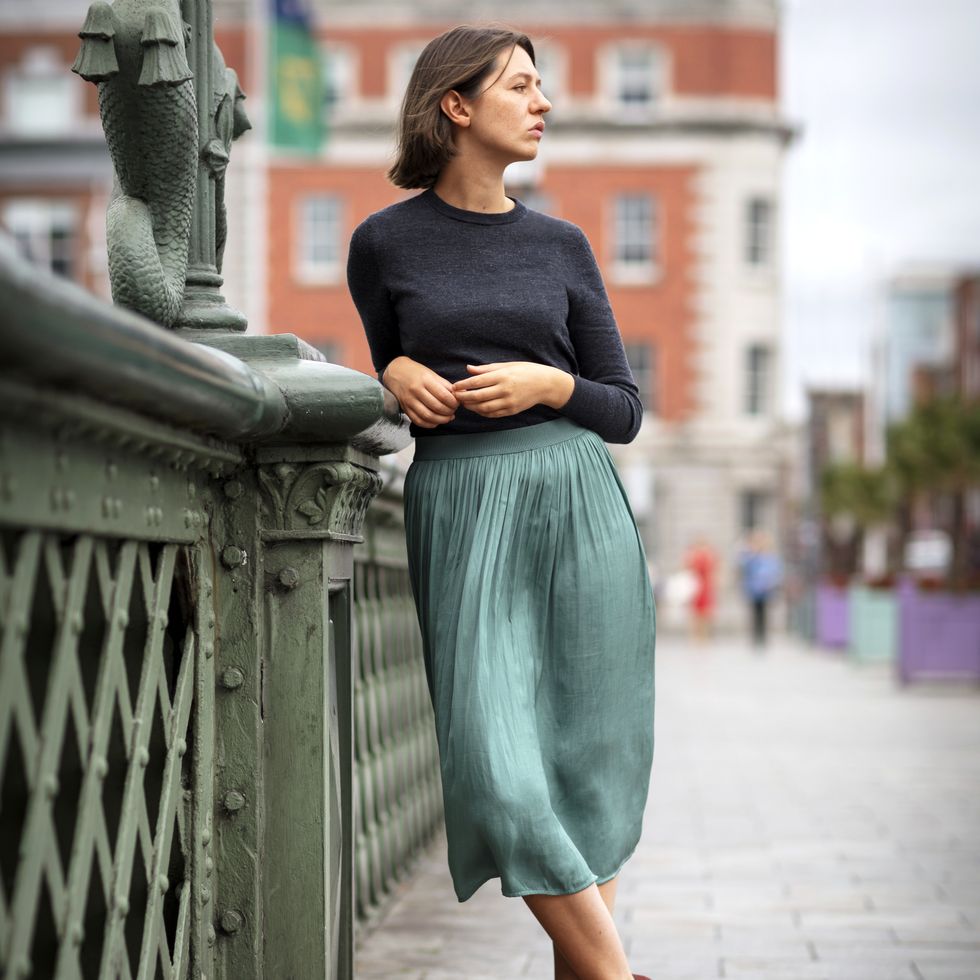
Sally Rooney

All of which, because of the bareness of the prose, has the effect of making Frances a little hard to take.

Which, ok, a brief temper tantrum on my part: I really, really hate when people object to books because the characters aren’t “likable” or because “there’s no one to root for”. I think it’s infantile to assess books the same way you pick friends: by how much you want to have a beer with them. If you’re only reading books that have people you explicitly like, fuck off to ‘The Babysitters Club’ and let the adults talk.

So it’s not a problem for me that I don’t like Frances (or Bobbi) at all. But, let’s be real: a book about complicated, narcissistic, chilly people hurting each other is a different emotional experience than one that involves heroic, kind people battling evil. ‘Conversations with Friends‘ is a very different book than, say, ‘The Hobbit’. I understand why people reacted to strongly to this book: it’s emotionally bracing. But, like most things that are bracing (a stern talking to from a loved one, a leap into an ice cold lake), it wasn’t pleasant until it was done.

And maybe it wasn’t even pleasant after it was done? But that’s OK – pleasant is emphatically not the point.

Rooney is experimenting with a different way of communicating about emotions. She’s trying to show the interior life of a young woman, show us her anger, and her loneliness, her fear and her attempts at love, the way that she herself experiences them. The prose is meant to be immersive – there is no framing here, to give you distance. And because Frances is angry and lonely and scared and receives no consolation from love, the experience is a little bleak, a little real, a little rough and almost totally undigested.

It’s tough, because I know I was supposed to love ‘Conversations with Friends‘, and so I really, really didn’t want to. When I finished it, I thought it was competent and over-rated.

But I’ve had a couple days to think on it, to get some emotional distance from Frances, and I think maybe I did love it. Or I really, really appreciated it? Or I saw the same thing all the fart-sniffing New York literary whosits saw: a very smart new writer trying something different. And succeeding.
Gilead

By Marilynne Robinson

ALL POSTS CONTAIN SPOILERS

“I can tell you this, that if I’d married some rosy dame and she had given me ten children and they had each given me ten grandchildren, I’d leave them all, on Christmas Eve, on the coldest night of the world, and walk a thousand miles just for the sight of your face, your mother’s face. And if I never found you, my comfort would be in that hope, which could not exist in the whole of Creation except in my heart and in the heart of the Lord. That is just a way of saying I could never thank God sufficiently for the splendor He has hidden from the world – your mother excepted, of course – and revealed to me in your sweetly ordinary face.” (p. 237)

The trouble is, I have never been any good at writing about love.

I’ve tried to write this review at least a dozen times now, beginning and re-beginning, deleting everything that I had written before and attempting again. I have adopted different stances, approached from different angles, in my attempt to talk about this book, but I can’t seem to find the words, to explain sufficiently what I felt when I read it.

And that’s because I’ve never been any good at writing about love.

Gilead‘ is a novel about love, a novel in the form of a letter from a dying father to his son. Ames is a preacher in Gilead, Iowa, the son and grandson of preachers. He is already an old man, a lonely, good man, when he meets and marries a much younger woman, who bears him a son at the age of seventy. When his son is seven, Ames is told that he, Ames, has angina pectoralis and will die within the year. Because he knows that he will never see his son grow up, because he knows that his son will probably not even remember him, Ames writes his son a letter, containing all the love and all the wisdom that he would have parceled out to him over the course of a normal lifetime.

I took a day off from work to read ‘Gilead‘. I began it late on a Monday night, and was pulled so quickly and so completely into it that I took off work on Tuesday and finished it. I have never done that before, missed work just to read.

I have cried while reading books before – it is (very) rare, but it happens. I can count the books which have wrung tears from me on one hand (it’s three*). I can recall, almost word for word, the single passage in each one which did it.

(*’A Primate’s Memoir‘, by Robert Sapolsky; ‘Moonfleet‘, by J. Meade Falkner; ‘The Story of Edgar Sawtelle‘, by David Wroblewski)

But no book has ever moved me the way this one has. I wept through, well, most of it. Wept actual tears: like, I sat in my comfy chair, in sweatpants and socks, with a box of tissues on hand, and actual tears ran down my actual face. I didn’t weep from from sadness, exactly, because ‘Gilead‘ isn’t a sad book. I wept from the disorientation that comes from being overwhelmed, from confusion, and from a tremendous longing to be happy.

Gilead‘ is a novel about happiness, and about goodness, and about God, but those words, ‘novel’, and ‘about’, are misleading. ‘Gilead’ resists concepts like plot (to the consternation of its detractors). It isn’t a story, per se – it is the examination of a life at its end. It is a window into one man’s heart, and the fact that the man has not technically ever existed does not mean that he is not real. Because he is now as real to me as any character I have ever encountered in print.

“I’d never have believed I’d see a wife of mine doting on a child of mine. It still amazes me every time I think of it. I’m writing this in part to tell you that if you ever wonder what you’ve done in your life, and everyone does wonder sooner or later, you have been God’s grace to me, a miracle, something more than a miracle. You may not remember me very well at all, and it may seem to you to be no great thing to have been the good child of an old man in a shabby little town you will no doubt leave behind. If only I had the words to tell you.” (p. 52)

My reaction, I should mention, is personal. I’m not the only person who loves this book, obviously – it won the Pulitzer – but a quick spin around the internet reveals the existence of an alienated minority who say things like, “the writing was very boring”; “I found this book dull and tedious”; “just really, really hated this book”; “no subject or plot or story or conclusion”; “I’m so glad that’s over”.

Marilynne Robinson

They aren’t wrong – Tom Clancy this is not. ‘Gilead‘ isn’t a sermon, exactly, but it is a meditation. A meditation on love, on whether true love of another and true love of God are both possible; on what it means to lead a good and virtuous life, on whether it is more important to be good or to be happy, on whether it is possible to be one and not the other; on what it means to love with humility, and what it means to die after having known joy.

If that sounds boring to you, please rest assured: I agree with you. It does sound boring. It sounds awful. I don’t think, if I had known what it was about, that I would have read it. And, despite having thought about it for weeks now, I’m still not sure why it isn’t boring. All I know is that, somehow, despite being about things which don’t really interest me (God, love, goodness, humility) and not at all about the things which do (sex, violence, zombies, epidemics, space battles, hyperinflation, sex, satanism, algorithms, time travel, sex), this book absolutely whuped my heart’s ass.

I know that this is insufficient. I know that I am failing, badly, to express how I feel. And I feel particularly terrible about it, about failing this particular book in this way, because the more a book moves you, the more you want to be moving about it. But I’ve never been good at talking about love, and that’s what this book made me feel. I’m not saying that I love this book – I’m saying that this book made me feel love. And I have thought about happiness, about how to live it, about how much I want it, every single day since I read it.

Some books are events in your life. Not many – only a few. Even people like me, maybe especially people like me, people for whom books are a life, even we don’t get many of these books. ‘Gilead‘ is one of my few. I have never been able to figure out whether there is rhyme or reason to which books reach out and grab you, but I suspect that there isn’t. I think, actually, that it’s just like love: in a long, lucky life, you’ll be side-swiped a few times, without reason, without warning. No way to defend yourself, no way to change back again into the person you were before you got hit. Nothing to do but pick yourself up and go back to work the next day, with puffy eyes, maybe a little wiser, a little better, but maybe not. Different, though, always different.

Fox 8

By George Saunders

All Posts Contain Spoilers

So, remember when we talked about what happens when an author you hate writes a book you love?

What do you do when an author you love writes a book you don’t?

George Saunders: it would be difficult for me to overstate my admiration for George Saunders. I love George Saunders. I love him not because he’s an incredible writer – though he is – but because he isn’t like anyone else. He’s strange, quiet genius who has been churning away for decades, creating these small, weird works beloved to writers and freaks and snobs.

George Saunders

For years, I’ve gawped at the imagination of George Saunders. He’s bizarre, and hilarious, and a little frightening; reading ‘The Brief and Frightening Reign of Phil‘, written in 2005, in the post-Trump era is to wonder at the existence of psychic powers.

I love him. I love his dark funniness, the twisted sadness which bleeds out of all of his characters, which runs through each of his worlds. I love the unanticipatable impossibilities that pop out from his prose, unexplained. I love the anger which animates every word. I wouldn’t miss one of his books for the world.

The aforementioned darkness, that is the thing I love most about George Saunders. I love the fact of it, but also the ease of it. Most writers show off their darkness; they are needy about it – the darkness is the point. But Saunders wears his darkness lightly. The hopelessness of his world is a backdrop, a stipulation, not resolved or resolvable, not emphatic or dwelt-upon.

I’m not saying that Saunders is always subtle – I’m saying that his worldview doesn’t explain itself, and it doesn’t offer relief. So how am I supposed to feel about a George Saunders’ story with a moral?

Fox 8‘ is the story of Fox 8. Fox 8 has always been different, a little dreamier than his fellow foxes. By skulking outside the house of a human family, Fox 8 has learned to speak Human, which comes in handy to him and his fox family when a Mall opens up alongside the woods where they live. The devastation of the local environment caused by the construction of the mall has diminished the food sources upon which Fox 8’s family has survived, and they are starving. However, speaking Human has given Fox 8 the sense that humans might be approachable, might just make marvelous companions for foxes, if only they can be
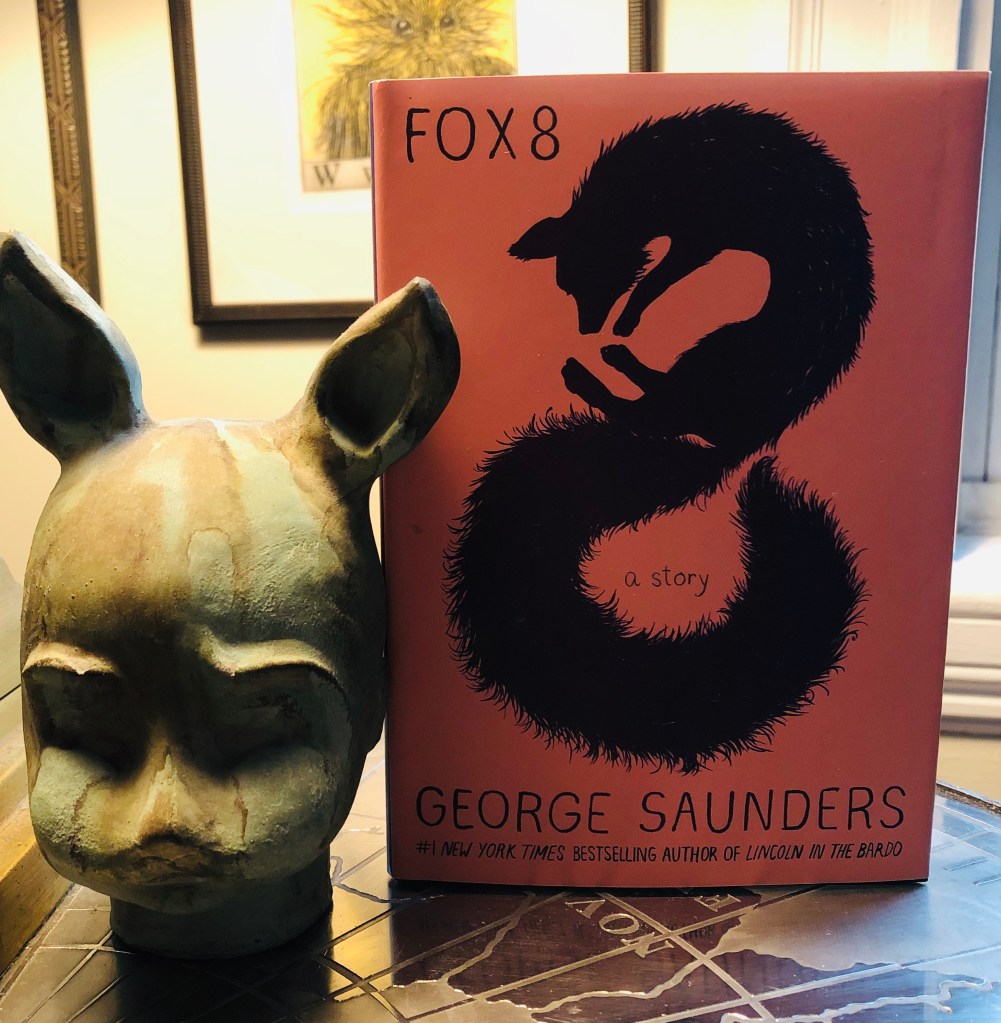
communicated with.

And so, with his best friend, Fox 7, Fox 8 decides to go to the Mall. Things go badly awry, and Fox 7 is brutally killed by the very humans Fox 8 has come to admire. The short little book ends with a plea from a disillusioned Fox 8 to us, a plea on behalf of all of our animal victims.

Time to own my biases: I am allergic to simple sentimentality. I do not like to be preached at. I believe that the world is a complicated and murky place, a canvas of grays with very little black and white, and I am skeptical of neat little takeaways, of simple conclusions.

Admittedly, environmentalism is a topic upon which a little moralizing is easy. The take-home message of ‘Fox 8‘ (and I’m not interpreting – it’s stated explicitly at the end) is: be nicer to little animals. Or, lest you think I’m simplifying, as Fox 8 himself puts it: “If you want your Storys to end happy, try being niser [sic].” And I certainly have no objection to that message. Or, rather, I have no objection to that message in particular.

But I have an objection to being spoon-fed any message. I don’t think that works of fiction should have a summary at the end – that deprives them of their magic, and robs me of my right to interpret them myself.

And it is particularly galling to be told how to interpret George Saunders, who is so weird, and so unexplaining in his weirdness. He has never been a simplifying or pedantic author – why has he decided to spell out the fortune cookie message of this book? Does he not trust his readers to get it anymore? Did the other books have no summary because they had no point at all? Or does he consider this point too important to risk that we might get the message wrong?

Another bias: I emphatically do not like books written in dialect. I will forgive a page or two, written in order to give the reader a sense of a character, but when an entire book, or all of a character’s dialog, is written in phonetic dialect, I find it arduous and infuriating. It disrupts the smoothness of my reading, makes me spend what I consider unnecessary effort in taking in the words. And I almost always find it pretentious or performative, a cheap way to make yourself look like a deeper or more creative writer, an illusion of character development.

And ‘Fox 8‘ is written in dialect. Or, not dialect, but in the sort of phonetic English a fox might learn from eavesdropping. Like,

“Wud it be easy? It wud not. It wud take Guts. But I have Guts. I once likked the tire of a Truk that was moving to see how it tasted, which the Groop teesed me about it, because hey Fox 8, why not wate until one found a Truk not moving, wud that not be easier?” (p. 41)

But ‘Fox 8’, for all its moralizing, is funny, and the dialect (really, the spelling errors) is part of that. For example:

“I woslike: This must be Fud Cort.

…Never had Yumans seemed so cul. We were sarounded by splender no Fox cud curate. Hense were fild with respek. Cud a Fox do this? Bild a Mawl? Fat chanse! The best we can do is dig are Dens.” (p. 28)

Or:

‘What I herd was a Story, but a fawlse and even meen one. In that story was a Fox. But guess what the Fox was? Sly! Yes, true lee! He trikked a Chiken! He lerd this plump Chiken away from its henhowse, claming there is some feed in a stump. We do not trik Chikens! We are very open and honest with Chikens! With Chikens, we have a Super Fare Deel, which is: they make the egs, we take the egs, they make more egs. And sometimes may even eat a live Chiken, shud that Chiken consent to be eaten by us, threw faling to run away upon approche, after she has been looking for feed in a stump. Not Sly at all. Very strate forword.” (p. 6)

See? Funny. Funnier for the spelling.

But still slightly exhausting to read, which ends up being OK, because ‘Fox 8‘ is only about fifty pages long. So, it’s funny, and weird, and charming. Perhaps ‘Fox 8’ is best understood as one of those children’s stories for adults, a genre I don’t hate, as a rule. If someone else had written it, I probably would have chuckled and forgotten it. But since it’s Saunders, I’m slightly flummoxed by it. Perhaps that’s all it will be: a strange, short, flummoxing episode in an otherwise blissful author/reader relationship. Slightly awkward, best forgotten.

1Q84

By Haruki Murakami

All Posts Contain Spoilers

When is it OK to decide that you don’t like an author?

I really struggle with this question.  On the one hand, there is more to read in this world than can be accomplished in twenty lifetimes, and so wasting time on authors you dislike comes at a high price, opportunity-cost-wise.

But, on the other hand, no two works, even by the same author, are completely equal, and to take a stand against an author is rule out works of theirs, unread, which you might love.

In a way, this is only a sub-section of the enormously important and complicated question: How do you decide what to read?  Do you hew to the canon?  Do you trust the recommendations of friends?  How about the New York Review of Books?  Do you read everything in the Sci Fi/Fantasy section, no matter what?  Let Amazon’s algorithm decide for you?

For myself, I hew strongly to canon.  I defer to the ages: I reach for Literary Giants, and cast a skeptical eye at modern literature (sometimes to my own detriment, as I have admitted).  I want to read the Great Books, even if that means missing a few cult favorites.

Now, I would like to be clear about something: something needn’t be old to be a Great Book.  An author doesn’t have to be dead before a critical consensus can emerge about his Greatness.  And really, it is this critical consensus to which I respond: if everyone thinks something is Great, I tend to think it’s worth spending some time and energy figuring out why.

So, yes, maybe I am a snob, but I do believe that, if the critical consensus is that an author is a genius, there is a higher bar to deciding that you don’t like them.  You should read a lot, if not all, of a Great Writer’s work before you should feel enfranchised to further disregard.

Why?  Why waste time on authors you hate, just because other people seem to think that they’re the shit?

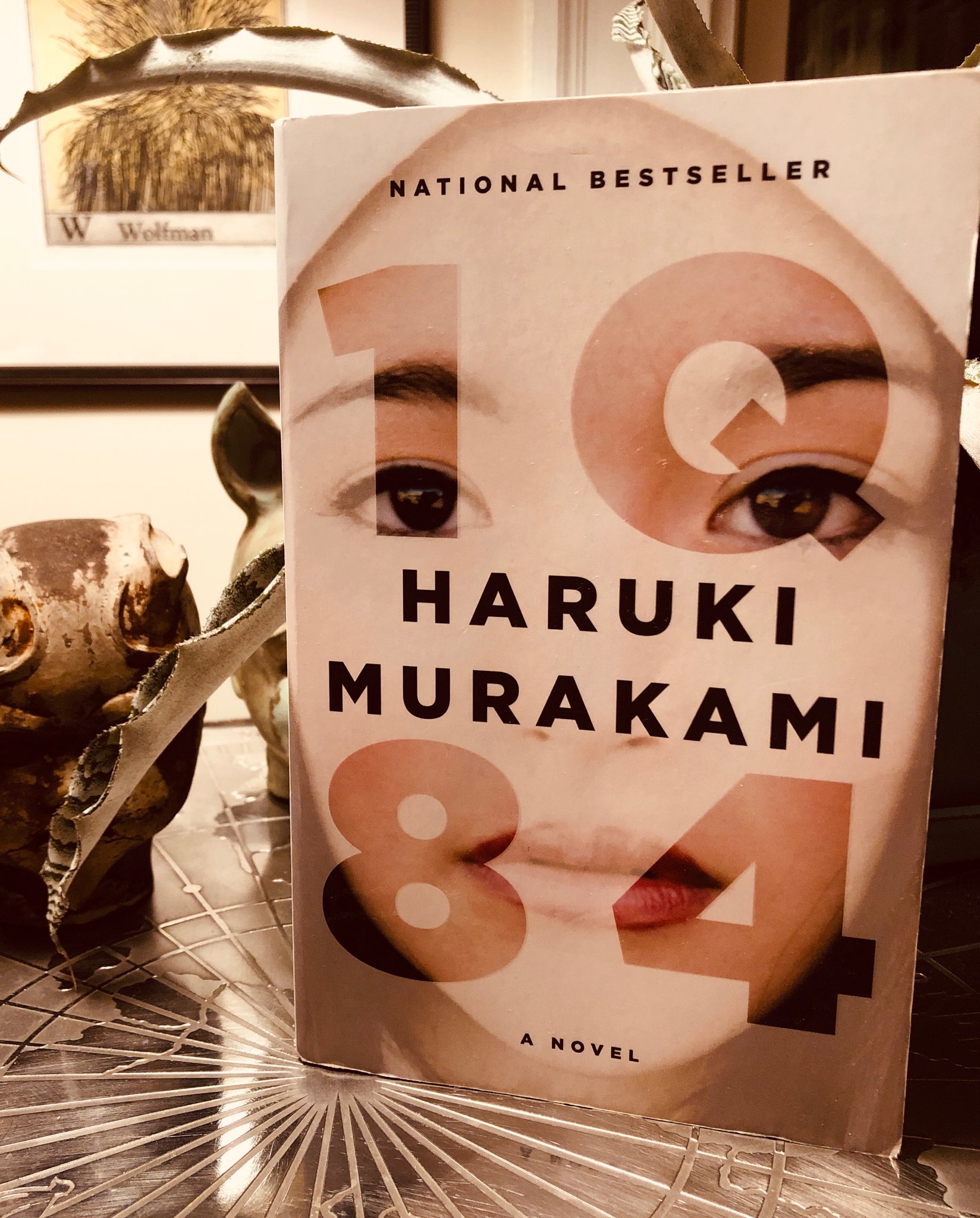
1Q84’ is why.

Before this, I had read three of Haruki Murakami’s books: ‘The Wind-Up Bird Chronicle’, ‘Kafka on the Shore’, and ‘Underground’, and he was definitely an Author I Did Not Like.  There was something about his style, about the bleak, gray expanses of his prose, which I found aversive, both boring and actively unpleasant at the same time.  He reminded me, in this way, of Don DeLillo, who’s grimness also seeps through his words and alienates me. 

But I felt a nagging sense of…not guilt, but unease, about this aversion.  Murakami is one of the most, if not the most, beloved writer of Japan, and it is apparently something of a national hope that he will win a Nobel Prize (and an ongoing source of national grief that he has not).

And yes, look, just because someone is good doesn’t mean I have to love them. An author can be both talented and not to your taste.

But there’s something patronizing about saying that, isn’t there? “Oh, yeah, Murakami’s great, really, such a good writer, just not my style”. Is art really like pizza, just a matter of preference? Surely not; surely we have some responsibility to Greatness, an obligation to ourselves to go to it, to try to see what other people see in it, and not to dismiss the men and women who have shaped the literature of nations simply as a matter of taste?

Haruki Murakami

So I didn’t know what to do about Murakami. I really didn’t like his books, and I didn’t want to read any more.

But I kept hearing about ‘1Q84‘. People told me that it was different than his other books, plottier, that the magically-realist tinge in his other books had come more to the fore. And I love George Orwell, and I find ‘1984’ devastating. So I decided to roll up to ‘1Q84‘ for my Christmas long-read, and give Murakami another shot.

And now I’m in a real fix, because I might have loved ‘1Q84‘. I think I loved it? I certainly lived in it, barely came up for breath. I had to: it’s 1,200 pages, and I finished it in about a week.

1Q84‘ is a magical tale. It’s also a cautionary tale about a bleak and dangerous future, but only a little. Mostly, it’s a love story, a profound and old-school love story, about two people who belong together, two souls who will find each other across time and space and distance. About two souls who will find each other across universes.

It is plottier than his other books. It is full of plot, and mystery, and magic. Details, mysterious connections, and sinister evil. I almost don’t want to say more, don’t want to give my normal plot summary, because anything I say I will be insufficient, either to explain the plot, or to express the strange, compelling aspect of the novel.

1Q84‘ is a novel from multiple points-of-view, a technique which, not to stress the obvious, either works or doesn’t. Here, it works. Aomame and Tengo (our protagonists) fill in the gaps in each other’s narratives, but in a way which builds suspense, fills out the world, rather than contradicting or merely delaying the plot.

And the novel is suspenseful, anxiety-provoking to the point where it disrupted my life. ‘1Q84‘ is one of those books that consumes your free attention, makes you want to sneak to the bathroom at work, leave parties early, tell friends that you have other plans, just so that you can keep reading.

But that compelling quality doesn’t necessarily mean that a book is ‘good’, per se. It only means that it is…well, compelling. And I guess that I’m not sure that ‘1Q84‘ is ‘good’, actually. I certainly don’t think that it’s beautifully written, but I am always hesitant to judge the language of a book in translation.

But, I think I also found it moving. It’s hard to say, because I am emotionally obtuse, but I think I became quite invested in the fate of these two characters. These traits of Murakami’s, the bleakness, the alienation, in ‘1Q84‘, they become the traits of the characters, of Aomame and Tengo, and they can therefore be solved, eased, by the existence of the other.

I think that is why I am so hesitant to give up on authors, to really leave them as lost causes. Sometimes (rarely, it’s true, but sometimes), the traits which alienate you from a writer, which make you hate a book, can change suddenly, can turn and become an aspect in a larger story which you love. When alienation is the work, it’s tough, but when alienation is a part which can be overcome, then you can work with the work, care about it and grow with it. You can root for it.

I can no longer say that I don’t like Haruki Murakami. We now occupy an ambivalent space, two bad books and one great one. Reasons for optimism, but an essential lack of trust.

But I’m not done with Murakami. Not yet.

The 13 Clocks

By James Thurber

All Posts Contain Spoilers

And now for something completely different.

“Once upon a time, in a gloomy castle on a lonely hill, where there were thirteen clocks that wouldn’t go, there lived a cold, aggressive Duke, and his niece, the Princess Saralinda. She was warm in every wind and weather, but he was always cold. His hands were as cold as his smile and almost as cold as his heart. He wore gloves when he was asleep, and he wore gloves when he was awake, which made it difficult for him to pick up pins or coins or the kernels of nuts, or to tear the wings from nightingales.” (p. 1)

Sometimes, I feel as though I’m the youngest living person who loves James Thurber. Thurber, who died in 1961, was a humorist and cartoonist, publishing most often in The New Yorker, and perhaps most famous as the author of ‘The Secret Life of Walter Mitty.’

My mother, who thinks he is hilarious, used to read me Thurber essays when I was kid. He is hilarious, in a dry, folksy sort of way. I see his collected essays and humors in used bookstores from time to time, and I always pick up a new title. I have never, however, encountered one of his titles still in print, on the shelves of a new book store.

Until now. Right before the holidays, I was wandering around the Brookline Booksmith when I spied, on their Fiction and Literature shelf, a novel by James Thurber that I had never seen before. It was a bright and colorful new printing of a novel called ‘The 13 Clocks‘ with an new introduction by Neil Gaiman, of all people! In which introduction Neil Gaiman describes ‘The 13 Clocks’ as “probably the best book in the world”.

OK, so I can admit this: I have some ego on the line where books are concerned. I’m not the best-read person on the whole planet, sure, I know that, but I’m no slouch. So I was a little miffed not to have even heard about a book written by an author I love, and I was super miffed not to have heard of it given that it might be “the best book in the world”. I expect myself to have heard of the best book in the world.

Creepy, right?

So I bought ‘The 13 Clocks‘, and I read it immediately.

And I can set your mind at ease, I think: ‘The 13 Clocks‘ is not the best book in the world. I can say that with some confidence; let Neil Gaiman come and do his worst.

The 13 Clocks‘ is the story of the wicked Duke and his niece, the beautiful princess Saralinda. The Duke is a cold man, and he is afraid that one day, a suitor will come and win the hand of Saralinda, which hand is the only warm thing in the Castle. So he has frozen time, and stopped all 13 clocks in the castle. Each suitor who comes to try for the hand of Saralinda is subjected to impossible tasks and, usually, terrible deaths.

However, one day, disguised as a wandering minstrel, the Prince Zorn of Zorna arrives at the castle, and falls in love with the Princess Saralinda. With the help of his friend, the ambivalently helpful Golux, he will try to rescue Saralinda from the Duke and restart time.

If that sounds to you like a child’s story, you’re not wrong. ‘The 13 Clocks‘ is one of those stories that is written for children, but with deep metaphorical meaning that is meant to move adults.

The cold duke

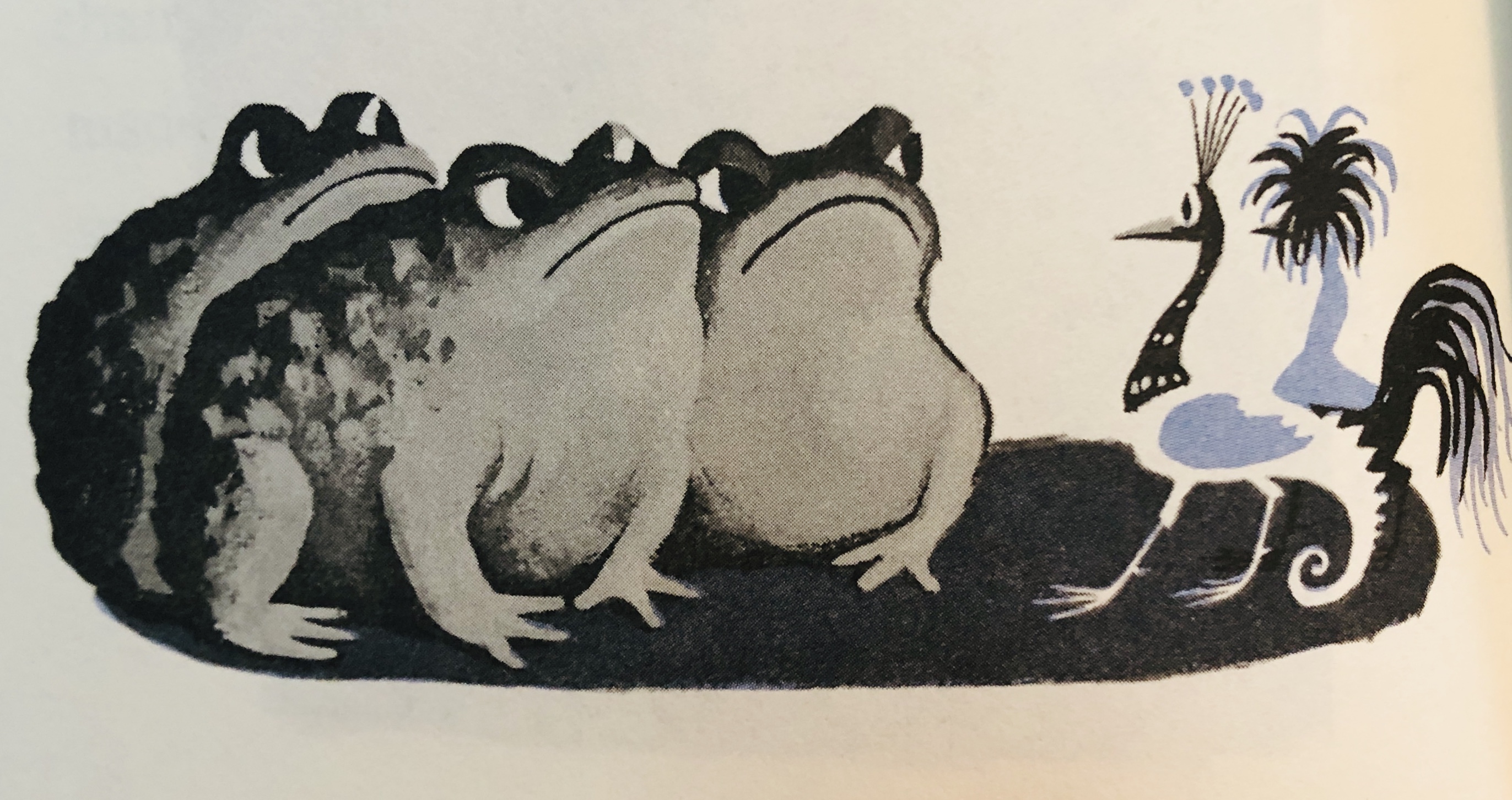
It has many characteristics of that kind of story: a simple story which ripples with deep, creepy currents; faint echoes of existential terror and deep grief hidden under alienating silliness; little word games, meant to sound to funny to children and clever to adults; cute absurdist paradoxes; witty illustrations.

A great example is the Todal. The Todal does not appear on screen (as it were); rather, it is a sinister force which threatens the Duke if he fails. It is described as a “blob of glup”, and is “an agent of the devil, sent to punish evildoers for having done less evil than they should”.

Do you see what I mean? Do you see the tension there between something frankly childish and silly (or, if you like, stupid), the blob of glup, and the more adult, sinister idea, the Satanic agent which punishes failure? That tension lasts throughout the book – you are always watching the childishness for the quick flicker of darkness which will move behind it.

“Something moved across the room, like monkeys and like shadows. The torches on the walls went out, the two clocks stopped, and the room grew colder. There was a smell of old, unopened rooms and the sound of rabbits screaming. “Come on, you blob of glup,” the cold Duke roared. “You may frighten octopi to death, you gibbous spawn of hate and thunder, but not the Duke of Coffin Castle!” He sneered. ” Now that my precious gems have turned to thlup, living on, alone and cold, is not my fondest wish! On guard, you musty sofa!” The Todal gleeped. There was a stifled shriek and silence.” (p. 107)

And, mostly, it’s pretty charming (that’s pretty clear from the excerpts, right?). So, why do I say with such certainty that ‘The 13 Clocks‘ isn’t the best book in the world?

Well, because something can be very sweet and very charming and very clever without shaking the foundations of the earth, that’s why.

I don’t think that the only role of literature is to move the world, to wrench and rip open the fabric of complacency which covers our eyes, and I don’t think that that is the standard by which all books should be judged.

But books do this – books have done this. Not all, but many. And some have even done it while being charming and clever and sweet. Some have even managed to do it while being beautiful.

And while those books exist, shaking the earth, there is no way ‘The 13 Clocks‘ is the best book in the world. It’s super cute, a great little read, but the best book? No.

Although, there is something I have not considered: perhaps Neil Gaiman lives (tragically) in a world without great books, without ‘East of Eden’, or ‘The Gulag Archipelago’, or ‘Brideshead Revisited’, or ‘The Screwtape Letters’ (which is the best book in the world). Perhaps Neil Gaiman lives in a world where the only books in the world are ‘The 13 Clocks‘ and, like, ‘On the Road’ by Jack Kerouac.

In which terrible case, he is absolutely correct: ‘The 13 Clocks‘ is the best book in the world. But, Neil, get out of there.

The Likeness

By Tana French

All Posts Contain Spoilers

“This is Lexie Madison’s story, not mine. I’d love to tell you one without getting into the other, but it doesn’t work that way. I used to think I sewed us together at the edges with my own hands, pulled the stitches tight and I could unpick them any time I wanted. Now I think it always ran deeper than that and farther, underground; out of sight and way beyond my control.” (p. 3)

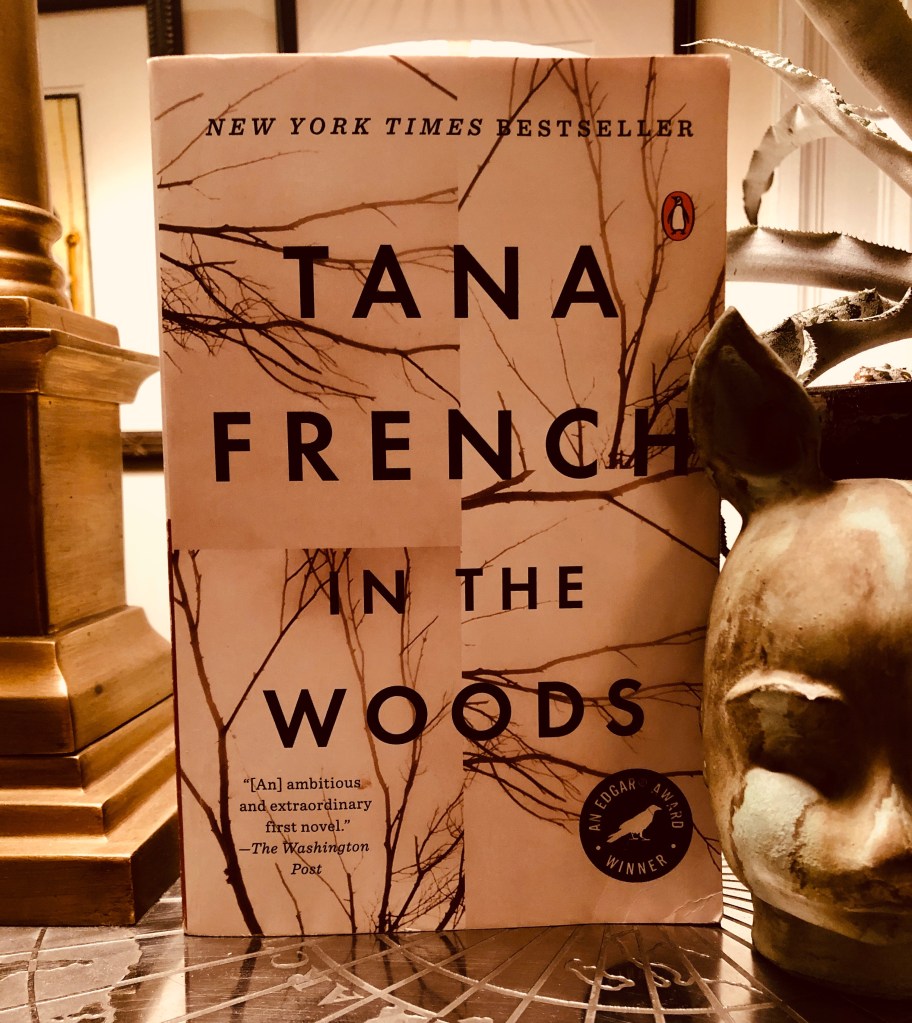
I wrote a few weeks ago about ‘In the Woods‘, the first book in Tana French’s Dublin Murder Squad series. I believe that I loved it very much; I think, in fact, that I did a crappy job reviewing it because I wanted to hurry up and read this.

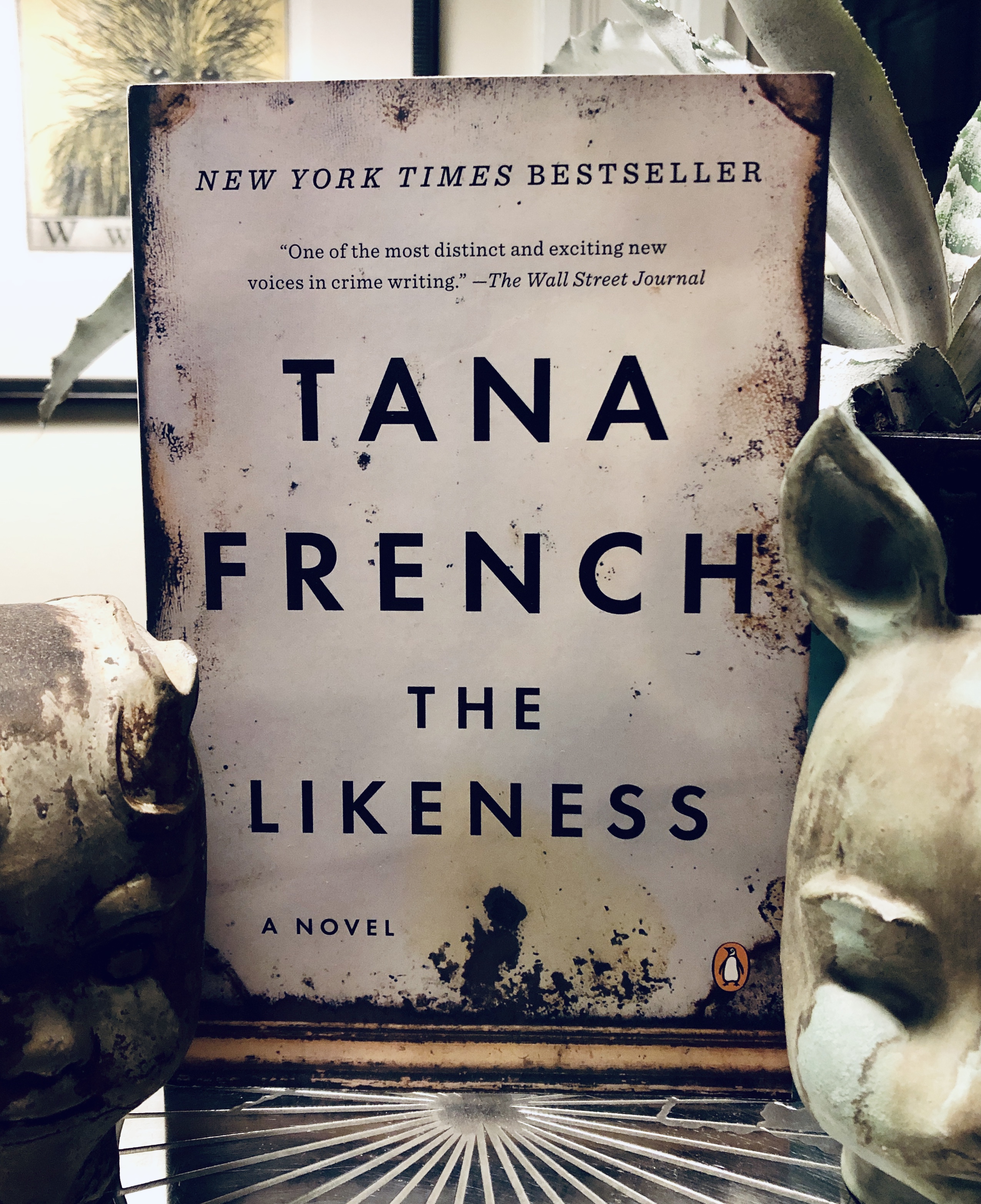
The Likeness‘ is the second of the Dublin Murder Squad series. Detective Cassie Maddox, exhausted and heart-broken after the events of ‘In the Woods‘, has retired from the Murder Squad and has been hiding out in the Domestic Violence division. One day, she gets a call from her old mentor from Undercover, Frank Mackey, to come see a dead body. Confused initially, for she has left Murder behind her, the call becomes clear when she learns that the body is carrying ID which states her name as Alexandra Madison. Lexie Madison: that is the name of Cassie Maddox’s old undercover alias.

So who has adopted Cassie Maddox’s discarded alias? This new Lexie Madison is a graduate student. She lives in Whitethorn House, a old estate she shares with her four closest friends, also graduate students. It soon becomes clear that the most unusual thing about the already unusual victim is this incredible close friendship. These five students, outsiders, belong utterly to each other, share a bond which is more like a family than any friendship Cassie Maddox has ever seen. And now Lexie has been stabbed to death, and left in a cottage near Whitethorn House.

And when Cassie Maddox sees the body, she realizes that there is another reason she has been called to this particular crime scene: not only does Lexie Madison wear her name, Lexie is also wearing Maddox’s face. The two women could be twins, they look so alike.

In order to exploit the remarkable similarity in their appearances, Mackey convinces the press to suppress the news of the murder, and sends Maddox into Whitehorn House to live with Lexie’s friends, to learn her life, to discover who might have killed her.

The Likeness‘ is two mysteries rolled into one: the mystery of Lexie Madison’s death, and the mystery of Lexie Madison’s life. The solution to both of these mysteries lies somewhere in Whitethorn house, among the four friends who loved her so deeply.

Honestly, my expectations for this book couldn’t have been a lot higher. I loved ‘In the Woods‘, and I barely paused for breath before starting ‘The Likeness‘. I don’t think I’ve ever vaulted from one mystery novel to the second in such rapid succession – normally, I have rules about this sort of thing, and I like to make sure that I don’t read books by the same author in succession (I know, don’t I sound fun?)

High expectations are not, usually, a great way to go into a book. It’s a little like deciding that someone is your soulmate on first sight: you just don’t have the info you need, and you’ve now prevented yourself from appreciating any lesser, more normal outcome. In the end, I was not at all disappointed by ‘The Likeness‘, but, while ‘In the Woods‘ grabbed me immediately, it took me a little time to acclimate to this novel.

Settling into ‘The Likeness‘ meant willingly suspending some disbelief about the unlikeliness of the premise. All murder mysteries are, more or less, unlikely: the realism quotient of the genre is low. However, anyone who has ever had a friend, or a family member, or a romantic partner, will know that this premise is particularly outlandish. No matter how alike two unrelated people may look, they would never be able to fool an intimate. If your best friend walked out of the house one night, and was replaced by an undercover cop who looked like just them and had seen a few videos of them, do you really think they would fool you for more than a day? Come on…

But, of course, that is so much not the point. Weirdly, the murder also isn’t the point. The point of ‘The Likeness‘ (as in ‘In the Woods‘) are the relationships. As Cassie Maddox lives with Lexie’s friends, as she wears Lexie’s face, she falls in love with the group, with the house, that Lexie loved. And she almost gets lost.

So, yes, it took me a little while to settle into ‘The Likeness‘. My own high expectations and the outrageous premise worked against my enjoyment for a little while, until something else sank in: Tana French has a totally different project than any other mystery writer I’ve ever encountered.

Tana French

A theme is beginning to emerge from French’s works: they are about the souring of love. This is a brave and unusual theme for a detective novelist. Detective novels nod at the warmer human emotions – someone occasionally kills from jealousy, or spurned love. But, mostly, as in life, people in murder mysteries kill from baseness: from greed, or sickness, or alienated rage.

In Tana French, it seems, people kill from love. Her novels are studies in love, not in the ordinary, pedestrian, every day love we all know, but the rare, deep, once-in-a-lifetime loves which some of us are lucky enough to be defined by. Both ‘In the Woods‘ and ‘The Likeness‘ are about these loves, about what happens when they break, but even more about the way we grow around them, what they make us into, and why it is that, when they do break, the consequences are catastrophic for us.

I think that this focus, this obsession of French’s with deep love, is what imparts so much beauty to her books, more even than her creepy, adjectival Irish English. These are stories of relationships – the murders haunt the periphery of these stories. They are the lurking threat which accompany the love, and it is the love which really interests French.

And this theme works for me on a profound level. Don’t get me wrong: I’ll tear through a paperback about a sicko psychopath with a sex dungeon and a penchant for taunting the police. I’m not too fancy for sex crime novels, or greed crime novels, or labyrinthine revenge crime novels – I like those novels, too!

But there is something about the curdled love which seeps through Tana French’s novels that just holds me in place, roots me to the spot, until I finish them. I love these novels, and while I’m reading, I belong to them. I’m upset when they end. They make me uneasy in my soul. I’m going to read every single one.

The Nix

By Nathan Hill

All Posts Contain Spoilers

“So banks and governments are cleaning up their ledgers after years of abuse. Everyone owes too much, is the consensus, and we’re in for a few years of pain. But Faye thinks: Okay. That’s probably the way it ought to be. That’s the natural way of things. That’s how we find our way back. This is what she’ll tell her son, if he asks. Eventually, all debts must be repaid.” (p. 732)

As you may have noticed by now, I don’t love contemporary fiction.  I read a fair amount of it, and I even like some of it, but I rarely love it.

I’m not sure exactly why this is.  The answer that I tell myself is that I rarely shine to contemporary novels because most of them, to put it plainly, are bad.

Now, of course, most novels of any time period are bad: most books are bad.  But if we are still reading and recommending a book that was written two hundred years ago, then we are reading it because generations of readers before us have identified it as good, vouched for it and passed it forward.  Each generation that a book survives is a finer and finer filter of taste through which it must pass, making it more and more likely that the book is good*.  Previous generations have done much of the work of selecting out the bad books of their own time for us.  And we will do the same for the books of our own generation.

*There is a wrinkle here, though, and don’t think I don’t know it: once books achieve the status of “great”, once they become venerated, people becomes less likely to notice that they are, in fact, bad, and less willing to say so if they do notice, and so some bad books get kind of grandfathered past the normal critical filters.  It’s a real problem (ahem, I’m looking at you, Edgar Allan Poe, looking right at you).

But, since we are the first filter through which contemporary novels will pass, contemporary novels are, therefore, the novels most likely to be bad.  They are unfiltered.  And I, personally, think it shows.

So I have developed a mild aversion to them, a slight generalized contempt for books which are overly demotic, or casual.  Which are grounded too much in my own time.  Maybe I am less compelled by problems of modernity, by plot lines which heavily involve the internet, or television, or video games.  They might be fun (they usually are), but they never seem to have any artistic weight.  Somehow, if a writer mentions tweeting, I automatically assume that his book is Beach Reading, that it cannot be Great Art.

All of which is, I understand, a prejudice.  I am prejudiced.  Which is why I hope that you will believe me in particular when I say that, despite the fact that it is ultra-modern, that it involves the internet AND television AND video games, ‘The Nix‘ is a really great book.

I’m obviously not the first person to notice this (it was a bestseller) but I may be the most reluctant.  I had ‘The Nix‘ slated as Beach Reading for sure, and was irritated when it showed up on all those curated tables in all my favorite bookstores, and was absolutely not going to read it.  However, one day my best friend and I were wandering through one of those bookstores and he pointed to it and said, ‘That’s a great book.  You would love that book’.  And because he is my top-ranked #1 Book Recommender, I thought, ‘Oh shit, I’m going to have to read ‘The Nix’.

(By the way, to offer some measure of how much I didn’t want to read ‘The Nix‘, how much I would rather have been reading ‘Ivanhoe’ and Graham Greene and other snobby shit, I will also mention that that was two years ago.  ‘The Nix’ has been sitting on my To Read Shelf, complete with a recommendation from the person whose opinion on books I trust above literally anyone else’s, for two years.)

Which, shame on me, because I adored it.  My best friend was right (he always is): it is a phenomenal book, and I crashed through it in about two days, loving every minute of it.

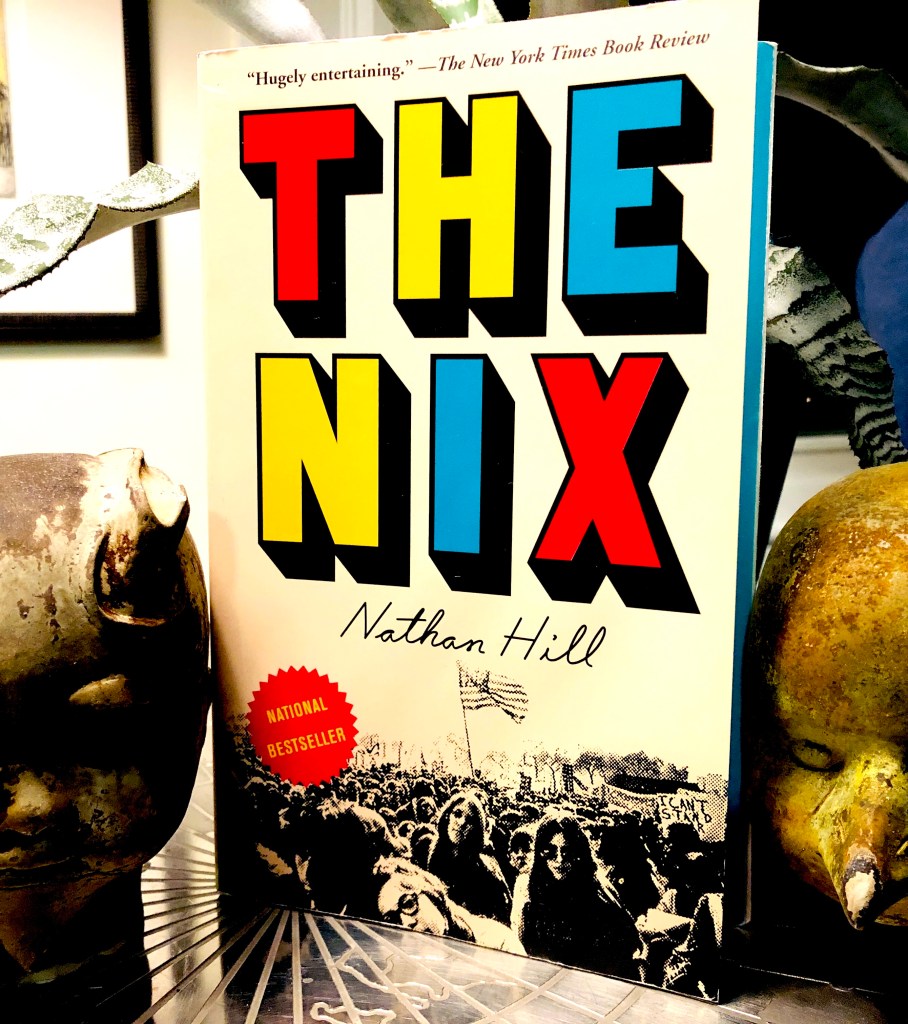
The Nix‘ is the story of Samuel Andreson-Anderson.  Samuel is failed writer who makes his living as a mediocre professor of Literature at a mediocre liberal arts college, but who spends most of his time online playing World of Elfscape.  Samuel’s sadness, his essential passive loserdom, his failure as a writer and as a romantic figure, were all locked in place on the day when he was eleven and his mother Faye abandoned him, utterly and without warning.  Samuel has had no news of his mother for twenty years when, one day, she resurfaces. She resurfaces when she is arrested for throwing rocks at a conservative Presidential candidate.

The Nix‘ manages to do the thing which so few contemporary novels actually do: to use the trappings of modernity to explore the genuine existential crises of modernity.  Most contemporary novels wear their modernity on the surface, referencing the cultural soup we’re all bathing in without really utilizing it.  They seem so desperate to prove that they are culturally fluent that they spend all their time showing off all the culture that they know, making jokes and allusions that won’t last five years, without exploring what any of those cultural artifacts really mean for the people who use them.

Nathan Hill

The Nix‘ doesn’t make that mistake.  Nathan Hill uses his character’s context – it is a tool with which he interrogates the peculiar human problems which modern humans have.  He isn’t just being funny about video games – he’s trying to figure out why people get lost in them.  He’s trying to figure out why people get lost at all.

“And since beginning with an Elf warrior named Pwnage he had advanced to play a whole stable of alternate characters with names like Pwnopoly and Pwnalicious and Pwner and EdgarAllanPwn, and he made a name for himself as a fearsome gladiatorial opponent and a very strong and capable raid leader, directing a large group of players in a fight against a computer-controlled enemy in what he came to regard as a being a conductor in a battle-symphony-ballet type of thing, and he rather quickly got extraordinarily good at this…because he believed that if he was going to do something he was going to do it right, he would give one hundred and ten percent, a work ethic he liked to think would soon help him with his kitchen renovation and novel-writing and new-diet plans, but which so far seemed to apply only in the area of video games.” (p. 411)

Hill also avoids another easy pitfall of the contemporary novel: depiction of the dreariness of life as the point of the art. There is a school of art which eschews grand events, seeks instead to act like a mirror to everyday life, to explore the depth and nuance of a totally ordinary life in all its putative depth, all its normal beauty and sadness (the seminal, original novel of this kind is ‘Mrs Dalloway’. I hate novels like this – I find them boring, and drab, and I understand that that is sort of the point of them, but knowing that I was meant to be bored does not actually alleviate my boredom.

The Nix‘ isn’t drab, or dreary, or ordinary at all. It is colorful, and plotty, and exciting. Things happen which would never happen to you, or to me, which would never happen to anyone, really, but because they are well-drawn and funny, the novel works tremendously well as a whole.

I loved this book.  I thought it was funny, and moving, and clever, and wise.  It contained the right mix of correct, quotidian details and outlandish, unlikely plot elements so that I was able both to relate to it and stay hooked into the story.  This wasn’t a novel about my modern life – it’s a novel about a crazy, sad, unlikely modern life, a much more entertaining modern life than mine will ever be.

I thought that I didn’t like reading novels about my own cultural moment – as it turns out, I only like reading them when they are written by a master, and then I love reading them. This book was so good, I ordered it for about three different people right away, and called my best friend for more recommendations. I have no pithy ending line, no great lesson here. ‘The Nix‘ was a joyful, funny read. I think it is a great book. I’m so glad I read it. I wish I could read it again, for the first time, all over again.

In The Woods

By Tana French

All Posts Contain Spoilers

“What I warn you to remember is that I am a detective. Our relationship with truth is fundamental but cracked, refracted confusingly like fragmented glass. It is the core of our careers, the endgame of every move we make, and we pursue it with strategies painstakingly constructed of lies and concealment and every variation on deception. The truth is the most desirable woman in the world and we are the most jealous lovers, reflexively denying anyone else the slightest glimpse of her. We betray her routinely, spending hours and days stupor-deep in lies, and then turn back to her holding out the lover’s ultimate Mobius strip: But I only did it because I love you so much.” (p. 3)

Perhaps no literary form elicits such universally strong feelings as the detective novel.

I know of no reader who is indifferent to the detective novel. Actually, I know of no reader who does not love them – the trouble is, we all love different ones.

And our preferences feel significant. Like our political affiliation, or the movies that make us cry, the kind of detective novel we love feels like it reveals a lot about what kind of reader we are.

Everyone, of course, admires Agatha Christie. She is the Shakespeare of detective stories: she may not move you, personally, but no one would deny her her exalted place, first in the canon.

But, beyond Agatha, what kind of detective story do you love? Do you prefer the cold, cryptic little tales of Sherlock Holmes? Do you like the gory, plotty American novelists, the elaborate sadistic murderers of James Patterson and Patricia Cornwall? The poetic, moody novels of Benjamin Black? The cerebral, funny British women: Josephine Tey, Dorothy Sayers?

Me, I like them all. But I love very few: ‘The Daughter of Time‘, ‘And Then There Were None‘, ‘Christine Falls‘, maybe. And no author has ever commanded urgency from me. Detective novels, for me, are treats, picked up once and a while, chewed through quickly, and then put down, left behind, details almost entirely forgotten. They are more an escape than a book; I inhabit them, but I don’t take them with me, and I don’t rush on to the next one.

This casualness in my relationship with detective novels is, in large part, the fault of the form. The great strengths of the detective novel are also their great weaknesses: they are highly circumscribed, formulaic. The genre has conventions which must either be observed, or else deliberately eschewed: either way, the conventions dictate the story.

The narrowness of these conventions make detective novels blend together. Which was that series, the one with the lone-wolf detective who doesn’t play by the rules? The one who has a substance-abuse issue and a troubled past? Oh, that’s right: every single one.

But this narrowness is also, I think, why people love these novels so much. The highly predictable nature of these novels make the small differences between them significant. They look so like each other, but when you spy a difference you love, you appreciate it all the more for its subtly.

I have found one that I love. In fact, I have found one that I love so much that I suspect that I may love the author and not just the novel. I have found one that I love so much that I ordered, in one burst, all the other books in the series, before I was even one third finished with it.

I’m not the only person who feels this way. Tana French has been blowing up my pop-culture recommendations lately. I’ve heard her name on every podcast I listen to, read it on every book club reading list that crosses my path. And, normally, this kind of ubiquity prejudices me against the object. I am perverse, and childish – I hate liking something that everyone else likes.

But Tana French is better than my immature contrarianism. ‘In the Woods‘ is the first of the six Dublin Murder Squad novels. That meta-title, ‘Dublin Murder Squad’, makes these novels sound macho, high testosterone and swaggering, in a way that ‘In the Woods’ is emphatically not.

In the Woods‘ is about the investigation of the murder of a little girl. The body of twelve year old Katy Devlin is found outside the housing estate where she lived; it is also the estate where Detective Rob Ryan lived, decades before, and from which his two best friends went missing one day, from the woods. They were never found, and Rob has no memory of that long-ago afternoon. Now, he and his partner Cassie Maddox have been sent back to find out what has happened to Katy.

Of course, the devil of the detective novel is in the details – you learn almost nothing from the premise. This premise, a murdered child, an unlikely coincidence, this could be any detective novel. But Tana French has written something beautiful, and strange, and she has managed to do so within the confines of this genre, which requires extra skill.

Bad detective novels are about crime – good detective novels are about people. ‘In the Woods‘ is about friendship. It is about the deep and abiding love that grows between people, and what happens when it is ruptured, or when it curdles. It is about friendship as a binding force, and about broken friendship as a denaturing force, deranging. It is about what is means to have a friendship so close that it is closer than family, and then to lose it. It about grief and how it hardens us.

Tana French

There is so much I admire about this book. I admire the story: it is subtle and careful. Most detective stories rush into plot – they are split between poor dialog and action sequences. It is a genre characterized by speed, and tidiness, which cannot bear a long pause, or a loose end.

French, on the other hand, is a patient author. She lingers with her characters for their own sake – they are the point of her novel, not the murder. Her world is not a tidy one, and not all crimes will be solved, not all motives answered. She is not dealing in archetypes here, but endeavoring instead to imagine people, and people are messy. They are not, like crimes, solvable, and so she does not solve them. Most detective novels are about one big mystery, and if there other mysteries, they orbit the main mystery and will be solved with it.

But, in French’s world, people are all mysteries, and so mysteries spring up between them, and a murder, or a disappearance, is just one of the many possible difficulties that might happen in the endless collisions between unknowable beings. And so most mysteries, in her world, will never be solved. And even if you learn who, when, where, and how, you will never really understand why.

And she is a lovely writer. I have a prejudice that Ireland produces especially beautiful writers of English, that the prose that they make has a particular lyrical quality which I have always loved. Detective stories are not the place for Joycean prose-poetry – those kind of verbal gymnastics would be, frankly, annoying – but you hear the poetic bent in French’s prose, in her descriptions, in the moody, creepy pall which hangs over her Dublin.

This book owned me completely, and so here is the plain truth of it: I don’t want to write anymore about ‘In the Woods‘ – I want to go read the next Dublin Murder Squad book, ‘The Likeness‘, which has already arrived and is hollering silently at me from my desk. This is the highest compliment I know how to give an author, really: I don’t have time to write about them – I have to go and read them.

Tales of Mystery and Imagination

By Edgar Allan Poe

All Posts Contain Spoilers

Guys, is it just me, or is Edgar Allan Poe kind of…bad?

I’m having the slightly creepy experience of reading a book which is considered ‘classic’, picking up a work of Great Literature, and finding it to be, well, bad.  And not just a little bit bad, or simply not to my taste – really and obviously bad.  Just crappy.  Indefensible.

I’m sorry to have to say this, but I think that Edgar Allan Poe is a bad writer.  It grieves me, honestly, to pan the most famous author of spooky stories, to turn my nose up at the man who basically invented creepiness, but these are bad stories, badly written!  I can’t be the only person who’s noticed this, can I?

I hate these moments, these The-Emperor-Has-No-Clothes-moments, when everyone around you exclaims that a piece of culture is brilliant but, try as you might, you just can’t see it.  It’s obviously not brilliant, but no one will admit it and you wonder, is it me?  Am I crazy?  Am I missing something?  Or is Edgar Allan Poe just a bad writer and no one has the guts to say it?

I’m gonna get of ahead of you here and just slot in a few disclaimers.  First of all, I am not simply having trouble with the normal, more formal English of two hundred years ago.  I have read, and loved, many of Poe’s contemporaries, even his predecessors – I love the fruity olde English of yore.  This is not a problem of idiom, or style.

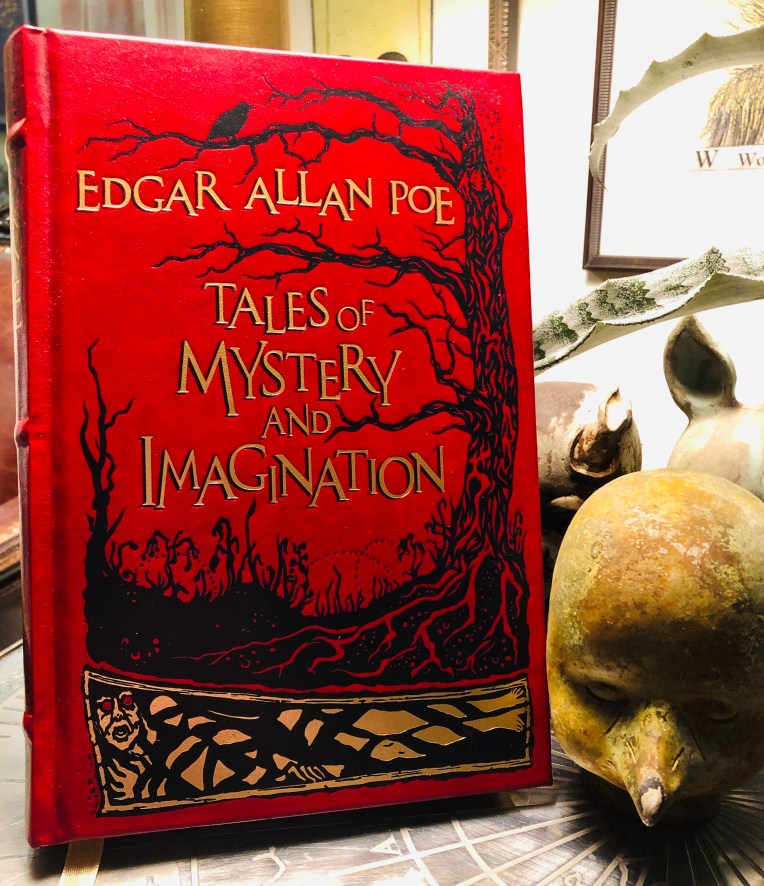
And I didn’t just read a few bad stories, his early attempts, for example, when he was still learning the ropes.  My copy of ‘Tales of Mystery and Imagination‘ contains twenty stories, including all his ‘best’ and most famous ones: ‘The Fall of the House of Usher’, ‘The Tell-Tale Heart’, ‘The Murders on the Rue Morgue’, ‘The Pit and the Pendulum’.  I read this book cover to cover.

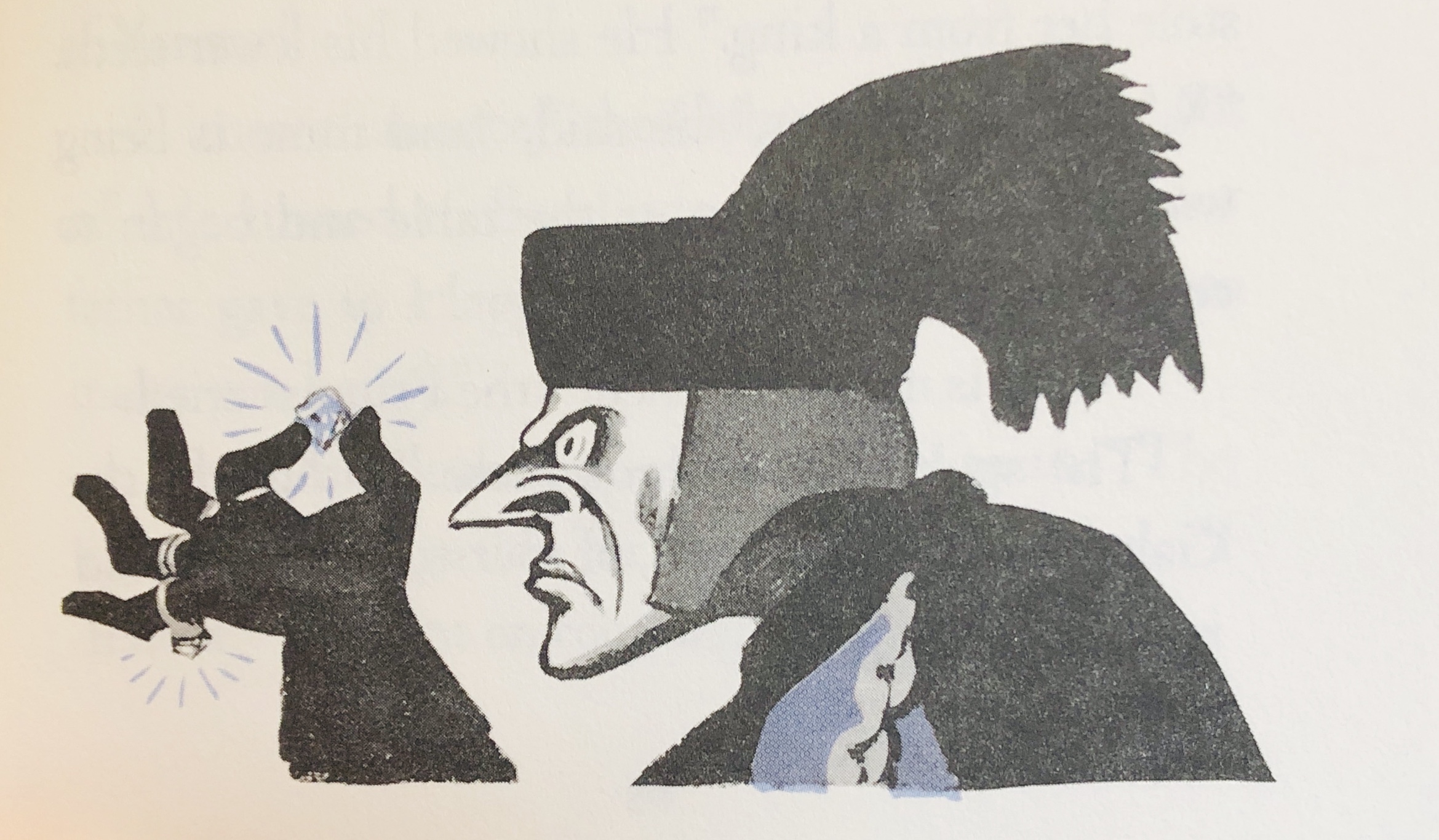
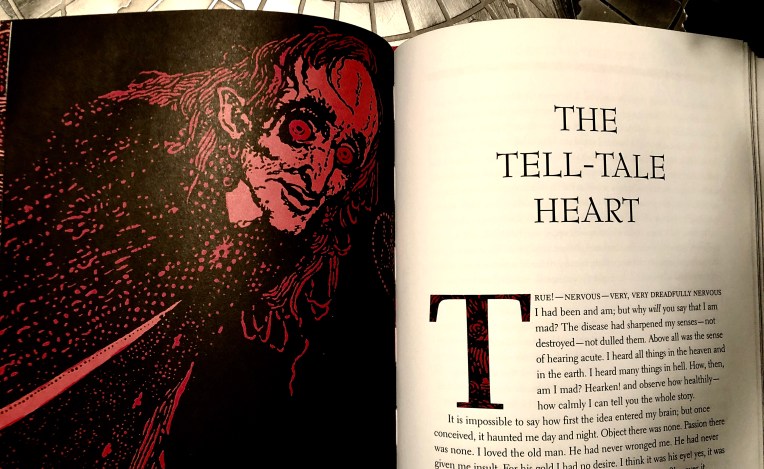
The only thing I liked about this book was these creepy illustrations, by Harry Clarke.

And it was hard-going, I can assure you.  These are not easy stories to read, or fun.  Poe’s prose is turgid, and purple, arduous and encumbered.  Reading him is like running through wet sand.  Let me give you a few examples, chosen – I swear to God – basically at random:

“‘You behold around you, it is true, a medley of architectural embellishments.  The chastity of Ionia is offended by antediluvian devices, and the sphynxes [sic] of Egypt are outstretched upon carpets of gold.  Yet the effect is incongruous to the timid alone.  Proprieties of place, and especially of time, are the bugbears which terrify mankind from the contemplation of the magnificent.  Once I was myself a decorist: but that sublimation of folly has palled upon my soul.  All this is now the fitter for my purpose.  Like these arabesque censers, my spirit is writhing in fire, and the delirium of this is scene is fashioning me for the wilder visions of that land of real dreams whither I am now rapidly departing’.” (‘The Assignation‘)

That is self-indulgent nonsense.  Here, try another:

“Ah, Death, the spectre which sate at all feasts!  How often, Monos, did we lose ourselves in speculations upon its nature!  How mysteriously did it act as a check to human bliss – saying unto it “thus far, and no farther!”  That earnest mutual love, my own Monos, which burned within our bosoms – how vainly did we flatter ourselves, feeling happy in its first upspringing, that our happiness would strengthen with its strength!  Alas! as it grew, so grew in our hearts the dread of that evil hour which was hurrying to separate us forever!  Thus, in time, it became painful to love.  Hate would have been better then.” (‘The Colloquy of Monos and Una‘)

He sounds like a fourteen year old girl trying her first slash fiction.  Have I broken your spirit yet?  Can you bear another?

“Yet, although I saw that the features of Ligeia were not of a classical regularity – although I perceived that her loveliness was indeed ‘exquisite,’ and felt that there was much of ‘strangeness’ pervading it, yet I have tried in vain to detect the irregularity and to trace home my own perception of ‘the strange.’  I examined the contour of the lofty and pale forehead – it was faultless – how cold indeed that word when applied to a majesty so divine! – the skin rivalling [sic] the purest ivory, the commanding extent and repose, the gentle prominence of the regions above the temples; and then the raven-black, the glossy, the luxuriant and naturally-curling tresses, setting forth the full force of the Homeric epithet, ‘hyacinthine!'” (‘Ligeia‘)

What incredible rubbish.  Honestly, that is just bad writing – it’s not fancy, it’s not expressive, it’s not sensual or sophisticated.  It’s terrible.

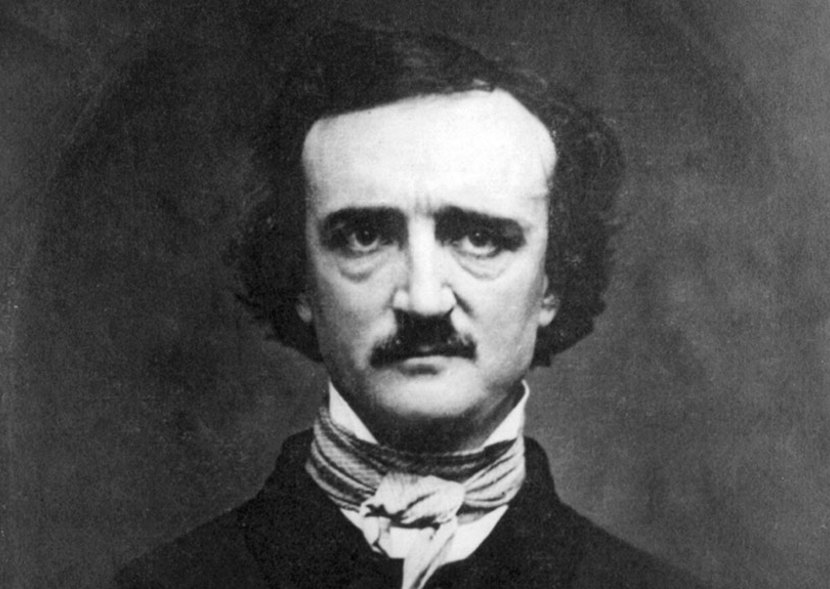
Edgar Allan Poe.  I feel a little bad saying all these mean things about him – he looks so sad.

And my objections to Poe are not merely stylistic.  He is not just a bad crafter of prose – no, worse: he is also a bad crafter of stories.

I know, I know – this is going to be a bridge too far for some people.   But bear with me, because I’m about to make a distinction which is very important to me.  There are two different elements (at least, but let’s stick with two for right now) to a well-crafted plot: the Premise and the Unfolding.  The Premise is the foundation on which the story rests; the Unfolding is how the Premise roles out into the plot.

Greatness, in a book, is most often found in the Unfolding of the plot.  Often, this great Unfolding rests on a magnificent Premise, but it needn’t: a masterful Unfolding can make Great Art of a simple, well-worn Premise.  But it is almost impossible to rescue a great Premise from a bad Unfolding.

Which is a shame, because there is almost nothing as lovable as a great Premise, and when you meet one, you want desperately for it to become Great Art.

But wishing does not make it so.  I have a theory that Edgar Allan Poe is considered a great writer because he is pretty great at the Premise.  All of his most famous stories share this trait: they have great Premises.  A man accidentally walls his comatose wife up in the family tomb.  A brutal, senseless murder stymies the police because it was committed by an escaped gorilla.  A murderer is so haunted by guilt that he cannot escape the sound of the beating heart of his victim.  A man is trapped in the most hideous torture chamber ever devised by the Inquisition.

These are phenomenal Premises, and it’s hard to imagine that their accompanying stories might really be bad.  But, please trust me, they are.  Poe is a terrible writer of plot: he cannot pace, does not construct narrative well.  He tells, and does not show.  His stories are uneven.  He spends way too much time on irrelevant details (pages and pages devoted to the windows in the House of Usher) and rushes the denouement.  Sometimes his stories don’t even have a denouement – they just trail off into nothing, as though he wandered away from the table.

Which, OK, he was sort of inventing a genre.  Some unevenness is expected.  But, not really: people wrote ghost stories before, and novelty is no excuse for bad writing. 

We are lucky: we live in a time of plenty, book-wise.  There is so much to read, too much to ever accomplish in a lifetime, in ten lifetimes.  We must pick and choose, and so it might be time to leave Poe behind, to thank him for his service, to be grateful for what he gave us, for the traditions which he inspired, but to let go of the primary material.

So, if you will allow me, I would like to give you a small Christmas gift: time.  I would like to save you the time you might have spent reading Edgar Allan Poe.  I almost never do this – I believe in reading the Classics for yourself.  But this time I believe I can, in good conscience, free up some time for you.  I think, if you’ll let me, I can give you this time back.

Because, no matter how much I love scary stories, no matter how I grateful I will always be to the man who made them Literature, I cannot tell it other than this: Edgar Allan Poe is a bad writer.

Happy Holidays.