Ivanhoe

By Sir Walter Scott

ALL POSTS CONTAIN SPOILERS

I think we sometimes assume that old stories are boring stories.

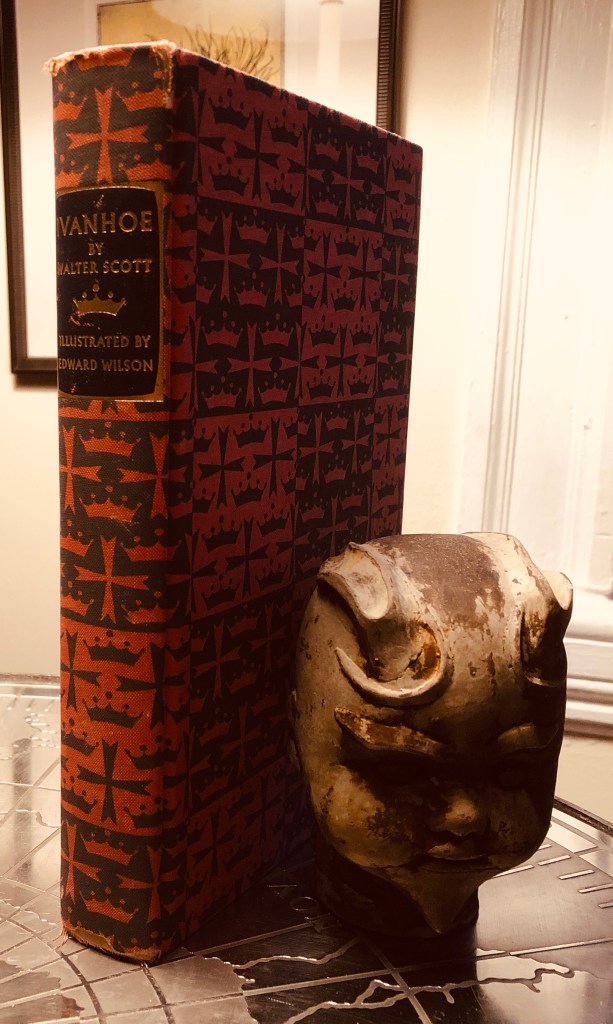
Ivanhoe‘ is an old story. I found my copy in my favorite used bookstore, ‘Second Story Books‘ in Washington D.C. It’s a Heritage Press Edition, and I’ll confess to a weakness for this kind of hardback reprint. They are wildly inconvenient and hard to read (too heavy, difficult to hold), but they really make you feel as though you are reading a proper book. And I’m a sucker for proper books.

But I bought my ‘Ivanhoe‘ years ago and, clearly, I haven’t been in a rush to read it. Honestly, as beautiful as my edition is, I suspected that it was going to be boring. I took a run at it a year or so ago: it opens with a brief exposition of the continuing effects of the Norman Conquest, and then cuts to a scene in the middle of an old-growth English forest, where two good-hearted Saxon yeomen are complaining about anti-poaching laws. So, yeah, it seemed like it was going to be really, really boring – I put that thing down like it was on fire and didn’t pick it up again until last week.

Old stories aren’t just boring-seeming because they’re, well, old, and because we think we’ve heard them already (although that is part of it) – it’s because we think that old stories are simple.

And they sometimes are, but we mostly think that old stories are simple because old stories are foundational – they are the stories upon which later stories have elaborated. They aren’t simple, but they are archetypal, which makes them predictable.

They also aren’t modern, which is obvious but important. They aren’t written in our vernacular, and their vernacular often seems cheesy to us: lacks the rawness, or subtlety, or emotional complexity, of our own.

All of which gives these stories a sort of hokey, old-timey feel which can strike some people as quaint and some people as lame.

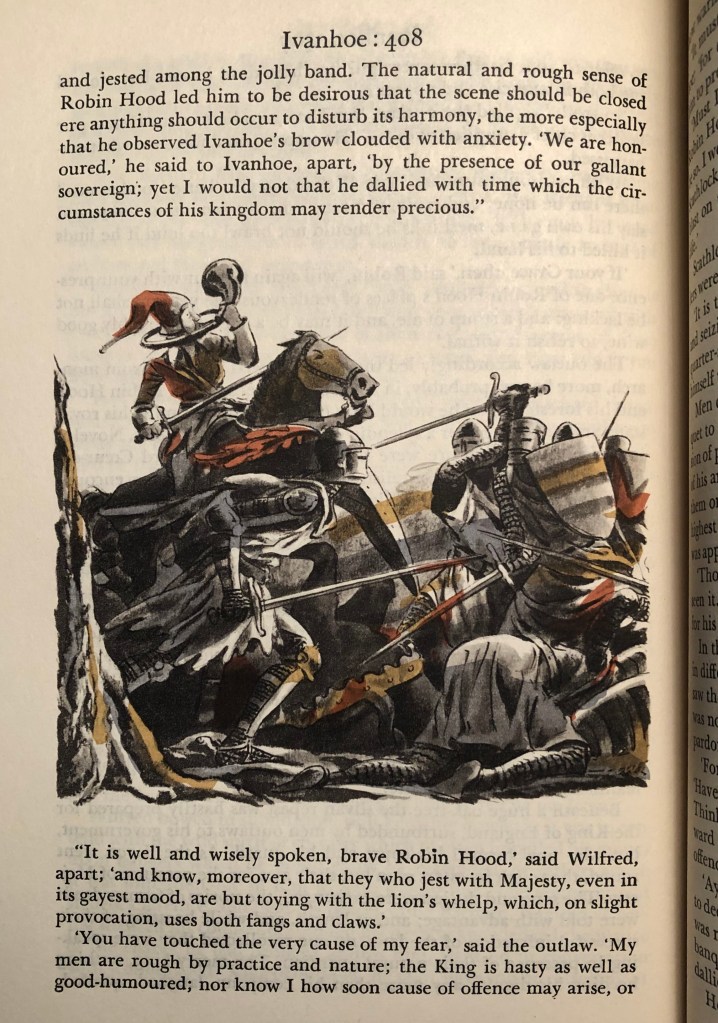
Ivanhoe‘ lands right in the sweet-spot of this quaint/lame zone. This is a long-ass novel of Ye Olde England, and it’s filled with all the cliches of that genre. Robin Hood is here, Friar Tuck is here, Richard the Lion-Heart is here (his wicked brother John is here); there is an archery contest, there is chivalry and maidens and Sherwood Forest and wicked Norman knights and valiant Saxon knights and tournaments of honor.

But it’s a classic, and my beautiful copy kept calling to me, so I took another stab at it.

Pretty quickly, though, after I pushed through the two soul-crushingly boring yeoman, I realized two things:

  1. Ivanhoe‘ is a weirdly complicated story. Its plot is complicated; its characters are complicated; its morals are complicated.
  2. I actually have heard this story before.

As it turns out, big parts of Disney’s ‘Robin Hood‘ (you know, the amazing cartoon from when we were all kids, where Robin Hood is a fox and Little John is a bear?) is ‘Ivanhoe’-adjacent. There is no Maid Marion in the novel, but the whole scene with Robin Hood at the tournament taunting Prince John and winning the archery contest in disguise? That’s ‘Ivanhoe‘.

But Disney’s ‘Robin Hood’ is a simple story of good and evil – ‘Ivanhoe‘ isn’t. Or, it is, but with a lot of shades in between.

The story is almost unnecessarily complicated, and several attempts to summarize the plot have convinced me that it isn’t a worthwhile exercise. Part of the problem is that ‘Ivanhoe‘ is actually many stories woven together: two love stories, one tragic, one classic; a tale of chivalric honor over villainy; several tales of knightly valor; three tales about the honor of thieves; one tale of a sibling rivalry between two princes; a tale of a prodigal son; a tale about the loyalty of servants, and the wisdom of fools; a tale of a wicked usurper and a virtuous king; a story of the Jewish diaspora, and the terrible wickedness of Christians to Jews; and a tale of palace intrigue, all set against the backdrop of the tale of a conquered people trying regain their dignity. With some comic relief thrown in.

It’s a lot, and that really doesn’t even begin to describe it all. Before everything is through, there will be a tournament, a siege, Robin Hood will end up fighting alongside Richard the Lion-Heart, a castle will burn down with people in it, maidenly virtue will be rewarded, maidenly lack of virtue will be mocked and punished, a beautiful woman will be tried for witchcraft, a man will die of a broken heart, someone will come back from the dead, and lots and lots of horrible things will be said about Jews.

A Maiden

And I know that this sounds like a bunch of tropes all strung together into some sort of batshit Merry Old England mad-lib, and it kind of is! But if you’re expecting something simple, something quaint, ‘Ivanhoe’ isn’t it.

And if you are expecting easy moral takeaways, ‘Ivanhoe‘ won’t give them to you. There is one pure villain and maybe two pure heroes – everyone else is complicated. People are strong and weak, they succeed and fail, they are subject to imperfections but may overcome them, with work. They love truly, but with private reservations. They have virtues and failings, and sometimes they die and it’s unfair, and sometimes they are forgiven and it’s even less fair. It’s all very…modern.

Well, not all of it. The equivocation is modern – the Jew-hating chivalry is not.

Sir Walter Scott apparently used to be hot shit in Britain. He was a poet and author in the early/mid 19th century, but he was equally or more famous for his novels. ‘Ivanhoe‘ is the one for which he is best remembered now, but at the time he was also known for the Waverly novels, and ‘The Bride of Lammermoor’.

And one gets the sense, reading ‘Ivanhoe‘, that he was also pretty progressive for his time. A major theme of ‘Ivanhoe’ is that Jews are People, Too, pleaded with the sort of earnest heavy-handedness that indicates to me that the message was not uncontroversial.

Sir Walter Scott

And it’s a good message, but it’s delivery is decidedly pre-modern: Scott is going way out of his way to show you that, despite all the usury and their maniacal love of riches, Jews are also capable of love and goodness, even, in some rare cases, true human virtue. At one point, Robin Hood must admonish Isaac of York not to spare any expense in saving his daughter’s life:

“Yet, ere Isaac departed, the outlaw chief bestowed on him this parting advice: ‘Be liberal of thine offers, Isaac, and spare not thy purse for thy daughter’s safety. Credit me, that the gold thou shalt spare in her cause will hereafter give thee as much agony as if it were poured molten down thy throat.'” (p. 327)

And though Isaac acquiesces, because he loves his daughter (because, remember: Jews are People, Too!), the loss of fortune hurts him. Though the depictions of Isaac and Rebecca are meant to sympathetic, they are in fact anti-semitic and vile, and they represent, for me, an immovable obstacle to loving this book truly.

We’re allowed to be ambivalent about classics. It’s hard to remember that, sometimes, when we’re confronted by a handsome old hardback. But we are: we don’t have to love them. We can hate them, or like some parts of them and hate other parts. We can marvel at the complexity of the story and recoil at the endless, patronizing anti-semitism and laugh at the old-timey language and roll our eyes at the values.

I wonder sometimes whether classics are not our best-loved novels, but the ones which evoke the strongest ambivalence from us. The ones that elicit the strongest positive and negative emotions from us, at once. ‘Ivanhoe‘ was a ripping read, I tore through it, and I was held genuinely in suspense. That’s not to say that I loved it, but I’ll remember it.

Purity

By Jonathan Franzen

ALL POSTS CONTAIN SPOILERS

We were going to have to talk about Jonathan Franzen eventually.

Whether you like him or not, Franzen has earned (by skill or notoriety) consideration as one of the preeminent living American novelists. He keeps churning out novels that keep being taken very seriously by the critical establishment, and, like, Barack Obama.

I have a complicated emotional relationship with Franzen. On the one hand, I suspect Franzen is probably kind of an asshole, and I don’t think he’s the sort of generation-defining novelist he clearly believes that he is. On the other hand, I find his novels bizarrely absorbing. They are almost astonishingly vividly imagined – you get the sense that if you asked him where the aunt of the ex-boyfriend of the main character’s best friend went to college, he would know that.

I’ve read ‘The Corrections‘ and ‘Freedom‘, which are about the normal existential angst of normal people as they normally age (sort of, but essentially). I was therefore surprised to hear that he had written a novel about a young woman who, while, yes, having existential angst, rather non-normally joins a group of anarcho-hackers in Bolivia who are led by a charismatic Julian Assange-like figure. It sounded like of a departure, and I enjoyed his other books enough anyway, so I decided to read it.

Purity‘ turns out to actually be several stories. It is the story of the eponymous Purity “Pip” Tyler, a 23 year old woman who has been raised in Northern California by her lunatic mother Penelope, who will not tell her who her father is or even her own family name.
Pip decides to accept an internship with the Sunshine Project, a possible-cult which collects incriminating documents about governments and corporations from leaks and hacks and then publishes them. The Sunshine Project is lead by Andreas Wolf, who is handsome and charismatic and German and psychotic.

Purity‘ is also the story of Andreas Wolf, and of the one man he ever considered a friend, Tom Aberant, who is now the editor of the Denver Independent. Tom is one of the two people who know Andreas’ darkest secret, that he once killed a man, and so he will send Pip to work at the Denver Independent, to spy on Tom and threaten him.

And it’s also the story of Leila Helou, Tom’s partner, who is married to someone else and who is trying to help Tom get over his catastrophic first marriage to a woman named Anabel Laird. Anabel was a mentally unstable heiress and performance artist who destroyed his life.

Purity‘ is complicated. And, in this way, it’s a departure from Franzen’s novels (at least from the ones I’ve read). His other novels are intricate, but they are realistic. ‘Purity’ is not realistic. It is about absurd people, celebrities, and unlikely, impossible, coincidences. It’s about messianic hacktivists, and secret billionaires, and surprise children.

If this plot sounds furry and outlandish, it is, but in a good way. It’s like Franzen has loosened up, and decided to write about things that actually entertain him (murder), rather than things he thinks are going to earn him awards (midlife crises). And the new, loose look really works on him: ‘Purity‘ is really fun to read. Much funner than ‘The Corrections‘, that’s for sure. It’s got that usual Jonathan Franzen pull, but with way more plot than his other novels.

But there’s a problem, and I’m not quite sure how to express it.

Ok, how about this:

My father once said something about Phillip Roth that really stuck with me.

I’m sure you know this, but many people think quite highly of Phillip Roth. One of those people is my mother, who has all of his books and thinks that he is one of the greatest American novelists.

My family was arguing about Roth one day – someone (I don’t remember who) had ventured the possibility that he is overrated (it was me) – and my mother was outraged. My father listened patiently to her arguments and then, at the end, simply said, “I don’t know. I want to like him, but it makes me feel weird that, in every single one of his novels, the “narrator” has to blow a load on a woman’s face. I don’t want to know that much about Philip Roth.”

My dad was exactly right: sometimes, an author reveals himself a little too intimately for the comfort of the reader. Something about their fiction feels too real, they seem a little too fixated on something, or something is described a little too lovingly, or in a little too much detail. And you know that you have, unwillingly, gotten a little peak into their mind. That they have shown you their own predilections, without your consent.

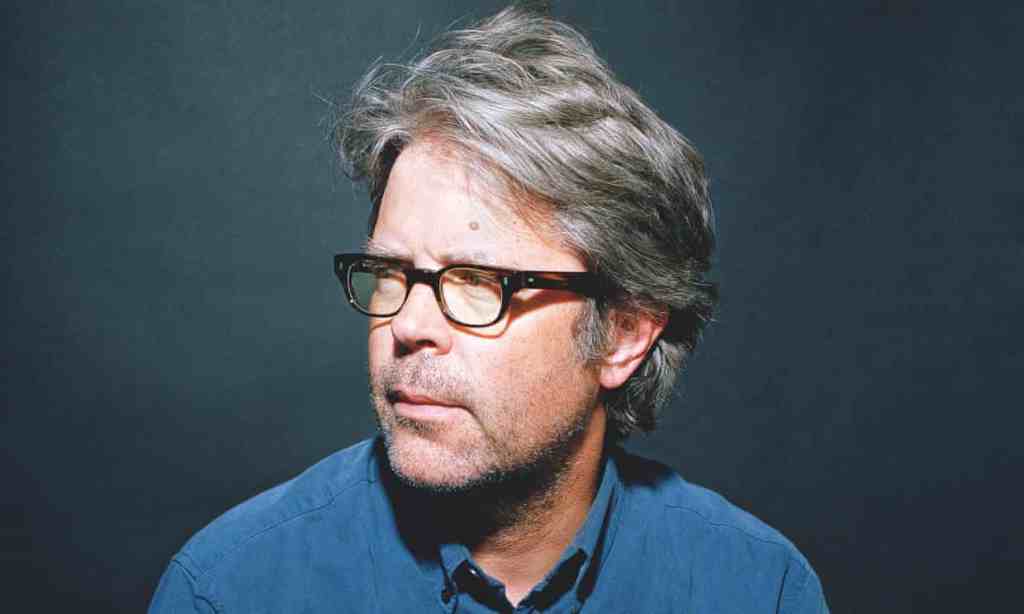
Jonathan Franzen

That you can never know for sure only makes this feeling creepier. Maybe you’re wrong – maybe Philip Roth doesn’t get off on degrading women, not even a little, not even the slightest tiny bit, and it’s a coincidence that it happens in basically every single one of his novels – and you’ve falsely convicted some innocent author, in your mind, of a preference they do not have. It’s a suspicion you can never prove. But what distinguishes this feeling is a certainty that you have learned something about the author, and not about the book.

What I”m trying to say is, I’m a little creeped out by the emphasis on cunnilingus in ‘Purity‘. Normally, I’m very pro, but I’m getting hung up on how much time Franzen spends talking about how much his adult male characters enjoy going down on young women. Very young women.

Maybe it’s just super necessary for the plot that several middle aged guys get an enormous amount of sexual enjoyment from going down on barely-legal women in their care. Oh, yes, in their care, or employ. So, I suppose I should have said: middle aged guys get an enormous amount of sexual enjoyment from going down on barely-legal women over whom they have power.

It’s a whole skeevy thing, and it’s really tainting my impression of a book that I otherwise enjoyed a lot more than I thought it would. I was glued to ‘Purity’, but I kept being yanked out of my single-minded absorption by the awful feeling that I was spying on some private fantasy of Jonathan Franzen’s. Not a fun, sexy one. A yucky one.

Purity‘ is a fun read, it truly is. It made me want to like Franzen more, it made him seem less pretentious. ‘Purity’ doesn’t read like a novel written by a man desperate to prove he’s serious; it reads like a novel written by someone who loves to write novels, and it’s so much more enjoyable.

If it weren’t for the Humbert Humbert thing, this would be a mild rave review, a sort of rave-by-comparison. But the truth is, I remember a lot more about the cunnilingus than I do about the rest of the plot. And not in a good way. And it’s left me with an uneasy feeling. I want to like Jonathan Franzen, but I didn’t want to know that much about him.

Women Talking

By Miriam Toews

ALL POSTS CONTAIN SPOILERS

I think it’s time to have a granular conversation about what it means to ‘like a book’.

The problem is, when someone says that they like a book, they might mean any number of things, alone or in combination.

They might mean that they think that the book represents a technical achievement, that it demonstrates skill or creativity. They might mean that it moved them, that they resonated with something being expressed, or that something of the events being portrayed in the book felt particularly real to them. Or they might have meant that it was super fun, or funny, or exciting, or whatever.

This is why you can “like” Stephen King’s ‘The Stand‘ and “like” Solzhenitsyn’s ‘The Gulag Archipelago‘; those are both true statements that mean totally different things.

And it’s also why we give a sort of extra credit to books that achieve multiple of these ends, books that are fun and humane, or skillful and entertaining. We recognize that we like them in multiple ways, that they have landed points in multiple categories.

But if you can like a book in more than one way at once, it means that it is also possible to like a book in one way and really not like it at the same time, in a totally different way. To like it along one of these axes, and to dislike it, potentially strongly, along another.

Which is how I feel about ‘Women Talking‘.

A little backstory is relevant here.

There is a substantial Mennonite population in Bolivia. In the late aughts, women in the Manitoba Mennonite colony started waking up in the mornings in pain, covered in blood and semen, with rope burns around their wrists. They were told they were imagining it, that they were dreaming, that they were consorting with the devil in their sleep.

Eventually, it was discovered that a group of men in the colony had aerosolized a horse anesthetic and had been spraying it into houses while families were asleep. They were then breaking into the houses and raping the women. Over several years, it is estimated that they raped hundreds of women – eventually, 130 victims were identified, ranging from ages 3 to 60. The men were turned over to the Bolivian authorities, tried, and have been convicted of multiple counts of rape and assault.

This is a true story – these things really happened.

Women Talking‘ is the novelization of one very specific part of this story: the experience of the women.

The men of the Molotschna (a fictional Manitoba) have left the colony to post bail for the rapists. They have done this so that the guilty men can come back to the colony and be forgiven by their victims. Without this forgiveness, neither the men, nor the women they raped, will be able to get into heaven.

Two families of women, three generations each, have gathered in a loft while their men are away in order to discuss what to do. Half of them want to leave, to take their children and flee, run to safety.

The other half want to stay and fight.

Because the women of Molotschna cannot write, they ask August Epp, a former apostate who has returned to teach the children, to write down what they say. August is not a man, not by the standards of the colony, since he has no wife and no children and cannot farm. But he is not a woman, no matter how much he may sympathize with, or love, them. He can only listen, and record, and try to help.

Women Talking‘ is a tough read. It’s kind of a brutal read, actually.

Not in the way you’d expect, or, at least, not in the way I expected. I was prepared to grapple with the horror of what was done to the women (in real life, never forgetting that), but that’s not what ‘Women Talking‘ is about. Not exclusively.

The first thing that the women of Molotschna have to settle among themselves is whether they are people, the way the men are, or whether they are animals, the way the men treat them. It’s a matter of some debate between them, whether they are animals or not. It is not obvious.

This is where the brutality of ‘Women Talking‘ really lies: in the fact that what has happened to the women is the inevitable result of their living in a system which teaches them, and the men around them, that they are not people. That when women are literal objects, the men around them will treat them like objects.

Miriam Toews

It’s hard, as a woman, to read a novel about women trying to see their way to their own personhood. Trying to decide whether it is better to stay in a place where they are raped in their homes at night, where their young daughters will be raped in their beds, or to leave their homes, their husbands, their sons, and set out into a world they don’t understand, where they don’t speak the language. It’s hard, as a woman, to imagine having to make that choice yourself.

It’s a desperate choice, and desperate choices are hard to read about.

It’s also…a little boring to read about.

I know I’m not supposed to say that about a novel about rape. And I know that I’m really not supposed to say that about anything called ‘Women Talking’. And I would like to assure everyone that I feel the appropriate amount of respect and feminist appreciation for ‘Women Talking‘, which is stark and singular and effective and, at moments, really deft and lovely and humane.

But, because of the way that ‘Women Talking’ is written, it’s also sort of…arduous. Let me give you an example:

“Ona speaks: If it has been decided by the elders and the bishop of Molotschna that we women don’t require counseling following these attacks because we weren’t conscious when they happened, then what are we obliged, or even able, to forgive? Something that didn’t happen? Something that we are unable to understand? And what does that mean more broadly? If we don’t know “the world,” we won’t be corrupted by it? If we don’t know that we are imprisoned then we are free?

…Greta Loewan sighs heavily. She says that although we may not be animals we have been treated worse than animals, and that in fact Molotschna animals are safer than Molotschna women, and better cared for.

Agata Friesen reminds Greta that, due to issues of time, we have agreed to abandon the question of whether the women are animals are not.” (p. 39)

It doesn’t exactly zip along, does it?

Look, it’s not supposed to, that’s clear. ‘Women Talking‘ isn’t trying to be the snappy, feel-good book of the year, and I wasn’t expecting it to be. But it did often seem as though ‘Women Talking’ was trying to be deliberately plodding.

Which, OK, I can think of reasons why an author might try to make their book deliberately plodding: she might be trying to show how overwhelmed the women are, disoriented and building a world-view from scratch, for example. To show that, when you must remake your whole self, your progress is slow, is plodding, when you start from nothing. That is a worthy project.

But a project may be worthy and still excruciating to read. And because ‘Women Talking‘ was slightly excruciating to read, I had trouble actually caring about any of the women in it. And it feels as though connecting with what happened to these women (again, can’t say it enough: in real life) was maybe the point? Or at least would have been good?

Women Talking‘ is clearly the work of a capable author, and I’m sure that Toew’s stylistic choices are choices. I appreciated ‘Women Talking’, but I didn’t like it.

Or, rather, I liked it the way you like things which are hard and important, but which you secretly dread having to consume. I liked it in the way of worthy things, not in the way of joyful things. In the way of sheer, awful truths, and not beauty.

But it is true, and for that reason alone, it should be read. A novel needn’t be beautiful, if it’s true.

Rusty Brown

By Chris Ware

ALL POSTS CONTAIN SPOILERS

I’ve never read a graphic novel before.

This isn’t a principled stance I’ve taken – I know the whole spiel about how graphic novels are novels, and they are High Art now, and they are very sophisticated and deal with adult themes. I’m not disputing any of this – how could I? I’ve never read one.

Art evolves, and I’m completely fine with that. I know that sounds defensive, but that’s only because it’s in print, on the internet: I really am fine with that. I have watched completely open-mindedly as the graphic novel has become mainstream and achieved artistic legitimacy. I think it’s a good thing – I think more inclusive artistic definitions almost always benefit the form, and the culture, over time. They accelerate growth.

But I have never read a graphic novel, again, not because I have a problem with them – not at all! – but because…I don’t like them.

I don’t like reading them, and ‘reading’ is the operative word there. I think they’re often beautiful, visually sumptuous and mesmerizing to look at. But I have been reading for a long time, and I am used to the flow of words on a page. On a page that doesn’t have a ton else on it, a page where, if there are pictures (which there almost never are), the words arrange themselves tidily around the pictures and don’t scatter themselves through it.

I find graphic novels a little difficult to read. That may be the point, right? It might be that the difficulty of finding and ordering the words, visually, is designed to make you slow down and look at the pictures. It may be that this actually makes you take in the words more deliberately, makes you pay more attention.

But I do not, viscerally, enjoy the drag on my mind. I am used to ease when reading, total mental comfort. The ability to immerse myself, mentally, effortlessly, in a text, is one of the things I love about reading. It’s almost meditative. It feels like swimming. So I have found the new proliferation of graphic novels amazingly easy to resist.

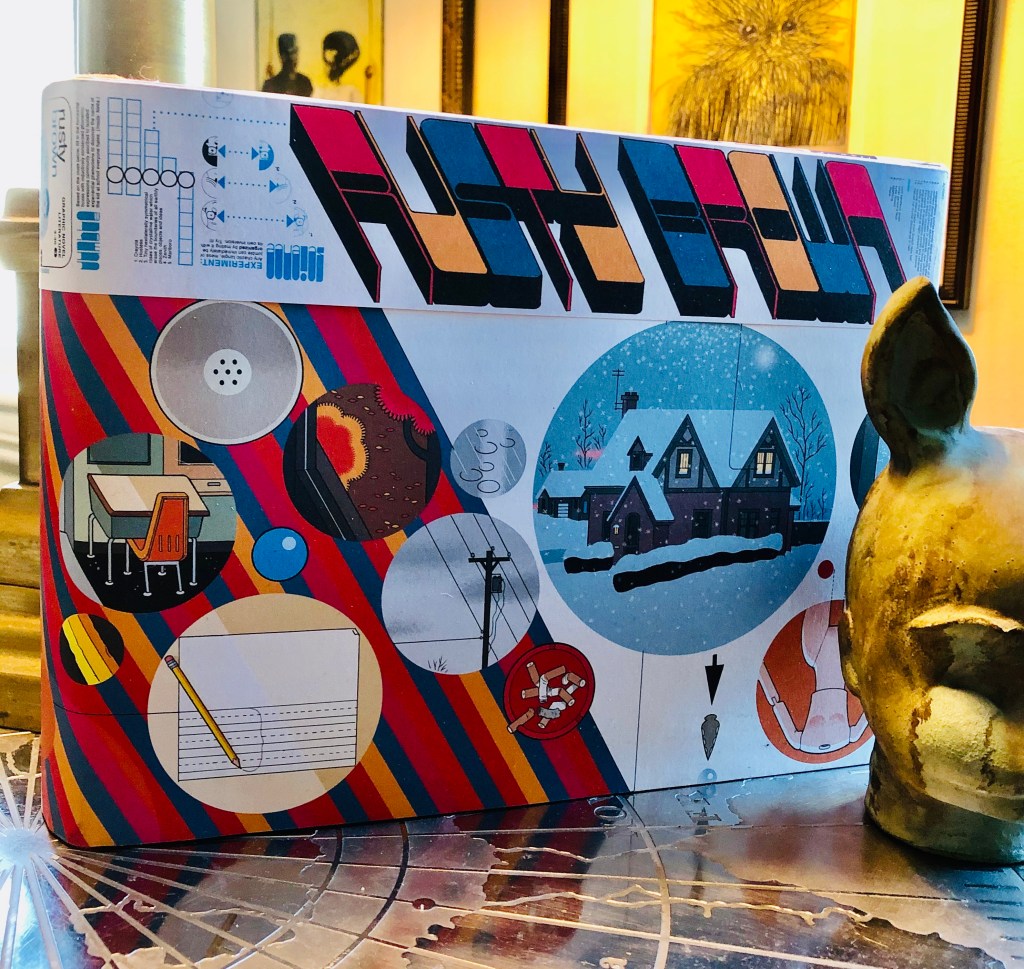
But my mother gave me ‘Rusty Brown‘ for Christmas this past year, explaining (sort of apologetically) that it got really good reviews*. And it is gorgeous, with amazing, complex layouts and lush, arresting pictures. So, the other day, when I was totally fried from work and wanted to try something a little different, I sat down and read it.
*My mother was completely correct, by the way: the reviews for ‘Rusty Brown‘ are ecstatic.

And now I have a question: how am I supposed to feel about this book?

I’m not asking what I’m supposed to feel: happy, sad, existentially frantic. I’m asking how I’m supposed to feel: am I supposed to feel the way I feel about books? The way I feel about visual art? The way I feel about movies?

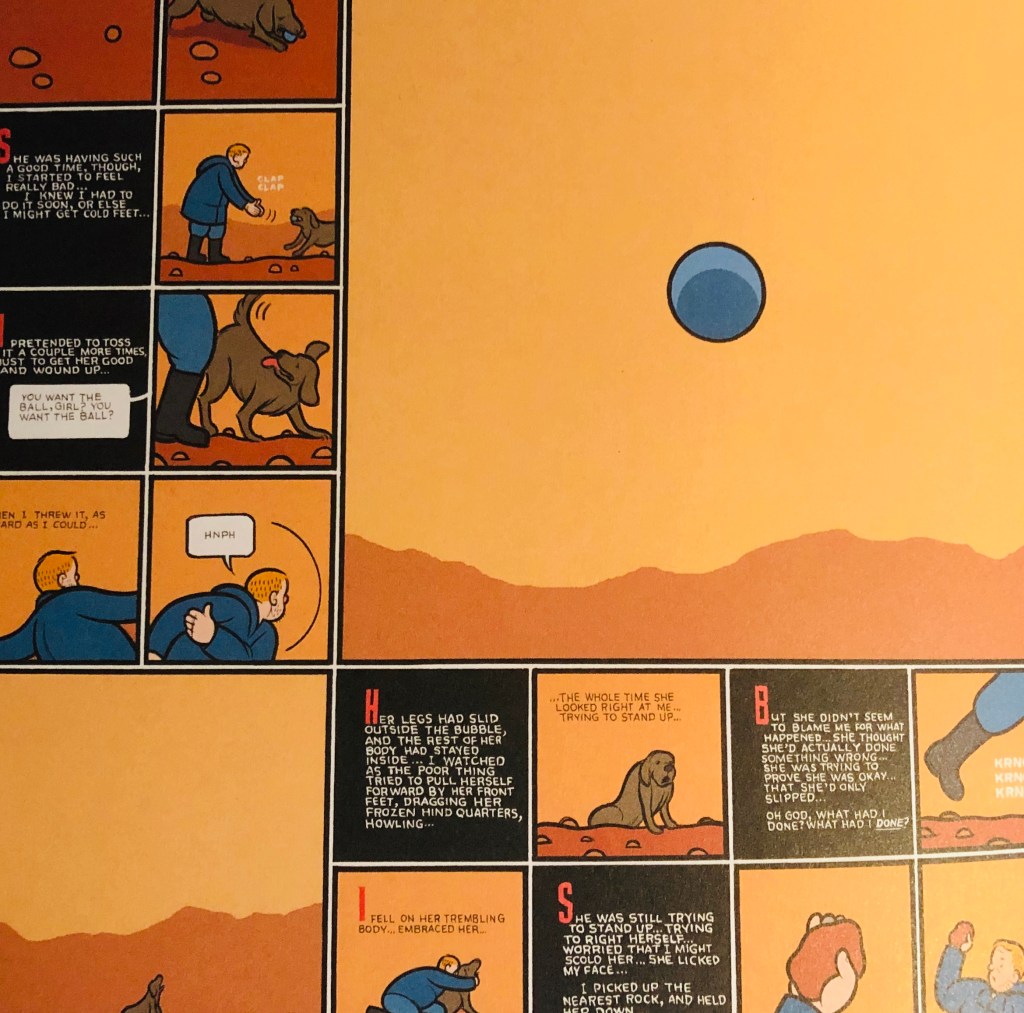
Rusty Brown‘ is a story, it’s a narrative; it has characters and a plot (sort of), a lot of which are communicated through the written word. In this way, ‘Rusty Brown’ is a book. But it’s so visual – the story, plot points and character elements, as well as overall mood, are all communicated visually. In this way, it is like a movie.

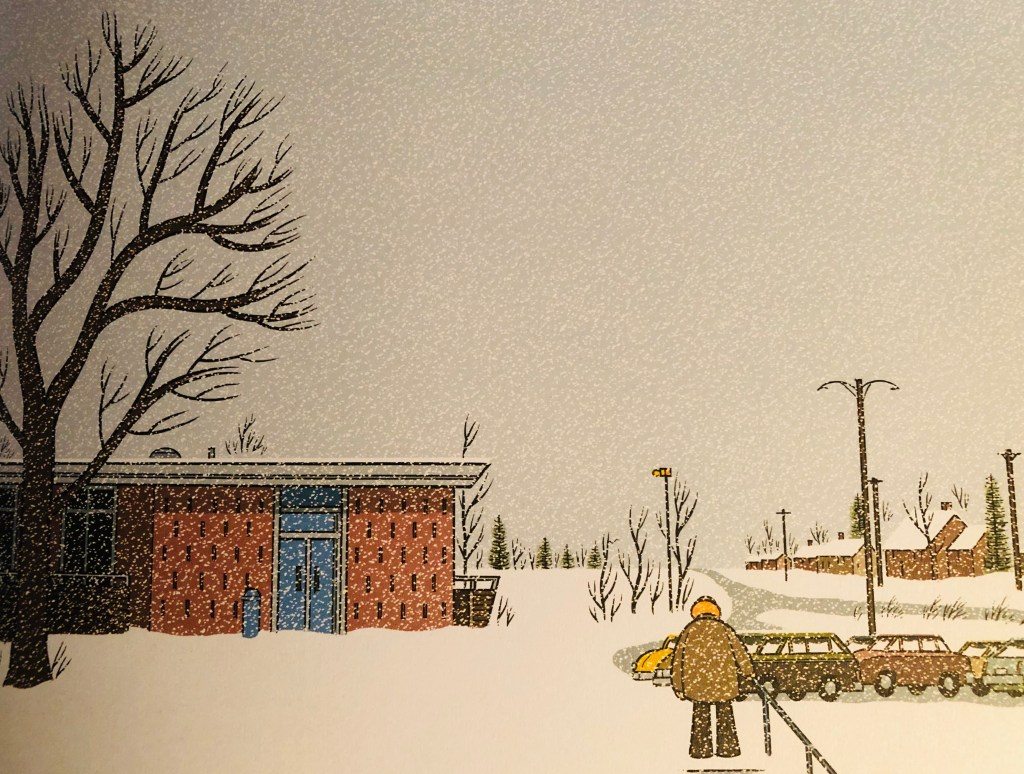
And some panels are so stunning that you stop, and stare, and react to them just as pictures. They are moving, desolating, some of them. They almost all involve snow.

I can see why ‘Rusty Brown‘ received such incredible reviews. The pictures are incredible, moving back and forth between schema and detail seamless, laid out so inventively that they are almost mobile. They communicate shock, grief, the grinding passage of time, profound alienation, vast, existential bleakness.

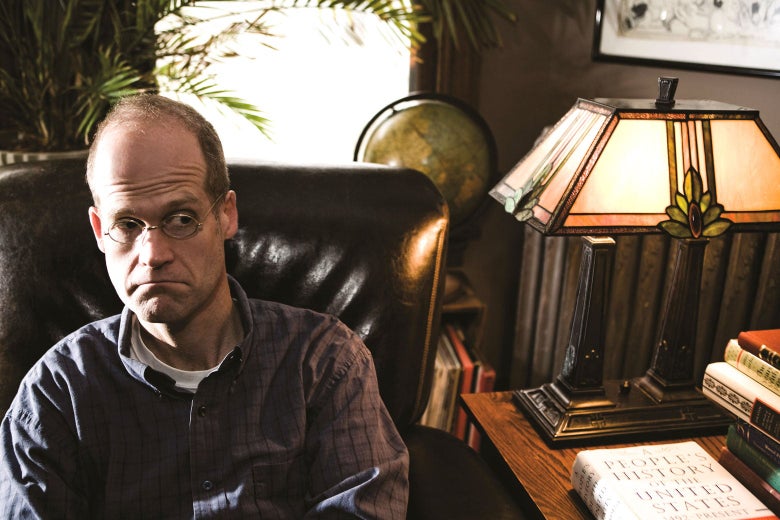
Chris Ware

In fact, most of the emotional content of ‘Rusty Brown‘ is bleak. It is the story of several lives which meet around a middle school in Omaha, Nebraska. This is what I mean when I say it has a plot, sort of: it actually has several plots, or rather, several lives. It’s about an intersection – it doesn’t have a climax. It’s about the rich, complicated human context that lies underneath even the most ordinary moment, in the most ordinary place. It asks you to consider how long the journey has been that has gotten you here, has gotten everyone here, how much everyday time, everyday suffering, has accumulated underneath each and every one of us.

So it doesn’t really have a plot – it has a tone. To quote the New York Times, “Though there are a couple of perverts (and possibly a criminal), his characters aren’t people of wealth, power or energy; they’re self-conscious, often inarticulate, trying to break free of the mundane or anesthetize themselves to it. The characters weave in and out of the 113-page opening sequence, which dissects a single day at a Midwestern school in the 1970s, with its smell of “spilled teacher’s lounge coffee, old milk, formaldehyde and lip gloss and hot lunch.”

Each of the characters is lost, alienated, lonely. The children are awkward, afraid they won’t fit in. The adults are aging, fading, their youthful dreams lost, their bodies unrecognizable. Everyone is miserable. Or, to quote The Guardian, “The remaining narratives display a shared concern with regret and ageing, anxiety and ennui (there’s a lot of repetition and masturbation), the sense of lives being missed for a combination of factors, from parental neglect to racial intolerance. The book poses essential questions about the formation and hardening of character: what limits our chances of happiness or fulfilment? How do behavioural patterns form? And why are they so hard to break?”

It’s kind of a lot: a big book about the grinding alienation of life, hard to read, emotionally bleak. It’s a masterpiece, but, like many masterpieces, it’s impressive rather than fun. I am impressed; I am also really, really glad that the book is over.

It’s a rough thing to think about how hard, how much quiet suffering the people around you are carrying around. Beautiful, bleak pictures make it both easier and harded to connect with material like this, at least for me. Pictures are vivid, yes, but they are less vivid than my imagination, and the pictures relieve me of the need to imagine.

Is the entire genre the same emotional gray of ‘Rusty Brown‘? In my imagination, all graphic novels are beautiful and dismal, and I’m sure that’s not right. I feel contaminated by this novel more than I understand it, laid low and blue. It was really, really good, there’s no way to miss that, but it’s hard, and strange. It’s grand, and sad, and lovely, and cold. It’s pretty magnificent, but in a way that leaves you more lost than when you started.

Ultimately, it’s hard for me to mentally file ‘Rusty Brown‘ as a ‘book’ in my mind. The experience is more like a movie – the parts of it which are the most moving are the visual parts, not the words. It doesn’t elicit book-feelings – it elicits movie-feelings, photograph-feelings.

So, I think I want to read another graphic novel.

Maybe this sounds weird, but I have a sneaking suspicion that I won’t be able to figure out how I feel about this form until I read some more. Different kinds of graphic novels, not just this sad, magnificent one. I’d like to read a funny one, a sweet one, and a violent one. And probably about eight sexy ones.

My Sister, the Serial Killer

By Oyinkan Braithwaite

ALL POSTS CONTAIN SPOILERS

“All he wants is a pretty face. That’s all they ever want.” (p. 69)

There’s an idea (which I’m not sure that I totally believe but whatever) that you can only write what you know. And even if I don’t totally believe that that’s 100% true, it certainly makes sense that writers will be able to paint a clearer picture of something which they themselves have seen, describe more accurately something which they themselves have felt.

Which means, I’m afraid, that if you want to read about women’s rage, the deep, seething fury of women against men, you really ought to be reading things that women wrote.

I’m not sure that I would have described myself as wanting to read about women’s rage, but I have found that I resonate with books about it, that I recognize them and am interested in them. I resonated withDietland‘, another novel about the violence of male priorities and disproportionate female response to them. I think everyone resonated withThe Power‘, another revenge novel of female violence (actually, there have been kind a lot of these lately, huh?)

Korede and Ayoola are sisters. Korede is older: responsible, cleanly, fanatical about order and planning. She can cook and maintain a household. She is about to be made head nurse at the Lagos hospital where she works. She walks, virtuous and lonely, through her life, taking care of the sick. And she is in love, from afar, with Tade, the handsome doctor she works with. The only person in whom she feels she can confide is a coma patient in her ward.

Ayoola is beautiful. She has the kind of beauty that causes the men around her to behave like complete idiots. She has no job; rather, she designs clothing that she models on Instagram. She is the favorite of their mother, the favorite of every man in the Lagos area, the favorite. She is bright and funny and charming and brave and the world loves her.

She has also murdered her last three boyfriends.

Each time, Korede has helped her hide the body, wash away the evidence. Each time, she has believed Ayoola when her sister told her that the killing was done in self-defense. And though it has become harder to believe each time, she has continued to keep her sister’s secret.

Until, one day, Ayoola comes to visit Korede at the hospital, and snares Tade, the doctor whom Korede has loved for so long. And Korede, with her heart broken, has to decide whether Tade, whom she knows would never hurt a soul, is safe with her sister, or whether her sister might be a much different animal than she has allowed herself to admit.

I spent most of ‘My Sister, the Serial Killer‘ thinking that the story was pretty fucking obvious. This isn’t to say that I didn’t enjoy it – quite the contrary. The book is written in a wry, spare voice and parceled into short chapters with snappy titles (some of which are so short as to almost qualify as brutal prose-poems), the combined effect of which is suspenseful and almost bizarrely readable. This is the writerly voice that Bret Easton Ellis wishes he had.
But I thought I knew exactly what story I was reading, and I was wrong (this happens to me a lot, and I never, ever learn). I thought that this was a story about a woman facing the fact that her sister is a monster, about watching the evidence pile up and trying not to see it, but eventually confronting it when someone innocent, someone else she loves, is threatened. A pretty basic, totally fun story.

“Ayoola is wearing dungarees – she is the only person I know who can still pull those off – and she is licking ice cream, probably from the parlor around the corner. She pauses the licking, not because she is moved by Peju’s words, but because she is aware that it is proper to pause whatever one is doing when in the presence of someone who is grieving. I spent three hours explaining that particular etiquette to her one Sunday afternoon.” (p. 161)

That’s not what this story is. This is one of those stories where there isn’t only one monster, and the question that Korede will eventually have to answer isn’t whether or not her sister is one. It’s whether, in a monstrous system, there are any heroes. Whether men are capable of loving, really loving, a woman for who she is, and, if they aren’t, then whether they are worthy of being loved at all. And if they aren’t, if you cannot love men, who do you love? Whether, in a world where men will always objectify, use, and abandon you, the only real love that exists is the love between women. Whether the only love that lasts is family.

Ayoola is not the monster of ‘My Sister, the Serial Killer‘, despite the fact that she is a serial killer. The monster is Tade, the kind man who, at the end of the day, can only love a woman for her beauty. Who cannot be turned from beauty even if it means saving his friendships, or his life. Who believes that his love is sincere, premised on deep connection, while it is in fact only a response to how a woman looks in a skimpy dress. Who will forgive anything (literally, anything) in the woman he loves except ugliness.

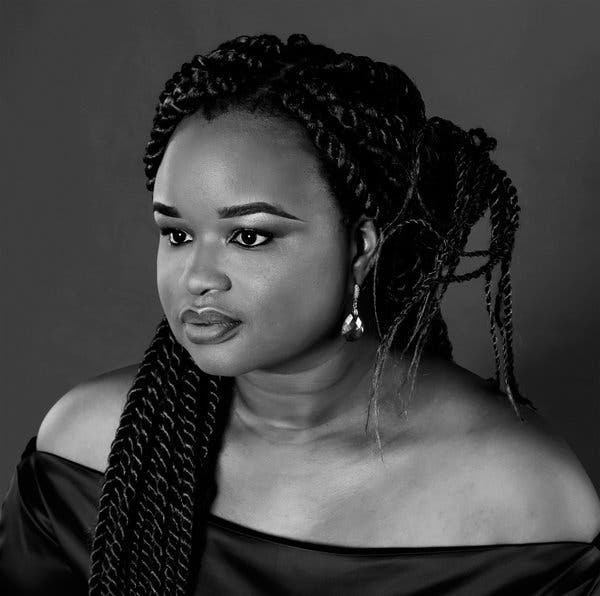
Oyinkan Braithwaite

I love stories like this, stories where the serial killer ends up not being the bad guy. Although, of course, that’s an over-simplification: Ayoola is a very bad guy. But, at the end of the day, she is all that Korede has. And, Braithwaite seems to ask, what did you expect Ayoola to become? Brutalized by her father, every man she has met since has let her get away with anything she wanted, as long as they got to treat her like a beautiful thing. Why should she treat men as though they were people, when they have never, ever, done the same for her? Just because you worship an object doesn’t mean it’s not an object.

It’s a really good question, actually. I spent most of ‘My Sister, the Serial Killer‘ rooting against Ayoola. I think I was supposed to: she’s a gorgeous, gold-digging, man-stealing serial killer. It’s pretty breath-taking that Braithwaite can take you from really hating Ayoola (the way you can only hate a man-stealer) to understanding why we will always choose her. Why we, as women, have to always choose her.

It’s especially impressive because Braithwaite accomplishes this emotional allegiance-shifting without ever declaring anything. There are no manifestos here, no pedantic speeches or feminist rah-rahing. All you as her reader experience is the world through the eyes of one woman, Korede, and you and Korede must realize together why she is angry and at whom. Korede is angry because she isn’t beautiful, you both knew that, but you must realize together that being angry at Ayoola because she is doesn’t make any sense. Because the only reason that it matters, Ayoola’s beauty, is because men are too base, too primitive, too shallow, too evil, to see anything else.

At the end of the day, ‘My Sister, the Serial Killer‘ is about who deserves our care and who doesn’t. And, in a cold, dark world, we cannot afford to extend care to those who do not care for us, who do not honor our essential humanity. And in Braithwaite’s world, men, be they ever so handsome, ever so kind, be they doctors even, do not care for us. They do not honor our essential humanity if we are not beautiful, because they don’t see us. And they don’t see us if we are beautiful, because then our beauty is all they see. And if they cannot care for us, then we should not care for them. We must care then, as sisters, for each other, even if we are beautiful.

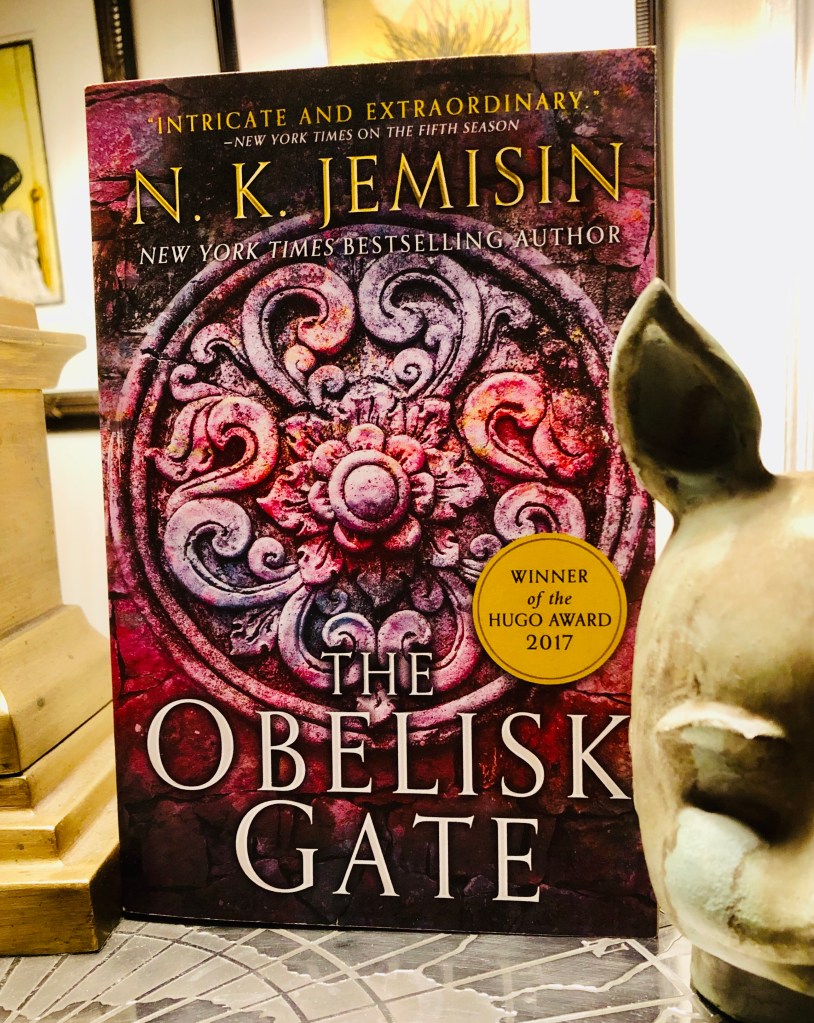
The Obelisk Gate

The Broken Earth: Book Two

By N. K. Jemisin

ALL POSTS CONTAIN SPOILERS

So, now I’ve had some time to think.

Sometimes, when you’re flying through a book, you don’t stop to think about why you’re loving it so much. This is especially true with plotty books – you don’t need to think about why it’s working, you can just lie back and enjoy the ride.

But it’s a worthwhile exercise, once you pause for breath. And I had a busy week at work, and so was forced to spend time NOT reading ‘The Broken Earth Trilogy‘ trilogy, and so I thought about it.

I want to be clear: this pause was not voluntary. I need to work to eat; otherwise, I would have chewed all the way through the series without washing or sleeping. But, like I said, it was a busy week, so I only just now finished ‘The Obelisk Gate‘, the second book in ‘The Broken Earth Trilogy‘ series.

And I know that ‘The Obelisk Gate‘ is technically a separate book, but the entire series really reads like one book, one story, and I am only taking the time to stop and write about this installment for the sake of personal discipline. So, for coherence, I will probably refer to the trilogy as a single work, which it clearly is.

And I’ve been thinking a lot about why the trilogy is so good. And…

I don’t know.

The Broken Earth Trilogy‘ trilogy is about a world that is ending. And I suspect that, like all stories that are about the world ending, it is really about the evil which people do, which comes out of us naturally, inevitably, like breath. About the primitive, tribal cruelties that we perpetrate, in all times, all places, when we are frightened.

There’s a question I wonder sometimes: do you have to understand a novel to love it?

There are two ways to say what a novel is about. Let’s take an easy one: what is ‘The Scarlet Letter’ about? Well, technically, it’s about a woman being punished for adultery through sartorial intervention.

But, obviously, that’s not what it’s really about about. ‘The Scarlet Letter’ is about sin, and guilt, and hypocrisy. It’s about how God is all-knowing and all-loving and we are not, and so when man’s law tries to approximate God’s law, the discrepancy will necessarily result in injustice. It’s about humility.

See what I mean? There’s about, and then there’s about about.

I know what ‘The Broken Earth Trilogy‘ trilogy is about. Jemisin is a clear, effective writer, much more than most science fiction or fantasy writers. Even when she is describing things which are actually beyond description, she is never hard to follow or understand. She’s really good.

But I am not at all sure that I know what this trilogy is about about.

On the most superficial level, ‘The Broken Earth Trilogy‘ trilogy is an allegory about racism and xenophobia and otherness. It’s about human cruelty, and about whether we are capable of preserving our humanity, our ability to be kind to the other, when we are desperate, or in danger, or facing extinction. And the fact that this allegory is obvious a) doesn’t mean that it isn’t a valuable metaphor (it isn’t as though we’ve solved this problem, so, by all means, let’s keep working it through in prose) and b) doesn’t mean that it’s all that’s going on in these novels.

I also suspect that it is about about climate change. Bear with me: the premise of ‘The Broken Earth Trilogy‘ trilogy, tectonically-speaking, is that humans, at the acme of their civilization, committed an act which so permanently destabilized the earth’s crust that it threatens the survival of everything on it. This is understood by all living human inhabitants of the earth as its revenge, that the earth is essentially, permanently, hostile to human life. That seems pretty clear to me.

But the problem with explicating allegory is that it makes the work seem preachy, or academic, or pedantic, and that is emphatically not the case here. In fact, the lack of pedantry is partly why I’m having trouble discerning the allegory.

So, am I allowed to love a story without understanding the allegory?

Obviously, the answer is yes – I can enjoy it any way I want. I can even enjoy it while totally misunderstanding the allegory. But (and honestly, this may be wrong) I think that understanding the allegory makes the experience of the books richer. And I know that this makes me sound like a complete nerd, but I am a complete nerd, and I really do enjoy a book more when I understand not only the story, but also the other stories which the story is referencing, the moral questions it is obliquely pondering, the historical events which it is recapitulating. They make me appreciate the story more, the skill of its writing, the depth of its thought.

And when you know, or suspect, that a story has these extra layers, and you aren’t quite getting them, it’s disorienting, like when you fall asleep in the middle of a movie and miss a whole bunch of plot. You might technically understand the ending, but can you say that you really understood the movie?

Not really, and so I don’t feel like I can say that I understand ‘The Obelisk Gate‘, and it’s making me feel very insecure, because I really, really like it. I want to understand it, and so I’ve been thinking about it.

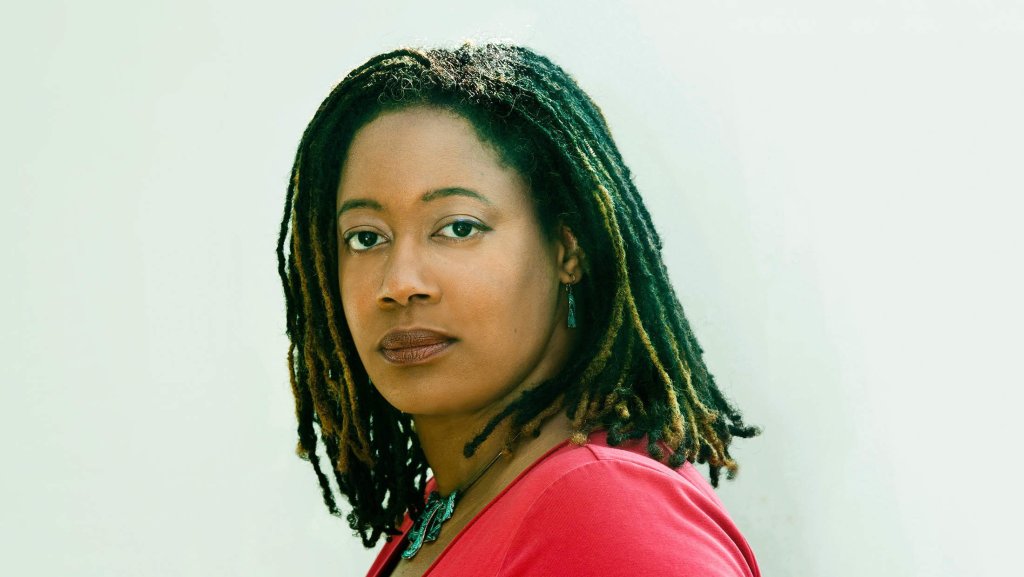
N. K. Jemisin

One of the most salient threads which runs through the first two novels of ‘The Broken Earth Trilogy‘ is that our fundamental selves are revealed through our treatment of our children. This is true on the level of the society as well as on the level of the individual. Children are a major, major part of ‘The Broken Earth’ books – love for them, grief for the loss of them, rage at the people who hurt them.

And cruelty to children winds through the books. There is an idea which pervades the entire trilogy (so far) that, in health, children are loved and cherished, protected and cared for. It is only in sickness that we allow them to be tortured or mutilated, abandoned or killed.

Earth has become a sick place, and the question which Jemisin is asking is, is it possible to be a healthy person in a sick place? Can you bring children into a sick world, raise them in a sick society, love them healthily when you cannot truly keep them safe? When the society in which they will grow up might abuse or murder them, use them or break them? When the very earth on which they walk might drive them and every one they love to extinction at any moment?

What does parental love even mean in that context? Parents love their children, ideally. Parents will do anything, risk anything, for their health and happiness – what does that mean in a world where health and happiness are impossible? What happens to love in a world like that?

It curdles, turns inward into rage, becomes destructive, deadens. Twists and becomes murderous in its turn. Even love becomes impossible, in a sick world.

Now that I think about it, this is kind of what ‘1984’ is also about. Actually, this is exactly what ‘1984’ is about: the idea that in a totalitarian society, even love, even private, romantic love, is impossible, because there is no private space for a human heart to have something normal and good, like love.

And, in ‘The Broken Earth Trilogy‘ trilogy, that’s true of parents, too: on a hostile earth, where we are threatened at every turn, where constant fear and danger have made us base and mean and vicious, we can’t even love our children. Because loving children is hopeful, and hope requires a future, and in a world with no future there’s no way to love them – it’s too painful.

I know that I’m not making ‘The Obelisk Gate‘ sound fun – I’m probably making it sound like the world’s bleakest book about parenting. It is fun, in a bleak, scary way. It’s one of the most absorbing books I’ve read in years, and, as I mentioned last time, I honestly just resent the time I have to spend here, writing about it, instead of thinking about it. It’s so, so good.

The Monster of Elendhaven

By Jennifer Giesbrecht

ALL POSTS CONTAIN SPOILERS

“Florian dipped gingerly, right at the sodden border cut by the tide, and plucked out a stone: perfectly round, an inch in diameter and opalescent in sheen. He held it aloft for Johann’s benefit. “The oldest stories of the North called these rocks Hallandrette’s Roe. She lays her clutch along the beach, and protects them from the destructive hands of mortal beings.” Florian turned on his heel and pitched the stone at the cliff-wall as hard as he could. It bounced off the slate harmlessly. “See? Hard stone. Unbreakable.”

Johann frowned. “How do you crack one open, then?”

Florian smiled, secretive. “A privilege reserved for Hallandrette’s chosen. When a wretched child, one wronged or wounded deep in the soul, throws what they love most in the ocean they may cast a roe against the stone and a hallankind will be born. Keep the stone in their pocket and the Queen sends to them one of her children.:

“A friend for the lonely soul.”

“A companion,” Florian affirmed, “made from the same dark matter that coats the bottom of the Nord Sea. A hallankind will love that wretched child as a brother or sister. They will drag whoever wronged their brother-sister-friend into the sea and wring them through the spines of their mother’s baleen until they are foam and sea particle, forgotten in the cradle of her belly.” (p. 52).

Maybe all stories are love stories.

OK, not ALL of them – it’s difficult to describe, oh, ‘Heart of Darkness’ as a love story – but it’s surprisingly hard to come up with a story that isn’t, in some way, a love story.

The trick of it is to understand that love stories sometimes come hidden in unlikely disguises. All sorts of people have love stories who don’t look like they deserve them. Broken people, evil people, sad people, rude people, angry people, all sorts of morally unphotogenic people who nevertheless occasionally find themselves looking for love, feeling love, or acting out of love.

In some ways, those are our favorite love stories. Maybe it’s because they are more suspenseful, since we aren’t sure that the characters in them will find love. Maybe it’s because they are more ambiguous, since we don’t know whether we really want them to find love. Or maybe it’s because they feel truer, since very few of us feel 100% certain that we deserve love.

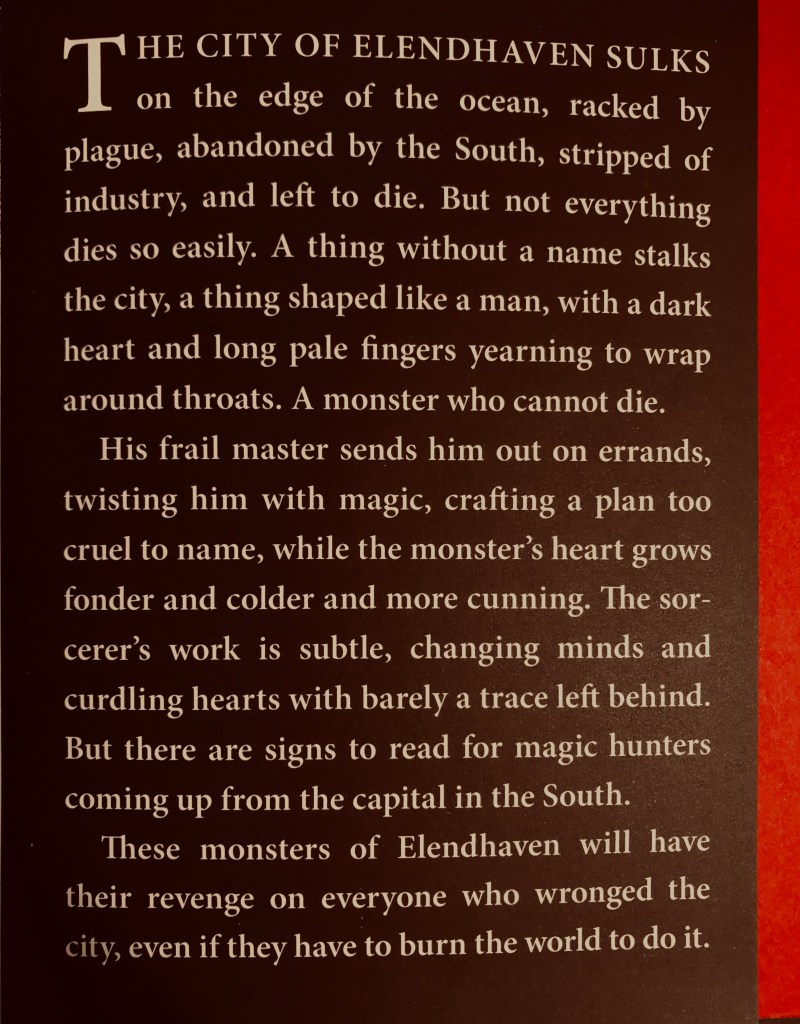
The inside jacket cover of ‘The Monster of Elendhaven’

When I saw ‘The Monster of Elendhaven‘ in a bookstore the other day, I didn’t think it was a love story. It doesn’t look like a love story. I’m not sure why I bought it – I’m not in the habit of purchasing books of unknown provenance. But the cover was creepy and the description was even creepier, and I was on a mini-vacation, so I bought it.

Elendhaven is failing industrial city on the northern edge of the map. A hideous accident generations ago has left the ocean poisoned and black. The ancient noble families of Elendhaven have fallen into poverty and the magic that was the source of their power has been outlawed.

Johann does not know who he is or where he came from. All he knows is that he used to be nameless, unloved, born of darkness, until he decided to call himself Johann. He tends to slide off people’s attention, unremarked and unremembered by anyone who meets him. And he can’t be killed, at least not permanently.

And he knows that he likes to kill people. Johann is an accomplished killer – a monster, in fact – who stalks the streets of Elendhaven taking whatever he wants and killing whomever had it.

One night, Johann chooses to rob Florian Leickenbloom, the last living member of the once-magnificant Leickenbloom family. Florian is a small, beautiful man who also happens to be, as Johann soon learns, a sorcerer. Orphaned as a child when the rest of his family was killed in a plague, Florian lives in hermitish seclusion, planning his revenge. And instead of killing him, Johann will fall in love with Florian, and help him realize his terrible plan.

I don’t know if it’s more or less beautiful when a monster loves another monster. But something I respect about Giesbrecht: her monsters are really monsters. They are ugly and evil; they hurt people and they enjoy it. They even hurt each other, and because they have lived lives characterized by pain, cruelty, and rejection, this is part of their love.

The Monster of Elendhaven‘ is gory, viscerally and explicitly gory. It’s creepy, and sexy, and kind of funny, and sad. It’s also romantic, I think?

Romance is not my strong suit, so I might be wrong. It’s also not my favorite genre – I actually have to leave the room during proposal scenes in movies, because they make me so uncomfortable. But, as far as I understand it, romances are stories in which two elements complement each other in a way which makes each feel as though things about them which had been wrong or missing are, in fact, purposeful and right.

This is why this they are powerful for us. We’re all missing pieces, or rough along an edge or two, crumpled where we should be smooth, and romances provide a reason for those traits: those are things which make us ourselves, so if someone loves us, then the self that we are is the right self, and therefore those things are right, too. Love justifies our pain, and our mistakes – it is the forgiveness from the world we need to forgive ourselves.

Jennifer Giesbrecht

And that’s why the romances of monsters are the most revealing romances of all: they are the far-out test case, the most extreme example. They are interesting, yes, monsters are always interesting, but it’s more than that: they are the limit on the possible. And you know you fit comfortably within their limit, and so you know that your experience, your romance, your love, will fit comfortably within theirs.

I wonder if I am the only person who read ‘The Monster of Elendhaven‘ and thought about love the whole time. I’m definitely not the only person who noticed it was a romance, but I might be the only person who thought it was a lovely romance (rather than a horrific one). That there is something beautiful about the idea of an abandoned little boy raging at the world, calling a monster forth from the ocean who will love and avenge him and who cannot die the way his family did. Who can therefore never leave him alone. In the idea that, if we are monsters, the world might provide another monster to love us, to make us whole.

Because maybe only a monster can truly love another monster.

It’s like there’s a whole other world, full of weird, creepy people (which I definitely am), and we get a whole different, creepy literature. But just because we’re weird and dark doesn’t mean that we don’t have feelings – it just means that our feelings are creepier and weirder than other peoples. And ‘The Monster of Elendhaven‘ is a romance for us.

Maybe that’s a weird reaction. But such a weird little book deserves a weird little reaction. ‘The Monster of Elendhaven‘ is a book about revenge and hate and gruesome death, and I thought that it was super romantic, but not in the way I hate – in a way I kind of loved. It’s the most romantic murder book I’ve read.

At least this year.

The Luminaries

By Eleanor Catton

ALL POSTS CONTAIN SPOILERS

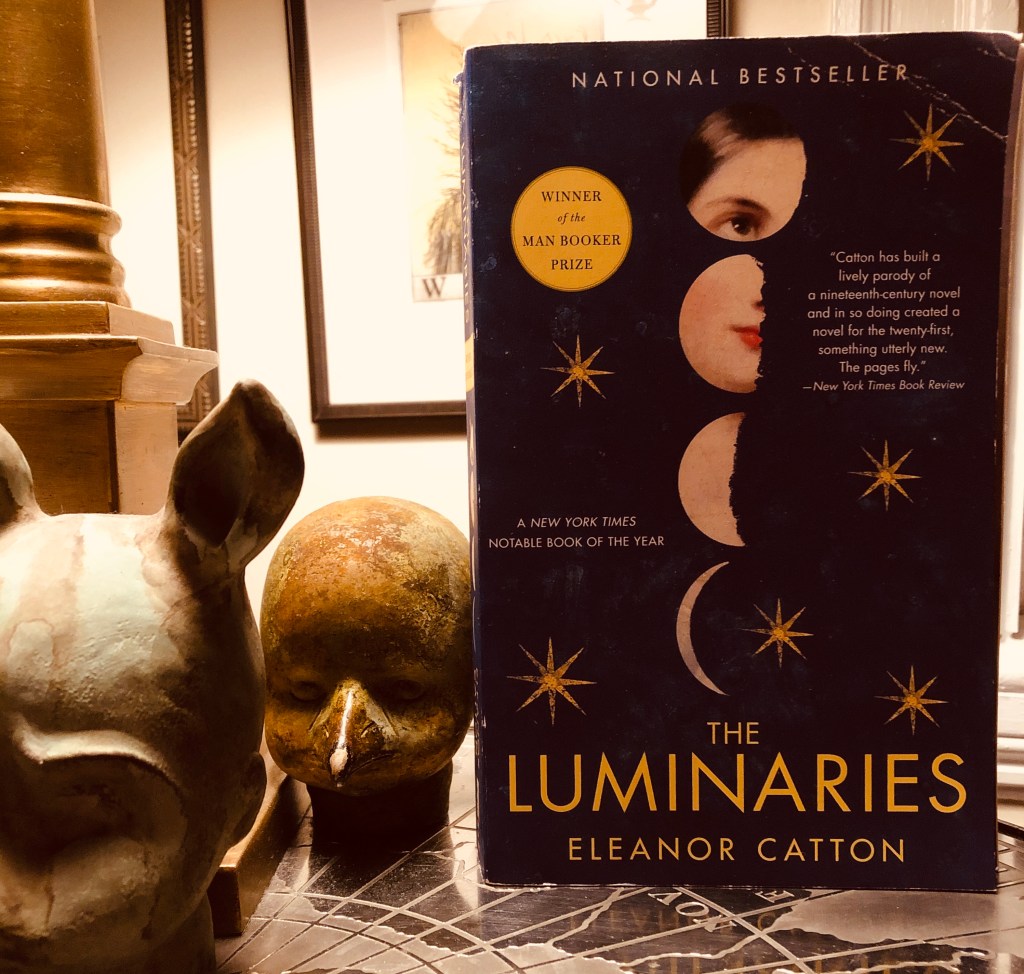
I was in the Harvard Bookstore a little while ago (which, like, I know I mention it a lot, but I spend a totally normal amount of time in bookstores, not a weird, excessive amount of time, at all…), sort of wandering around the Fiction and Literature section, and I noticed a very pretty book with a bright blue cover and yellow letters.

It was called ‘The Luminaries‘, and I had never seen it before, and it was a big book, a hundreds of pages, and the weirdest part: it had won the Man Booker prize. It won the Man Booker in 2013, when I was hypothetically paying attention.

To be clear: prizes aren’t that big a deal. Prizes are merely the opinions of people, and so, like other opinions of people, they are a mixed bag. Some are better, some are worse. As prizes go, I like the Man Booker, especially since they expanded eligibility to include all English-language novels. A prize is never a sufficient reason to read a book, but I think the Man Booker people reliably choose good and interesting books – I’m almost never left scratching my head over a Man Booker winner (which is NOT something can be said of the Pulitzer).

A prize is never a sufficient reason to read a book, but a Man Booker AND a really pretty cover? Why not?

So I bought ‘The Luminaries‘.

The Luminaries‘ is a murder mystery set in a gold rush town in the 19th century. En route to strike it rich in New Zealand’s gold rush, Walter Moody sees what he can only conclude is a ghost in a the hold of his ship the night before he makes land. Having a drink to calm his nerves in the smoking room of his hotel, he finds himself in the middle of secret meeting of local prospectors who have gotten together to puzzle over several strange, recent events.

Another local prospector, Crosbie Wells, a hermit working a useless claim, is found dead in his cabin, apparently of natural causes. However, when his cabin is examined, a fortune in pressed gold is found there. The richest man in town, Emery Staines, is missing. A prostitute, Anna Wetherell, has just tried to end her own life. And a gubernatorial candidate, Alistair Lauderback, seems to be in a dispute with the man who owns the very ship that Moody sailed in on. And the men in the smoking room of Moody’s hotel believe that all these events are connected.

If that sounds ornate and gothic, it is. Eleanor Catton has written a Victorian gothic novel, and then twisted it into something modern. She is clearly a student of the form – she clearly loves it – but her perspective is contemporary, and female.

She’s also a phenomenal writer. She’s got the gift of all great storytellers, the power of telling stories that make you completely forget that you’ve been sitting in your comfy chair in your jammies for two hours without moving and you can’t remember the last time you felt your legs and you have to pee. She has a particular gift for characterization: her character descriptions rise to the level of genius. They are complex and lovely and true-feeling, characters who seem somehow familiar while at the same time seeming unlike anyone you’ve ever met, someone utterly new and yet resonant.

“Walter Moody was not superstitious, though he derived great enjoyment from the superstitions of others, and he was not easily deceived by impression, though he took great care in designing his own. This owed less to his intelligence, however, than to his experience – which, prior to his departure for New Zealand, could be termed neither broad nor varied in its character. In his life so far he had known only the kind of doubt that is calculated and secure. He had known only suspicion, cynicism, probability – never the fearful unraveling that comes with one ceasing to trust in one’s own trusting power; never the dread panic that follows this unraveling; never the dull void that follows last of all.” (p. 18)

Eleanor Catton

“Shepard’s autobiography (a document which, if ever penned, would be rigid, admonishing, and frugal) did not possess that necessary chapter wherein the young hero sows his oats and strays; since his marriage, his imagination had conjured nothing beyond the squarish figure of Mrs. [Shepard], whose measures were so familiar, and so regular, that he might have set his pocket watch by the rhythm of her days. He had always been irreproachable in his conduct, and as a consequence, his capacity for empathy was small.” (p. 135)

“Quee Long was a barrel-chested man of capable proportions and a practical strength…The gaps in his smile tended to put one in mind of a child whose milk teeth were falling away – a comparison that Quee Long might well have made himself, for he had a critical eye, a quick wit, and a flair for caustic deprecation, most especially when that deprecation was self-imposed. He painted a very feeble picture whenever he spoke about himself, a practice that was humorously meant, but that belied, nevertheless, an excessively vulnerable self-conception. For Quee Long measured all his actions by a private standard of perfection, and labored in service of this standard: as a consequence he was never really satisfied with any of his efforts, or with their results, and tended, in general, toward defeatism.” (p. 258)

Maybe you didn’t think that the world needed an 800-odd page modern satire of a Victorian gothic murder mystery set in New Zealand and peopled with breathtakingly well-written characters – you were wrong. And here’s why:

Those old stories had one great virtue: they were entertaining. They were fantastically entertaining, which is perhaps the greatest virtue a story can have. But Eleanor Catton understands something about them: that underneath the entertainment they provided, those old stories missed so much about what was important about the world which was their setting.

They missed the lives of all the invisible people: all the poor people, the immigrants, the slaves, the ill, the whores, the women and children. All those people who just provide texture, color, to those old stories, who are just scenery. And that, even though those people never starred in those stories which we love, they were real, they had lives and feelings and hopes and griefs. And that, in any real world, they would also have stories.

And so she has written them in, not in an obnoxious, heavy-handed. PC sort of way, but the way the ought to be written: as a true and proper part of the world. And then, in the end, she reveals the whole point: that under the labyrinthine twistings of the plot, under the mechanisms and mysteries and villains and ghosts and buried treasures (and all those things are there, in this story), those humans, their human stories, were the point all along.

The Luminaries‘ is a love story which you don’t know is a love story until the very end. It’s a novel that reminds you that murders and thefts and betrayals and winfalls are all events that might happen in a life, but that the life is all that really matters. It’s engrossing through out, gorgeously written, sharp and funny, but, in the end, it’s beautiful, and I loved it.

Normal People

By Sally Rooney

ALL POSTS CONTAIN SPOILERS

“If people found out what he has been doing with Marianne, in secret, while ignoring her every day in school, his life would be over. He would walk down the hallway and people’s eyes would follow him, like he was serial killer, or worse. His friends don’t think of him as a deviant person, a person who could say to Marianne Sheridan, in broad daylight, completely sober: It is ok if I come in your mouth?” (p. 28)

There’s a well-worn bit of folk wisdom, that the body knows what it needs. That if you’re iron-deficient, you’ll develop a sudden, strong hankering for, like, kale. Or if a cold is about to come on and you need the immune boost that vitamin C provides, you’ll suddenly crave oranges. That your body can sense its own mineral needs, and translate these needs into food desires below the level of your consciousness.

Ok, sure. Why not? The body is smart.

I wonder, though, whether there is a similar process to address emotional deficiencies. Whether, when we are hurting, or in deep need of solace or wisdom of a particular kind, our psyches know to reach out and get it, even before we have understood the trouble we are in.

I noticed recently that I have been reading novels. I have been reading basically nothing except novels. This is unusual for me: normally, my non-fiction to fiction ratio is about 1:1.

Weirder still, the novels I am reading are changing. My bookshelves reveal a historical preference: I am, as we have discussed many times, a bit of a traditionalist, and so my shelves are dominated by dead, old, white men (which is coincident with, rather than representative of, my literary values: I don’t think white men are intrinsically better than anyone else – I think they gave themselves an unfair lead). If I were asked to list my favorite authors, not a single living author would crack the top…ten*?

*(Although, in the spirit of answering the query honestly: one of the authors I love the most in world, David Foster Wallace, ought to be alive)

And yet, lately, I have been reading almost exclusively contemporary fiction. Weirdest still, I have been reading almost exclusively fiction written by women.

This is enormously out of character for me, but sometimes the heart knows what it needs better than the head. And I have learned that, when the body craves something, it is probably best to consume it. So I’ve been leaning into my emotional needs and reading whatever strikes my fancy, no matter how contemporary, unvetted, or estrogenic it may be.

A few weeks ago I read Sally Rooney’s debut novel, ‘Conversations with Friends‘. I liked it – I thought it was a strong piece of work, but I didn’t feel nourished by it, particularly. I appreciated it, as an intellectual accomplishment, but I didn’t think that I connected with it, emotionally, at the time.
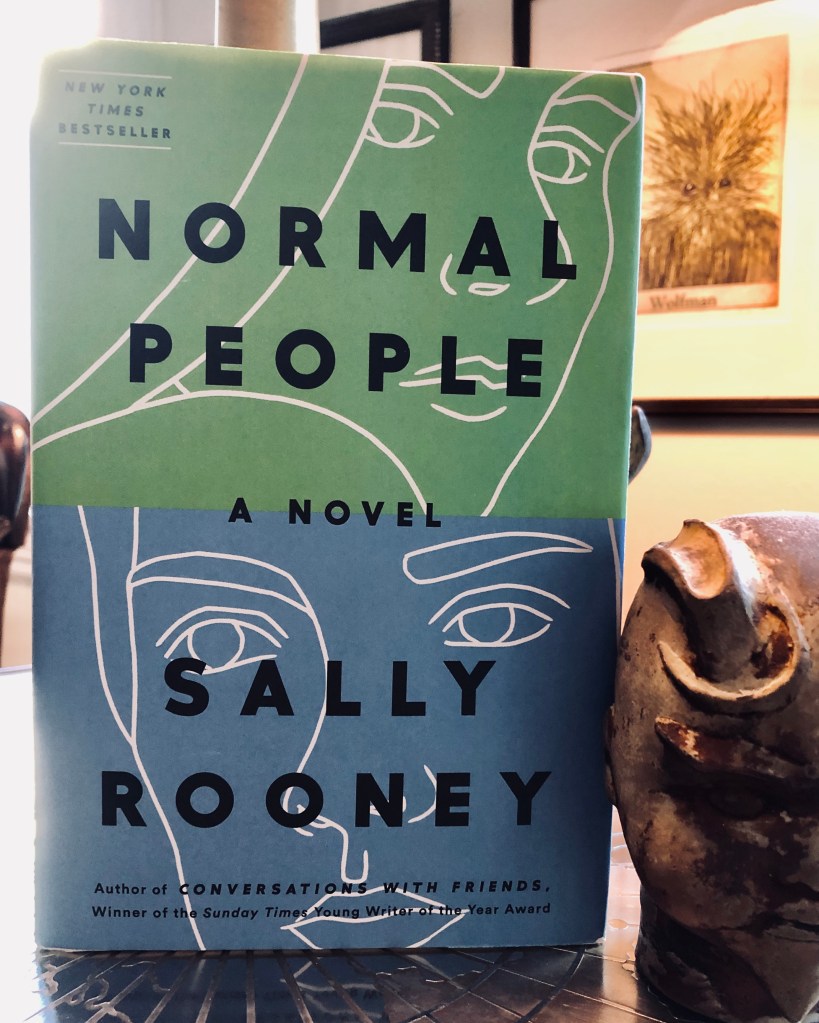
But I have felt the need to read her second novel, ‘Normal People‘, fairly urgently ever since. Like ‘Conversations with Friends‘, ‘Normal People’ made all the important literary people pee their pants, which of course made me not want to read it, but there was something that kept nagging at me. And so, this week, like someone with an iron-deficiency and a kale salad, I sat down and read ‘Normal People’ in one sitting.

Normal People‘ is the story of Connell and Marianne. Connell and Marianne know each other from school – Marianne is rich and unpopular; intensely smart and traumatized by a deeply fucked up family, she moves through the world almost totally alone. Connell is the son of her family’s housekeeper. He is popular and handsome; also smart, he is kind and everyone likes him.

In the afternoons when Connell comes to pick up his mother from Marianne’s house, he and Marianne will form a relationship that is both intense and secret. Her profound unpopularity makes Connell ashamed of her, an unkindness he will not really understand until they go off to Trinity together. There, as Marianne becomes popular and sought-after, and Connell is handicapped for the first time by his shyness and working-class background, both of them will try to discover if they love each other and whether they can be happy.

Conversations with Friends‘ is, at the end of the day, a story about friendship. It is a love story, but it’s about how love hides in friendship. ‘Normal People‘ is a love story, a story about great and transformative love. But it is written in the same spare-and-yet-unsparing style as ‘Conversations with Friends’, which makes it feel disorienting and scary and painful, sort of like being in love.

I’ve come to the conclusion that I find Rooney’s writing extremely effective. I thought at first that her severe lack of style was a little over-stylized (if that makes sense), but I’m completely on board now. The lack of authorial voice forces you into the perspective of the character, right up against them. It’s forgiving and present. Which is a particular accomplishment because ‘Normal People‘ alternately takes the perspective of both of its main characters.

I think it really comes down to why people read novels in the first place.

There are many valid reasons to read novels. People read them to be entertained, or because they are assigned them in school, or to make themselves seem smart.

But why do people read novels like this, as adults, when no one is watching? I think, and maybe I am only speaking for myself, that people read novels to learn about how other people feel, to understand their own feelings, to learn whether their own feelings are normal, to make sense of the world around them, to try to see the world through other people’s eyes and to see whether they are, in fact, part of a common humanity. They read them to see the great range of human emotional possibility, and to fit themselves within that range. They are maps for our hearts.

Sally Rooney

Which doesn’t mean that goodness doesn’t matter. I’m not sure that writerly skill necessarily makes a novel more emotionally effective – in fact, it’s often inversely correlated (Joyce, Pynchon, Faulkner, Dickens, so many of the great writers leave people cold) – but when a well-written novel is emotionally effective, the two qualities become greater than the sum of their parts.

That’s what happened with ‘Normal People‘. The brutal bluntness of the prose, the unflinching eye Rooney uses to examine her characters, the keen ear she has for the subtleties of complex and contradictory human emotions, all combine to make her novels an immersive and moving experience.

I think I understand why I needed to read ‘Normal People‘ right now. ‘Normal People’ is about whether or not broken people can be loved, and that is a question I’ve spent a lot of my life asking. And it is the question I’ve spent most of the last year obsessing over.

I think that ‘Normal People‘ is a probably a great novel, but I’m not really in a position to judge because the only thing that I can think about is how it was exactly what I needed. I’m used to thinking about whether or not books are good; I am used to connecting with them intellectually. I don’t usually just let novels happen to me.

And, of course, ‘Normal People‘ didn’t answer any questions, and didn’t solve any problems. I don’t think that was the point. And I didn’t feel better per se, but I did feel more connected. More normal.