

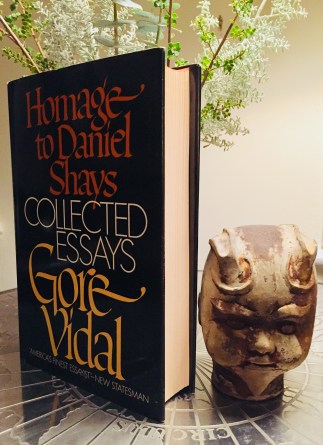
Collected Essays
By Gore Vidal
 Some writers possess a quality which, as you read them, makes you long more than anything else to speak to them.
This is not the same as admiring them. These will not necessarily be your favorite writers, or the writers of your favorite books. These are writers who shine through their own words, whose force of personality is so clear and so strong that they essentially read their own books to you. Grappling with them is so like being talked to by them that you want, sometimes quite desperately, to be able to answer.
Sometimes, of course, you do admire them. Sometimes they are funny, or good – for me personally, David Foster Wallace has always had this distinction. He is never far from his own work, even his fiction, and when I read him, I always wish I could just put the book down and query directly the mind which produced it.
But sometimes the writers are not admirable, not as a men at least, no matter their skills as writers. Sometimes they are arrogant, or supercilious, off-putting in some way, and your desire to speak to them is essentially antagonistic: you want to be able to argue back.
And sometimes they are both: vain, haughty, but brilliant too, and if an author can win you over in this case, if their brilliance overwhelms their obnoxiousness, they are among the most joyful authors to read, because you feel as though you are indulging in a guilty pleasure: I know he’s an ass, but he’s just so good.

H.L. Mencken is this sort of author. Christopher Hitchens is this sort of author. But, for me personally, the apotheosis of this category, writers whom you read for the sheer joy of agreeing with their meanness, is Gore Vidal.
‘Homage to Daniel Shays
Vidal is probably best remembered as a novelist (he certainly thought of himself as one), but I love him for his essays, his criticisms and his cultural commentary (he is a little like Orwell this way: remembered as a novelist, loved as a critic). He had an excellent mind; he was brilliant, capable, especially, of summing up people or situations with devastating clarity and pith.
It’s rare that self-important men are also funny; he is an exception to this rule. He is hilarious, usually in attack but not always. He is crisp and can cut through hypocrisy as through butter. More than that, the topic of the essay does not predict when humor will strike, so his wit is both amusing and surprising. In fact, he is likelier to be funny on unfunny topics (‘Satire in the 1950’s’
“Every schoolboy has a pretty good idea of what the situation was down at Sodom but what went on in Gommorah is as mysterious to us as the name Achilles took when he went among women.” (‘Women’s Liberation Meets Miller-Mailer-Manson Man’
)
“From the beginning of the United States, writers of a certain kind, and not all bad, have been bursting with some terrible truth that they can never quite articulate. Most often it has to do with the virtue of feeling as opposed to the vice of thinking. Those who try to think out matters are arid, sterile, anti-life, while those who float about in a daffy daze enjoy copious orgasms and the happy knowledge that they are the salt of the earth.” (‘The Sexus of Henry Miller’
“A profound tolerance is in the land, a tolerance so profound that is it not unlike terror. One dare not raise one’s voice against any religion, idea, or even delinquency if it is explicable by a therapist.” (‘Satire in the 1950’s’
“It is well known that the Soviet has always had a somewhat mystical attitude toward that sine qua non of the machine age: the interchangeable part.” (‘Nasser’s Egypt’
A large proportion of these essays are reviews of other works, and thank god: one of the best joys to be had in this collection, from the point of view of a book nerd, is reading Vidal’s opinions of other writers. He is capable of summing up other artists in lethal epigrams which leave them not even a shred of dignity, but which are also inarguably (to my mind, at least) true.
About D.H. Lawrence:
“I have often thought that much of D.H. Lawrence’s self-lacerating hysteria toward the end of his life must have come from some “blood knowledge” that the cruel priapic god was mad, bad, and dangerous to know, and, finally, not even a palliative to the universal strangeness.” (‘Norman Mailer’s Self-Advertisements’
About Graham Greene and Evelyn Waugh:
“Then there are the writers to whom neither sea nor boat exists. They have accepted some huge fantasy wherein they need never drown, where death is life, and the doings of human beings on a social and ethical level are of much consequence to some brooding source of creation who dispenses his justice along strictly party lines at the end of a gloomy day.” (‘Novelists and Critics of the 1940’s’
About F. Scott Fitzgerald:
“…F. Scott Fitzgerald, whose chief attraction is that he exploded before he could be great, providing a grim lesson in failure that, in its completeness, must be awfully heartening when contemplated on the safe green campus of some secluded school.” (‘Novelists and Critics of the 1940’s’
About Anaïs Nin:
“There are two kinds of narcissist: objective and subjective. The objective looks into the mirror and sees the lines, sees death upon the brow, and records it. The subjective stares with rapture into the mirror, sees a vision no one else can see and, if he lacks great art, fails entirely to communicate it.” (‘The Fourth Diary of Anaïs Nin’

Of course, an author’s greatness lies not just in language, but also in ideas. Meanness aside, it slowly emerges from these pages that Vidal was also wise, and when he turns his mind from the petty to the existential, he produces material which is beautiful. In these moments, his writing is so artful, so skillful and elegant, that I would stop and reread the same sentence several times, trying to understand exactly how he did it. A few of the passages in this book, I could die happy if I had written even one of them:
“While it is perfectly true that any instant in human history is one of transition, ours more than most seems to be marked by a startling variety of conflicting absolutes, none sufficiently great at this moment to impose itself upon the majority whose lives are acted out within an unhuman universe which some still prefer to fill with a vast manlike shadow containing stars, while others behold only a luminous dust which is stars, and us as well.” (‘Novelists and Critics of the 1940’s’
“It is natural for men to want power. But to seek power actively takes a temperament baffling to both the simple and the wise.” (‘Barry Goldwater: A Chat’
“Nor is it unnatural when contemplating extinction to want, in sudden raging moments, to take the light with one. But it is a sign of wisdom to recognize one’s own pettiness and not only to surrender vanity to death, which means to take it anyway, but to do so with deliberate grace as exemplar to the young upon whom our race’s fragile continuity, which is all there is, depends. I should have thought that that was why one wrote – to make something useful for the survivors, to say: I was and now you are, and leave you as good a map as I could make of my own traveling.” (‘John Dos Passos at Midcentury’
“And those who take solemnly the words of other men as absolute are, in the deepest sense, maiming their own sensibilities and controverting the evidence of their own senses in a fashion which may be comforting to the terrified man but disastrous for an artist.” (‘Norman Mailer’s Self-Advertisements’
You may not always agree with his conclusions (I didn’t), but he’s never, ever stupid, and he turns his critical eye on himself not infrequently. In these essays, Vidal proves to be ahead of his time on many of issues which remain contentious today: feminism, gay rights, taxes, personal liberty, the military-industrial complex, the intelligence of the electorate. I wish he were still here – he died in 2012, before I had really discovered him as a writer, and I wish that I had been quicker off the mark. I need his eye now, to help me understand the world, as I need George Orwell’s. In fact, this is the highest complement I can give a writer: I am lost without you.
But he’s gone, can’t be questioned, so all I can do is go back with him, rewind the tape, and watch his world through his eyes.


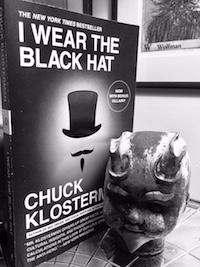 ‘
‘ ‘ is Chuck Klosterman’s loose meditation on villains in culture, on what makes someone seem villainous, on what makes some villains likable and some not, on the factors which inform villainy: context, intention, success (the full title is ‘
 The Bibliolater