
The Part About Zombies in General
By Colson Whitehead
ALL POSTS CONTAIN SPOILERS
I spend a lot of time thinking about monsters.
It’s probably not difficult to understand why: 1) they are so cool and 2) they are everywhere these days. We have a monster glut. We’ve always been obsessed with them, I think, but monsters are particularly culturally abundant right now: vampires, sexy vampires, vampires fighting werewolves, sexy werewolves, werewolves playing sports, vampires in love with people, vampires in love with vampire slayers, vampires in the American South, zombies in the American South, zombies in love, zombies fighting Mila Jovovich. It’s a lot.
It’s market-driven, clearly; people love monsters. I love monsters (always have), so I’m fine with it, but certain aspects of the monster ecosystem confuse me. To be specific, I am puzzled by the relative super-abundance of vampires.
All monsters are metaphors: they are scenarios dreamed up to interrogate existential problems. They are one of the ways that we ask certain questions, about life, death, humanity, brutality.
Vampires are absurdly popular, which is confusing to me because vampires are so shallow, metaphorically speaking. They are about immortality: what would you give up to live forever? Would you give up your very humanity if you could avoid death?
It’s not a bad question, but it is simplistic. First of all, it supposes that everyone wants to live forever, which, of course, we don’t. Second, it can be answered simply: yes or no. There is no philosophical meat. Either you would, or you would not, depending on how scared you are to die. There’s not a lot more there.
(I’m being a little reductive here, I know: there is actually a slightly interesting wrinkle in the vampire mythos: in order to live forever, you have to literally drain the life out of other people – is that worth it? But, of course, even that question assumes you want to live forever, which, again, isn’t universal.)
I’m not just shitting on vampires and their fans: werewolves are barely more interesting. They’re just a heavy-handed metaphor for human savagery, asking, “Are we responsible for our own capacity for violence if it’s innate?” It could be interesting question, but it does not deserve the creation of entire monster-type to address it.
Zombies, though, zombies are different. Zombies are deep. They are complex, multi-faceted, the most metaphorically rich of all the major monsters. Zombies are powerful.
Werewolves and vampires ask questions which make assumptions about what people want. They assume that everyone longs for immortality, that everyone has a brutal streak which can be interrogated in canine metaphor. I don’t think that this is true, actually – I think there are plenty of non-brutal people who prefer a natural lifespan – but, either way, these questions only address facets of ourselves.
Zombies, though, ask universal questions, questions with global scope: what makes us who we are? Are we our bodies, or are we our minds? If you had to choose between your life and the lives of your loved ones, which would you choose? Would you kill them to survive?
There comes a moment in every zombie story when a protagonist sees their loved one infected. It might be a parent, a child, a spouse, a sibling, the story is the same. The loved one is infected, but change isn’t instant: they will suffer a period of doomed lucidity, waiting to turn.
Zombie protocol is clear: once bitten, a person must be destroyed, lest they turn and spread the infection. This is the one inviolable Zombie Law, universal and non-negotiable. Our protagonist knows it, but, at this, the crucial moment, as they stare into the eyes of their most cherished person, they will falter.
This is what zombies are about: could you stare into the face of the ones you love and destroy them for the betterment of all? Even if you knew they were doomed, even if they begged you to put them out of their misery, could you?
(As an aside, this is why I think zombies canonically require headshots. This killing, this destruction of the loved one, must be brutal. You cannot ease them into a painless death, put them gently to sleep: violence is required. A bullet to the brain, head chopped off, a knife to the top of the spinal column – there will be no mistaking that you killed them)
This is the kind of metaphor I can get behind. This is a wrenching, terrible question that speaks to one of the few truly universal human experiences: the love of another.

Vampires and werewolves are narcissistic creations: they are about what we want (immortality, the ability to vent our rage without consequence). Zombies, on the other hand, are about what we are, especially in relation to other people. They ask us whether or not it is possible to be truly safe while loving someone else.
This problem, known in real life to everyone who has ever been scared of rejection, is made literal in all zombie stories: is being alone the only way to be safe? The instinct of our zombie-story protagonists (as with humans in general) is to band together, to forms tribes and then colonies of survivors, to huddle for protection. But more people means more risk: more chances to get bitten, more vectors to bring the contagion home. Someone will eventually fail to latch the door tightly, forget to close the blackout curtain, will sneeze at the wrong moment: the more people, the more likely this becomes. More than that, if you love someone, your judgment may be compromised – you are more likely to make bad, emotionally-driven decisions if you are attached to your fellow travelers. Is the comfort and help of other human beings worth it? Or are you better off alone?
Zombies are brainless on only the most literal level; metaphorically, they are complex, and literarily, they are far and away the most emotionally effective monster. The vampire story has not yet been written which can compare to the visceral impact of imagining your loved one – your child, your spouse, your sibling – changing, becoming less and less human, and wondering if you will have to kill them to save yourself. Would you be capable? How could you ever convince yourself, sufficiently and truly, that you could never have cured them, that they were truly lost? It is the impossible choice.
Why am I talking about this?
I’m talking about this because I just finished reading the zombie novel I’ve been waiting for my whole life and got really excited about the whole topic. I originally meant this to be a one paragraph intro, but I got carried away. I’ll talk about the book next week.

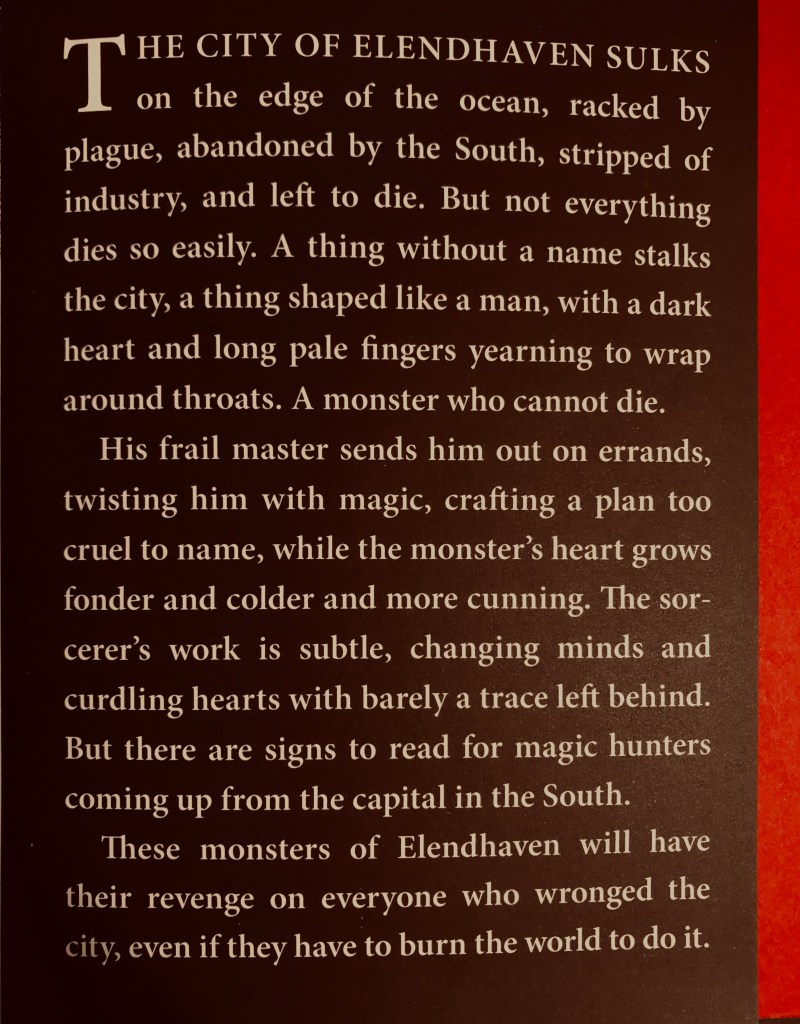
 ‘ in a bookstore the other day, I didn’t think it was a love story. It doesn’t look like a love story. I’m not sure why I bought it – I’m not in the habit of purchasing books of unknown provenance. But the cover was creepy and the description was even creepier, and I was on a mini-vacation, so I bought it.

 The Bibliolater