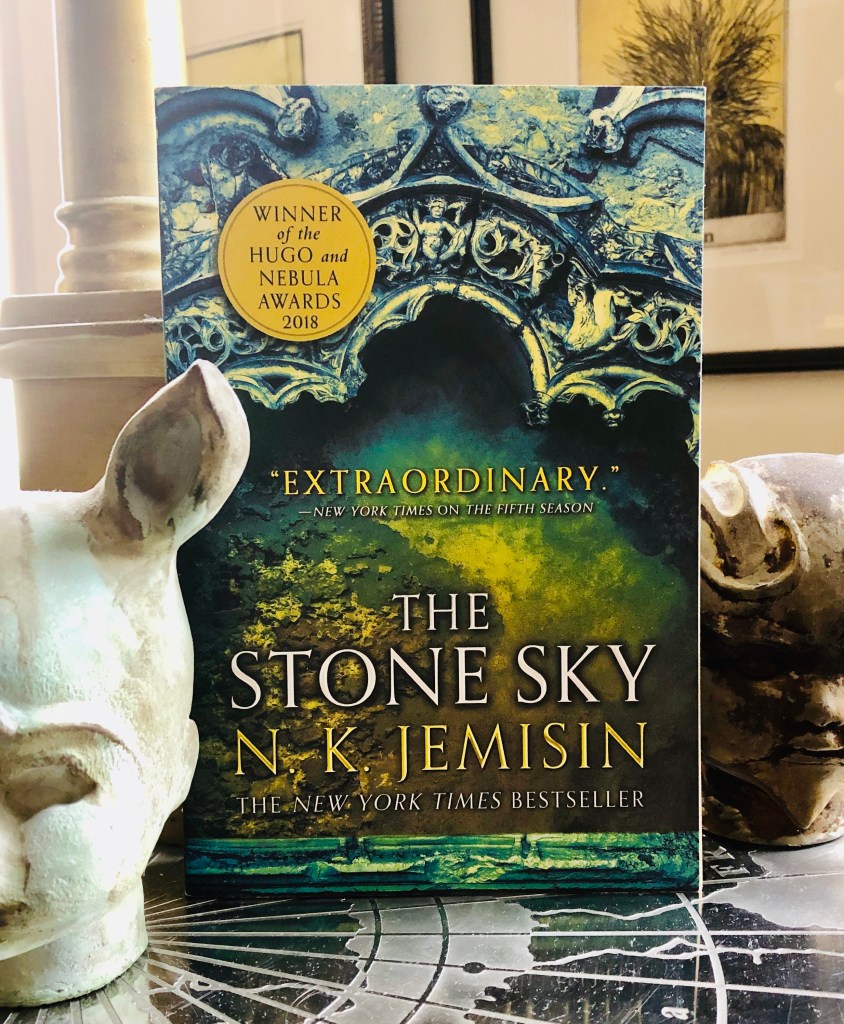
The Stone Sky

The Broken Earth: Book Three

By N. K. Jemisin

ALL POSTS CONTAIN SPOILERS

Normal warnings aside, I am really, really going to spoil this trilogy in here, so if you don’t want to know exactly how ‘The Broken Earth Trilogy‘ ends, don’t read this.

Um, I’m also going to spoil several movies.

You know that theory (we’ve talked about it before) that there are only, like, seven plots in all of literature? They, supposedly, are:

  • Overcoming the Monster
  • Rags to Riches
  • The Quest
  • Voyage and Return
  • Comedy
  • Tragedy
  • Rebirth

And they’re pretty self-explanatory. The theory goes that all the works of literature are just attempts on these seven basic plots: retellings, new perspectives, embellishments, interpretations. That these are the only stories there are.

OK, well, that may or not be true*, but I do know that, when you read a lot of stories, you notice that there aren’t so many different things to say as there are books. It’s not just plots – characters, premises, dilemmas, it all comes around again and again.

*I’ve never really been satisfied that any of those plots describes ‘Jurassic Park’. Maybe this is just me getting hung up on dinosaurs again, but ‘Jurassic Park’ doesn’t really fit any of those, does it? Which could it be? The Quest [to get out of Jurassic Park]? Overcoming the Monster [actually many little monsters and no one really overcomes them, just runs away]? I’m not buying it. I propose a new list: Overcoming the Monster, Rags to Riches, The Quest, Voyage and Return, Comedy, Tragedy, Rebirth, Jurassic Park.

Anyway, it doesn’t matter whether there are seven plots or seventy, or whether the above list is exhaustive. The fact is, when you read a lot, the landscape of fiction does becomes familiar to you.

Which can be kind of nice. Familiar landmarks help you orient yourself. They signal to you what kind of story you’re reading, what kind of lessons you’re meant to learn, what sort of characters you should expect to meet and what might happen to them. Often, they tell you how the story wants to be evaluated: it doesn’t, for example, make any sense to complain that there weren’t enough battles between zombies and werewolves in ‘The Notebook’ – ‘The Notebook’ isn’t that kind of story. How do you know that it wasn’t that kind of story? It didn’t have any landmarks of the kind of story where zombies and werewolves battle – no weird contagions which make people sort of bitey, no bodies of eviscerated sheep showing up around the village after the full moon, stuff like that.

But surprises are also nice – think how great it would have been if there had been even one zombie in ‘The Notebook’. Surprises make you realize that life isn’t over yet, that the world is still turning, that it’s worth trying new things, or reading new books. That, even if people have exhausted all the basic plots, they haven’t stopped thinking up new things to decorate them with.

And they don’t need to be big surprises, either; they can be small adjustments to old things, as long as you’ve never seen them before.

Which, I think, in the end, is the thing I ended up liking the most about ‘The Broken Earth Trilogy‘. Yes, the story was quite strong, and it was never badly written (which is about as good as it gets for genre fiction), and it didn’t get soggy at the end, but what I really ended up loving was that it surprised me.

And it surprised me in the most unlikely way: the villain surprised me!

Villains are never really surprising – even “surprise” villains aren’t really surprising, because you know that, according to the Laws of Fiction, you have to have been introduced to them already. And since, in any given story the number of named characters is relatively small, and since you must be prepared, according to the Laws of Fiction, for any character to turn out to be a surprise villain, even if you are surprised by who the villain turns out to be, you aren’t really surprised surprised, because you knew it had to be someone.

Which is why the last time I was really surprised by a villain was when, in the first ‘Saw’ movie, the villain turned out to be the dead body on the floor in the background! Because that dead body wasn’t a character, really – he was scenery. And scenery doesn’t usually turn out to be the villain*.

*Although, now that I think about it, why, then, wasn’t ‘The Happening’, by M. Knight Shamaylan, a movie in which the villain also turned out to be scenery (trees), more surprising? Maybe because, by the reveal, you were too irritated to be surprised.

This same mechanism is at work in ‘The Broken Earth Trilogy‘, but not in a cheap, one-shot reveal sort of way. The villain in ‘The Broken Earth’ is also scenery, but in the most fundamental way that there is: the villain is…the Earth.

I know that this sounds cheesy, but it kind of isn’t. I thought it was going to be cheesy, too: when I started picking up on the hints that the Earth was somehow malevolently set on destroying humankind, I thought for sure I was in for some irritatingly-heavy-handed climate change metaphor, where the Earth wasn’t really alive, but had become so destabilized by hubristic human overreach that it was functionally hostile to human life, yadda yadda yadda, we must all honor Mother Earth, so on and so forth, and I was like, anticipatorily bored.
No, that’s not what happens. In ‘The Broken Earth Trilogy‘, the Earth is alive. Alive and conscious, and angry. It is a living, thinking, speaking core of molten rock and hot gas in the center of the planet, and it hates us.

It’s..pretty weird, actually. It’s a great surprise, because it’s both functionally impossible to imagine ahead of time and totally easy to imagine afterwards: it’s hard to think of dirt as part of any living thing, but the Earth’s molten core lends itself right away to personification. It’s scary and angry already! All of which makes the premise (that we have failed to notice that the earth was alive this whole time) kind of plausible.

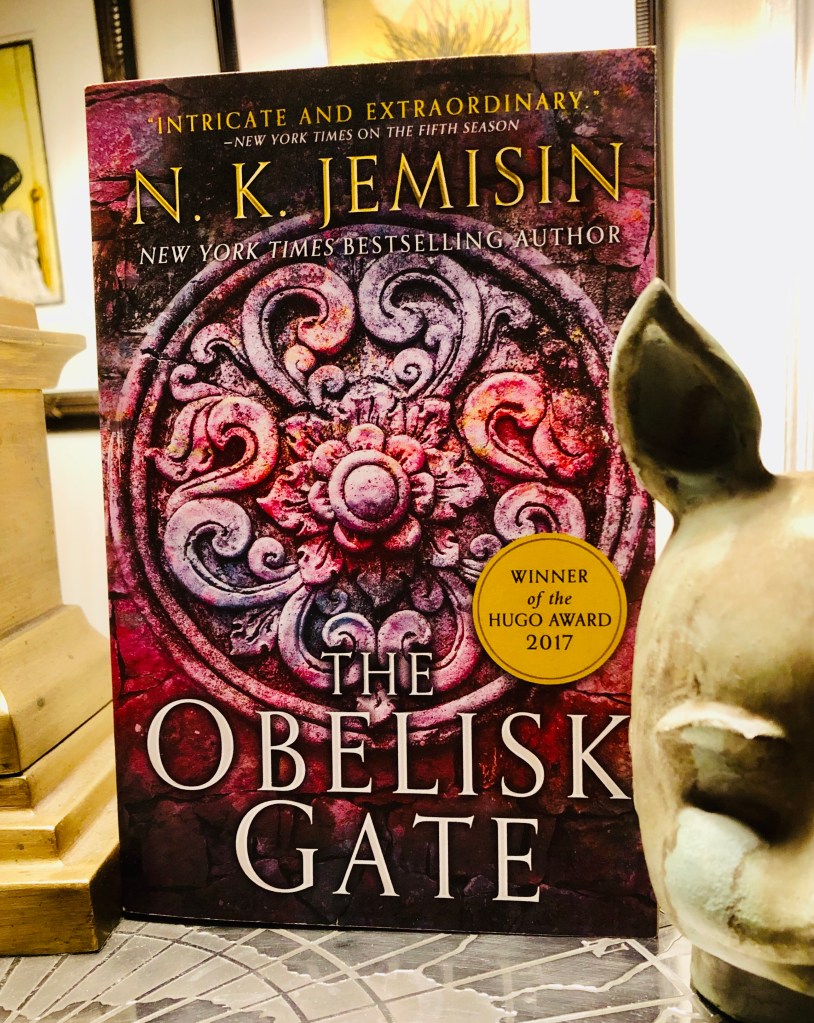
The Earth itself is the slow-reveal antagonist of the entire trilogy, but I didn’t begin to really grok that that until the end of ‘The Obelisk Gate‘. Which meant that ‘The Stone Sky‘ was a fun journey of dawning implication for me, especially as I began to figure out that the pseudo-villains of the first two books, the Guardians, are really just under the control of the Earth, via pieces of the Earth’s core which have been lodged in their brains.

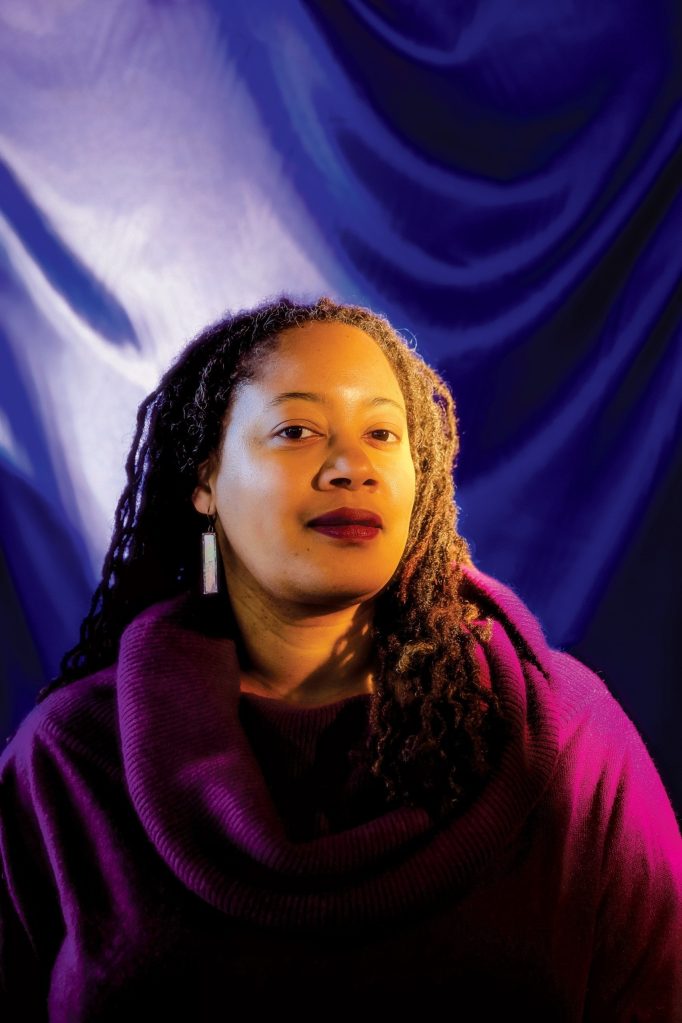
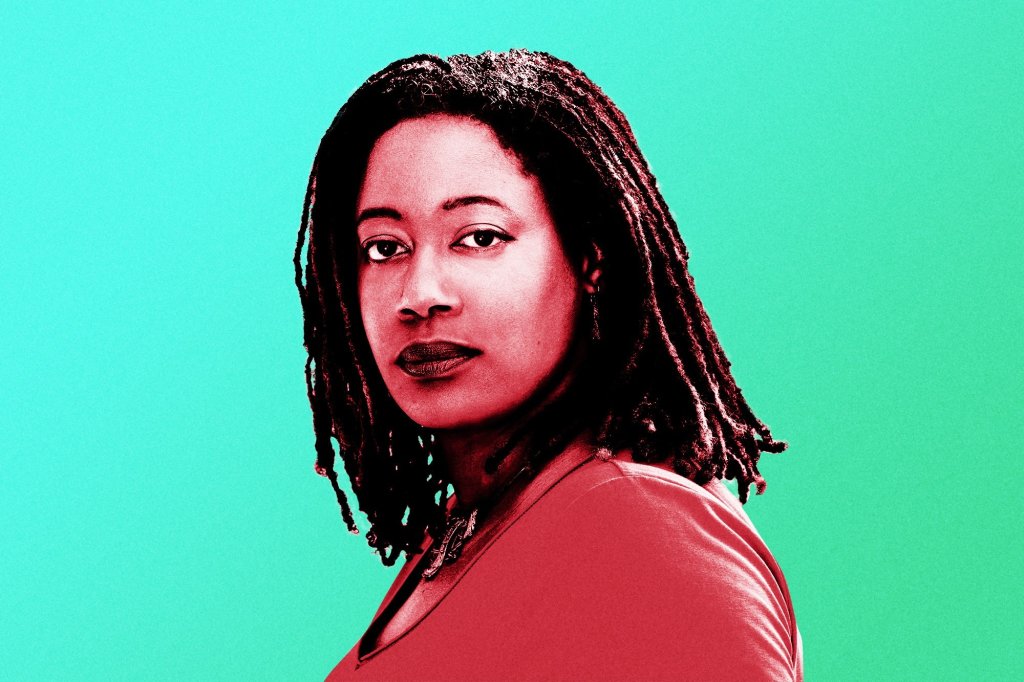
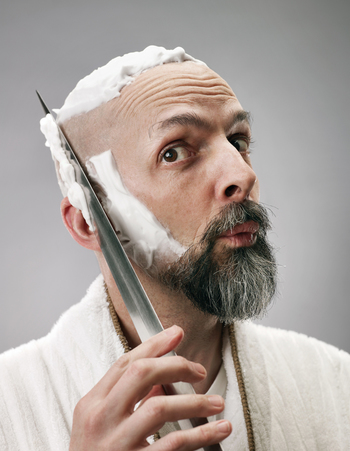
N.K. Jemisin (Picture taken from newyorker.com)

Which, again, sounds super cheesy when I say it like that, but it doesn’t play out that way! It’s actually pretty elegant, the way Jemisin rolls everything out, and lets the five or six separate mysteries she has created inform each other until, piece by piece, you realize that they are all the same mystery.

And it takes a while to knit the whole picture together, a satisfying, leisurely length of time, which wouldn’t happen if ‘The Broken Earth Trilogy‘ weren’t surprising. The only way that mysteries can afford to be leisurely (and ‘The Broken Earth’ is a mystery, at the end of the day) is if they are very, very sure you aren’t going to solve everything before the end and get bored waiting for the text to catch up.

And it worked! I didn’t figure it all out because I didn’t expect the, like, ground beneath everyone’s feet to be the bad guy. Who expects that?!?

As I said at the beginning, there is a lot going right in these books. And there is more to say, I’m sure, about the moral of this story, and about the humane character of the books, about what they mean and about how fun they are. There is a lot to be said for how strongly they are executed, how tight the writing is and how well-paced and well-structured the story is – this is really, really strong world-building.

But I’m mostly just so happy to have been surprised. I’m always grateful for a good story, surprising or not, but a story that shows me something new under the sun? Rarer and rarer, and the more precious for it.
The Obelisk Gate

The Broken Earth: Book Two

By N. K. Jemisin

ALL POSTS CONTAIN SPOILERS

So, now I’ve had some time to think.

Sometimes, when you’re flying through a book, you don’t stop to think about why you’re loving it so much. This is especially true with plotty books – you don’t need to think about why it’s working, you can just lie back and enjoy the ride.

But it’s a worthwhile exercise, once you pause for breath. And I had a busy week at work, and so was forced to spend time NOT reading ‘The Broken Earth Trilogy‘ trilogy, and so I thought about it.

I want to be clear: this pause was not voluntary. I need to work to eat; otherwise, I would have chewed all the way through the series without washing or sleeping. But, like I said, it was a busy week, so I only just now finished ‘The Obelisk Gate‘, the second book in ‘The Broken Earth Trilogy‘ series.

And I know that ‘The Obelisk Gate‘ is technically a separate book, but the entire series really reads like one book, one story, and I am only taking the time to stop and write about this installment for the sake of personal discipline. So, for coherence, I will probably refer to the trilogy as a single work, which it clearly is.

And I’ve been thinking a lot about why the trilogy is so good. And…

I don’t know.

The Broken Earth Trilogy‘ trilogy is about a world that is ending. And I suspect that, like all stories that are about the world ending, it is really about the evil which people do, which comes out of us naturally, inevitably, like breath. About the primitive, tribal cruelties that we perpetrate, in all times, all places, when we are frightened.

There’s a question I wonder sometimes: do you have to understand a novel to love it?

There are two ways to say what a novel is about. Let’s take an easy one: what is ‘The Scarlet Letter’ about? Well, technically, it’s about a woman being punished for adultery through sartorial intervention.

But, obviously, that’s not what it’s really about about. ‘The Scarlet Letter’ is about sin, and guilt, and hypocrisy. It’s about how God is all-knowing and all-loving and we are not, and so when man’s law tries to approximate God’s law, the discrepancy will necessarily result in injustice. It’s about humility.

See what I mean? There’s about, and then there’s about about.

I know what ‘The Broken Earth Trilogy‘ trilogy is about. Jemisin is a clear, effective writer, much more than most science fiction or fantasy writers. Even when she is describing things which are actually beyond description, she is never hard to follow or understand. She’s really good.

But I am not at all sure that I know what this trilogy is about about.

On the most superficial level, ‘The Broken Earth Trilogy‘ trilogy is an allegory about racism and xenophobia and otherness. It’s about human cruelty, and about whether we are capable of preserving our humanity, our ability to be kind to the other, when we are desperate, or in danger, or facing extinction. And the fact that this allegory is obvious a) doesn’t mean that it isn’t a valuable metaphor (it isn’t as though we’ve solved this problem, so, by all means, let’s keep working it through in prose) and b) doesn’t mean that it’s all that’s going on in these novels.

I also suspect that it is about about climate change. Bear with me: the premise of ‘The Broken Earth Trilogy‘ trilogy, tectonically-speaking, is that humans, at the acme of their civilization, committed an act which so permanently destabilized the earth’s crust that it threatens the survival of everything on it. This is understood by all living human inhabitants of the earth as its revenge, that the earth is essentially, permanently, hostile to human life. That seems pretty clear to me.

But the problem with explicating allegory is that it makes the work seem preachy, or academic, or pedantic, and that is emphatically not the case here. In fact, the lack of pedantry is partly why I’m having trouble discerning the allegory.

So, am I allowed to love a story without understanding the allegory?

Obviously, the answer is yes – I can enjoy it any way I want. I can even enjoy it while totally misunderstanding the allegory. But (and honestly, this may be wrong) I think that understanding the allegory makes the experience of the books richer. And I know that this makes me sound like a complete nerd, but I am a complete nerd, and I really do enjoy a book more when I understand not only the story, but also the other stories which the story is referencing, the moral questions it is obliquely pondering, the historical events which it is recapitulating. They make me appreciate the story more, the skill of its writing, the depth of its thought.

And when you know, or suspect, that a story has these extra layers, and you aren’t quite getting them, it’s disorienting, like when you fall asleep in the middle of a movie and miss a whole bunch of plot. You might technically understand the ending, but can you say that you really understood the movie?

Not really, and so I don’t feel like I can say that I understand ‘The Obelisk Gate‘, and it’s making me feel very insecure, because I really, really like it. I want to understand it, and so I’ve been thinking about it.

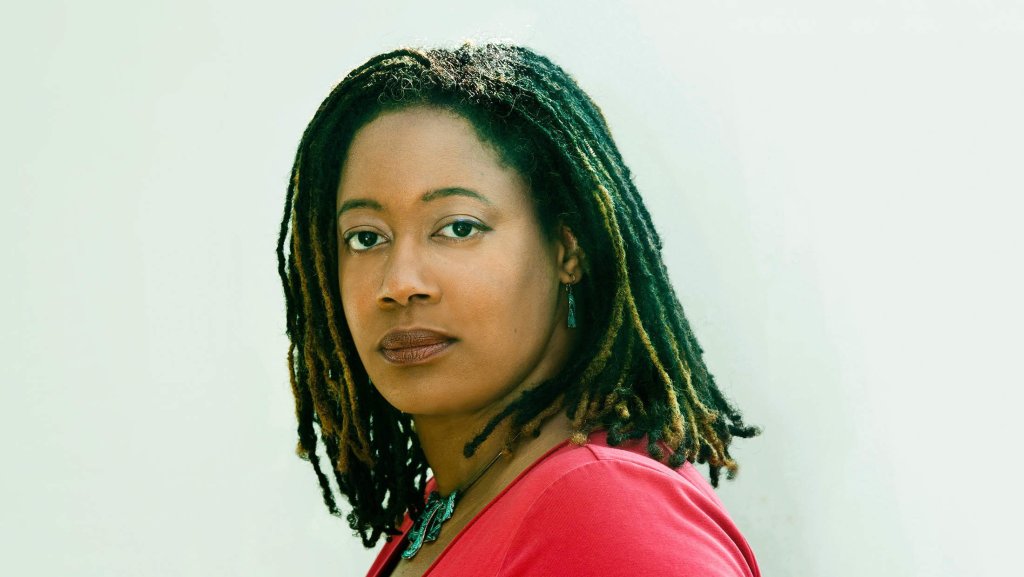
N. K. Jemisin

One of the most salient threads which runs through the first two novels of ‘The Broken Earth Trilogy‘ is that our fundamental selves are revealed through our treatment of our children. This is true on the level of the society as well as on the level of the individual. Children are a major, major part of ‘The Broken Earth’ books – love for them, grief for the loss of them, rage at the people who hurt them.

And cruelty to children winds through the books. There is an idea which pervades the entire trilogy (so far) that, in health, children are loved and cherished, protected and cared for. It is only in sickness that we allow them to be tortured or mutilated, abandoned or killed.

Earth has become a sick place, and the question which Jemisin is asking is, is it possible to be a healthy person in a sick place? Can you bring children into a sick world, raise them in a sick society, love them healthily when you cannot truly keep them safe? When the society in which they will grow up might abuse or murder them, use them or break them? When the very earth on which they walk might drive them and every one they love to extinction at any moment?

What does parental love even mean in that context? Parents love their children, ideally. Parents will do anything, risk anything, for their health and happiness – what does that mean in a world where health and happiness are impossible? What happens to love in a world like that?

It curdles, turns inward into rage, becomes destructive, deadens. Twists and becomes murderous in its turn. Even love becomes impossible, in a sick world.

Now that I think about it, this is kind of what ‘1984’ is also about. Actually, this is exactly what ‘1984’ is about: the idea that in a totalitarian society, even love, even private, romantic love, is impossible, because there is no private space for a human heart to have something normal and good, like love.

And, in ‘The Broken Earth Trilogy‘ trilogy, that’s true of parents, too: on a hostile earth, where we are threatened at every turn, where constant fear and danger have made us base and mean and vicious, we can’t even love our children. Because loving children is hopeful, and hope requires a future, and in a world with no future there’s no way to love them – it’s too painful.

I know that I’m not making ‘The Obelisk Gate‘ sound fun – I’m probably making it sound like the world’s bleakest book about parenting. It is fun, in a bleak, scary way. It’s one of the most absorbing books I’ve read in years, and, as I mentioned last time, I honestly just resent the time I have to spend here, writing about it, instead of thinking about it. It’s so, so good.

The Fifth Season

The Broken Earth: Book One

By N. K. Jemisin

ALL POSTS CONTAIN SPOILERS

I think that prejudices must be a little like guns: just as likely to hurt their owner as they are to hurt anyone else.

I’m just going to say this, straight-out: I’m always a little embarrassed to be seen reading a fantasy novel. I’m not defending this position – I know that this is shallow – I’m admitting this as the shortcoming is it.

But there it is: I’m always a little embarrassed to be seen reading a fantasy novel.

Because they look bad. I’m not saying that they are bad; certainly, they aren’t all bad. But they all look bad. For some reason, the marketing for fantasy novels has evolved certain universals (thin covers, big, serif-fonted, foreboding titles with moody, dramatic art behind them) that signal badness. The books all look cheap, interchangeable, and plotty.

See?

Which, fine. Nothing wrong with cheap, interchangeable, and plotty, if that’s what you’re in the mood for. But it’s not ‘Anatomy of Melancholy’, is it? And it always gives my vanity a little twinge, to be caught reading one. It makes me feel defensive, like I want to announce to everyone on the red line train with me, ‘I just finished ‘The Gulag Archipelago’, and so I’m just taking a little break!’

Which is vain and insecure, yes, and emphatically my own problem (no one on the red line gives a flying fuck what I’m reading, I promise). There’s a reason we have that old expression, ‘Don’t judge a book by its cover’, and even though that expression usually applies to people, turns out it applies just as well to actual books! Because if you avoid books just because they have fantasy-looking covers, sometimes you miss really good books.

I’m trying to explain how it is that I came to be the last person alive to have discovered ‘The Broken Earth Trilogy‘ trilogy by N. K. Jemisin: I ignored it because it looks like a bad fantasy novel. I’m sure that I have walked by it in bookstores a thousand times, sorting it pre-consciously into “garbage” into my head and moving on. Even if I picked it up and looked at the back, I would have immediately put it down and walked away, because the back cover makes ‘The Fifth Season‘ look like a garbage book.

But the other day, I was with a friend in Trident Bookstore and she spotted ‘The Fifth Season‘ on the Staff Recommendations rack and said, ‘You’ve read that, right?’

And I said, ‘No, I haven’t even heard of it.’ Which, given the look she then gave me, is clearly much more embarrassing than reading a fantasy book on the red line.

I now know, of course, that ‘The Broken Earth Trilogy‘ trilogy has made N. K. Jemisin the only author ever to win Hugo awards three years in a row. The third installment, ‘The Stone Sky‘, also won a Locus and a Nebula. The praise for ‘The Fifth Season‘ is so over-the-top it sounds sarcastic (“These novels are a gift to the whole of our culture,” says The Guardian – seriously?).
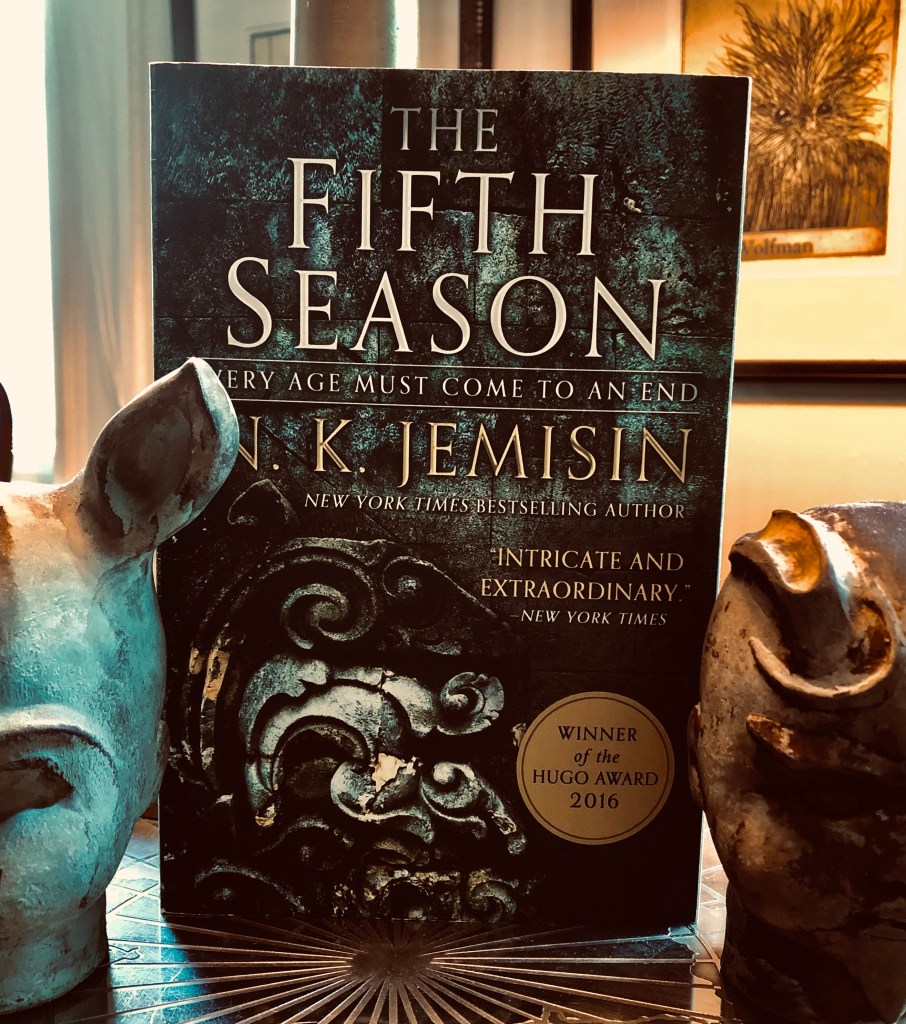
I’m not sure even how to describe ‘The Fifth Season‘ in a way that is going to do it justice. I’m worried that a description of the plot mechanics is going to make it sound…generic? And I don’t think that ‘The Fifth Season’ is generic. To be completely honest, I finished it about fifteen minutes ago, and I haven’t had time to digest it yet.

I know I loved it. I loved it so much that I’m feeling frankly kind of resentful that I have to be here, writing about it instead of just starting the next book in the series, ‘The Obelisk Gate‘.

I don’t know whether I loved it because it was “good” – I’m way, way past caring. I just know it’s a great story, an absolutely phenomenal story, set in a world which is complex and well-imagined and dark.

Fantasy is like any genre: it has threads that it can pull, values it can adjust, which are known to its readers, and which refer to the genre as a whole while still belonging to the story specifically. Part of what you admire when you admire a piece of genre fiction is the way that this particular story has used those conventions, has toggled those toggles. It’s a form of creativity within limits, and when it’s done well, the limits make the creativity even more impressive.

And so ‘The Fifth Season‘ plays with some ideas that will be very familiar to even casual readers of fantasy (or even just to people who have seen ‘Game of Thrones’). It takes place on an Earth subject to terrible seismic upheaval; severe tectonic activity causes global catastrophe every few centuries, periods of darkness and apocalyptic death: these are the fifth seasons.

Human civilization has learned to weather these periods of mass extinction through community stability and the careful husbanding of resources. However, planning alone has not saved them – magic is also necessary. For there have evolved among them humans capable of channeling and controlling seismic activity: the orogenes. Orogenes are very powerful and very dangerous, and normal people revile them. It is more common than not for young orogene children to be killed upon discovery in rural areas.

But, whenever possible, the forces of empire gather young orogenes and bring them to be trained in the capital. There, they are taught through brutal lesson to control their powers and put it to good use.

The Fifth Season‘ tells the story of three orogenes, all women. One is a child, just discovered and nearly destroyed. Another is a young woman, advanced in her training, as she is given for mentorship to the most powerful orogene alive. And the third is a mother, trying to live in secret, in hiding, after she discovers that her husband has just discovered the gift in one of her children, and so has killed him.

N. K. Jemisin

I’m making it sound kind of garbage, I know. It’s difficult to write about some of these things without sounding silly, and I’m just not a good enough writer to throw around made-up words for magical beings convincingly.

But, and this is all that really matters, N. K. Jemisin is. I made it through this entire novel without rolling my eyes once. That’s astonishing. There is something about the word ‘fantasy’ that sounds soft; it makes people (maybe just me?) think of Tolkieny shit, of mages and dragons and Chosen Ones, where the deepest and darkest metaphor is racism between dwarves and elves.

There’s nothing silly or soft in ‘The Fifth Season‘. Quite the contrary – this novel is dark, brutal, mean. It is violent, even wrenching. It’s characters don’t find relief anywhere, and neither will you. I don’t know if it’s a metaphor for anything (again, it really has been only fifteen minutes – I’m still sitting in the same chair, for fuck’s sake); sometimes a dark story is just a story about darkness.

But what a story it is.

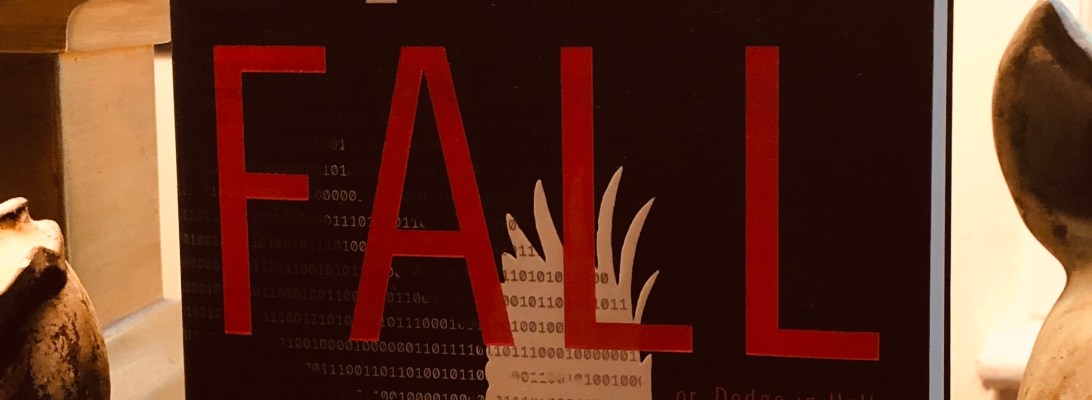
Fall

Or, Dodge in Hell

By Neal Stephenson

All Posts Contain Spoilers

There comes a moment in every Neal Stephenson novel when I can tell that Neal is bored.

This moment is familiar to anyone who has ever tried to write fiction, I suspect: sometimes, the sheer effort it takes to get your characters where you know they are going is exhausting. You want them to just hurry up and get there, but, somehow, they won’t, and so you trudge with them through what feels like endless plot, in order that they and the reader will understand their ultimate destination.

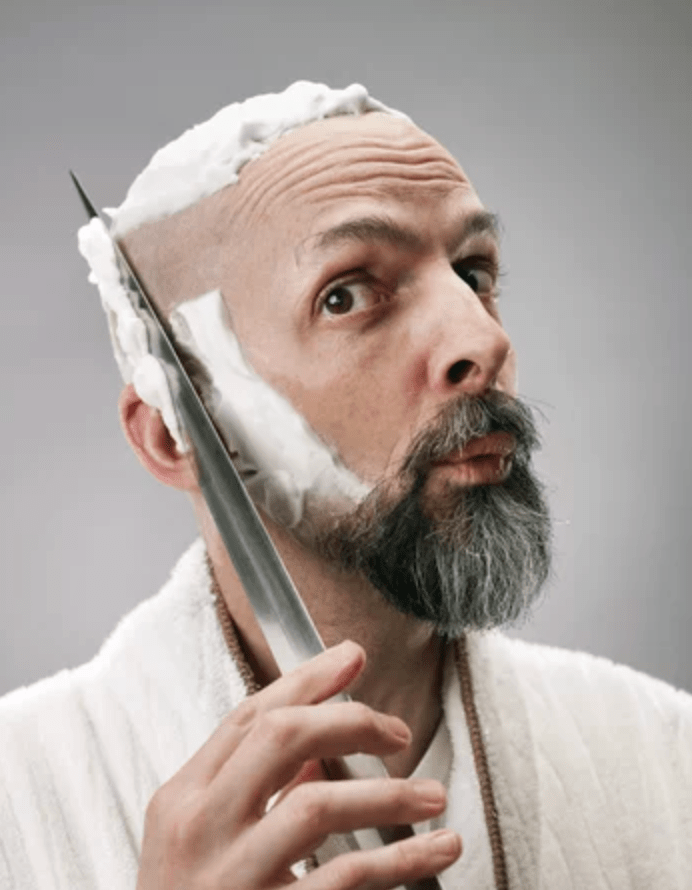
Neal Stephenson

These are some of the hardest moments in fiction-writing, at least for me – they’re joyless – but you try not to communicate this difficulty, this joylessness, to the reader. You obviously don’t want your reader to know that you’re bored, that you hated writing this part of your own story, that what they are reading is, essentially, infrastructure, the dull but necessarily support around the good bits. And so you work really hard to hide your boredom, your loathing, from the reader.

Or I try to hide it, and that’s why, despite my essential sympathy, Neal Stephenson’s boredom annoys me. It’s lazy; worse, it’s ungrateful!

Stephenson delivers seven-, eight-hundred page books to his readers, with labyrinthine, esoteric plots, plots which hinge on elaborate and esoteric mechanisms, arcane rituals of cryptography or minute robotics protocols. He is a man, some might say, in need of an editor. And we, his readers, go romping through these stories with him, willingly, happily, because they are great tales. But, really, the least he could do, for our sake, is not be clearly, obviously bored by the very stories he sends us.

Fall; or, Dodge in Hell‘ is Stephenson’s latest. Clocking in at 883 pages, it is a story about the future of the internet, about the digitization of consciousness, about humanity, and about death.
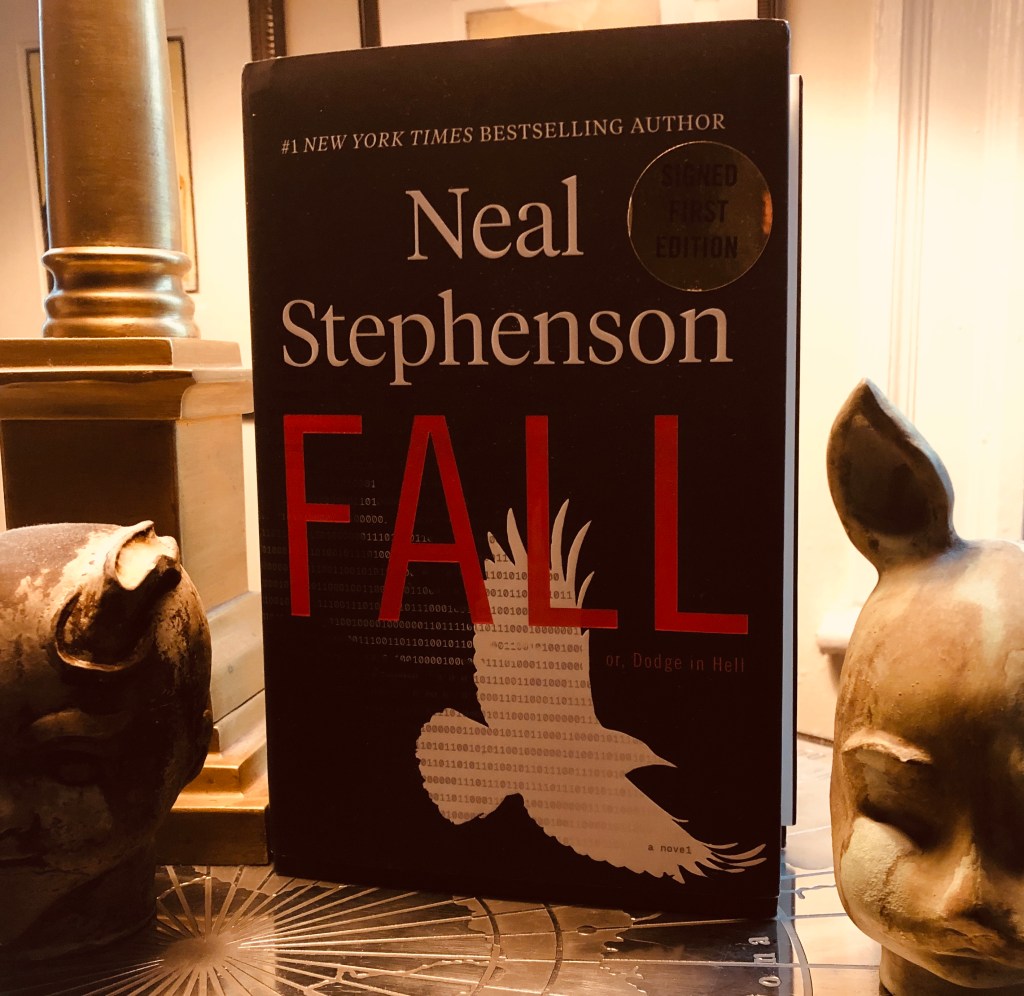
Richard ‘Dodge’ Forthrast is a tech billionaire, a man who has made his vast fortune producing video games, imagining worlds, creating virtual realities. When, against doctor’s orders, he eats before an out-patient surgical procedure, he begins to asphyxiate on the operating table. When he is declared brain dead, his family and friends learn that, some decades earlier, under the influence of a Silicon Valley fad, Dodge left instructions in his will that his brain be cryogenically frozen and his consciousness preserved by any mean necessary.

The Forthrast’s learn that this provision in Dodge’s will is largely the work of El Shepard, a reclusive, mentally-ill billionaire. Originally, El had imagined that whole bodies would be cryogenically frozen and revived; it is clear now, however, that that is not feasible. Instead, the brains of subscribers will be scanned, synapse by synapse, and uploaded and reconstructed in the cloud. According to El, these synaptic connections, the ‘connectome’, should constitute the complete consciousness of the individual at their time of death.

Fall‘ is a novel about the Singularity (or, one version of it): namely, the intelligence explosion, when an uploadable (sometimes artificial, but not in this case) intelligence acquires the ability to self-improve so rapidly that it permanently and fundamentally alters human existence. In ‘Fall’, this fundamental alteration takes the form of a provable afterlife, a known, watchable digital life after the death of the body, and the novel takes place in two realities: our own, and the digital world that Dodge’s consciousness creates, the digital world that becomes the new afterlife, peopled with uploaded human souls.

It’s not a new idea, but it’s a compelling one. Science fiction doesn’t need to generate novel premises to be great – in the hands of the right person, it can work wonders with the same old problems.

But if you’re going to tackle something zeitgeisty, you have to either answer people’s expectations, or thwart them. You need to either show them a meaning, explicate their moment for them, dazzle them with hope or fear, or you need to swerve. Surprise them, make them laugh. Turn their zeitgeist into a joke.

Fall‘ doesn’t do either, really. It just tells a story, a story about how uploaded human consciousness might turn a digital afterlife into a new pantheon (literally: Dodge hurls thunderbolts). About how, in the cloud, after death, we all might have wings. And wouldn’t that be fun?

Sure, there are a few vague, unresolved gestures towards the big questions (What is a soul? Can a human intelligence orient itself without the information provided by a physical body? Are we simply the sum of our memories, or is there a self which will reconstitute itself, independent of learned experience?). However, as we all remember so well from ‘Seveneves‘, Stephenson doesn’t actually think biology is interesting, and so tends to gloss over questions involving genetics, or neuroscience, or even philosophy, with the shallowest of treatments.

As so often happens to me when I read Stephenson’s novels, I am left with the impression that he builds his stories not around moral dilemmas, technological problems, or human conundra, merely around stuff he finds cool. He likes space robots and encryption and the Greek pantheon, so why not write novels about those things? Not for any specific reason, not to answer any questions, but just to flex the old mental muscles over some neato shit.

Which is probably why it’s so easy to tell when he gets bored. Character development (or, heaven forbid, plot logistics) isn’t nearly as cool as space robots, and if you aren’t in it for the characters, why the fuck would you bother? Just move through the boring stuff as quickly as possible and get back to the space robots.

Which is how you get passages like this:

“A few minutes later, Weaver was struck by a lightning bolt and vaporized. The surviving members of the party scarce had time to become shocked by this turn of events before the sky turned nearly black. At first some of them looked to Fern, as one who had survived a lot of strange weather, but she was too fascinated by what was going on in the sky to be of much use. Corvus was busy changing himself into human form, maybe reckoning wings and feathers would only get torn off by whatever was going to occur next. Mab seemed unconcerned; Prim had a clue as to why, which was that she might not have a body at all. But she was in some form of communication with Edda that no one else was privy to. Edda thus became the leader of the Quest, at least for now.” (p. 812).

Huh?

That passage, I’m sorry to be frank, is bad. It’s chaotic, and hurried, and abrupt. It’s not like the entire book is written that way, but big sections are, and during those sections neither you nor Neal Stephenson want to be there.

Fall‘ is, I don’t know, entertaining? I was entertained. There are villains and heroes, deaths and rebirths. Gods battle angels; ballads are sung. Thunderbolts are thrown; bad guys get their just deserts; human souls live in hives. Billionaires behave badly! It’s fun! It’s a fun book! And I like fun books, even ones that go one for 883 pages. I think fun justifies itself.

But I hope that I wasn’t supposed to learn any lessons, because, if I was, I missed them. I hope that this isn’t the deepest novel ever written about the Singularity. I hope it isn’t the smartest. Maybe it will be funnest, but I hope it’s not the best. I think we can do better.

The Underground Railroad

By Colson Whitehead

All Posts Contain Spoilers

The Underground Railroad

The Underground Railroad‘ is Cora’s story.  Cora is a slave on Randall’s Plantation in Georgia.  An outcast even among her fellow slaves, she has been a “stray” ever since her mother successfully escaped when she was a child, leaving Cora behind.  When her master dies and she is inherited by his sadistic younger brother, Cora is approached by Caesar, a fellow slave, with an offer to escape with him on the Underground Railroad.
The pair accept the help of a white tradesman from town, a station master on the Underground Railroad.  A thing of whispers and myth among slaves in the American South, Cora and Caesar are surprised to discover that it is a literal railroad, built underground, a network of tunnels under the slave states.  They take their first ride, emerging in South Carolina to the sight of skyscrapers (and our first clue that this is not a two hundred year old story).

Everyone loves ‘The Underground Railroad‘.  It won the Pulitzer Prize.  It reached #1 on the New York Times Bestseller List.  It received magnificent reviews; the four blurbs on the front of my copy are by the New York Times Book Review, the Washington Post, NPR, and Barack Obama.

Oprah loved it.

But I did not love ‘The Underground Railroad‘.  It’s quite good – good enough that there isn’t much point in trying to discern whether it is great, or merely very, very good.  It’s well-written and spare, effective and persuasive.  It has a novel premise, well-executed, stark and not overdone.

I appreciated these things.  But, when I put the book down, I found that it had left me cold.  I did not connect with it.

At least, I did not connect with it…at first.

Sometimes, you are the smartest person in the room – sometimes you are the only person brave enough not to drink the Kool-Aid.  But usually, when everyone around you likes something and you don’t, you’ve missed something.

I sat around for a long time, in bits and pieces over weeks and then months (I finished this book in September), staring at my computer and struggling to figure out why I didn’t love this book.  I was plagued by a sense that I was missing something, and I dreaded having to say out loud (in writing, no less) that I did not like it.  I tried to understand, to explain, why it is that the goodness (greatness) of a book isn’t enough to make us love it.  It isn’t fair that a book can be excellent and unloved, even by one person.  What more can we ask of a book, than that it be good?

And, in all that muddling, the book started to get to me.

Fictions which use alternative realities (science fiction, for example), rely on altered context for their effect.  By placing their moral or human conundra into totally unfamiliar contexts, or by radically changing one aspect of the environment, they throw the problems at the hearts of their stories into sharper relief.

But slavery is not a problem – it was a reality, an atrocity.  Rather, it was a long, unmeasurable series of atrocities, horrors visited upon real people, people just as real as you are.  These things happened.

The essential premise of ‘The Underground Railroad‘ is, what if slavery had not ended?  But slavery does not need to have been permanent to be overwhelming.  If you have already connected, on a visceral level, with what slavery was, then the fantastical extension of it into the present doesn’t teach you much.  And so, at first, ‘The Underground Railroad’ underwhelmed me.  It was jarring, upsetting, but, by being unreal, it lacked the monstrosity of actual slavery.

Alternative reality fictions work best when they show you something you would not have seen without them.  That slavery is was an abomination, that I had already seen.  The depiction was masterful, wrenching and beautiful, but I would have preferred to see something that I had not seen yet.

But, as thought more about it, my emotions started to catch on something.

In Whitehead’s imagination, the American South is not frozen in time; it has evolved, and each of the states of the South has also evolved, differentiated, developed their own brand of slavery to accommodate the particular needs of their economy, their people.

Georgia is brutal, primitive, indistinguishable from its antebellum self.  South Carolina has evolved a sinister, “progressive” state-run program wherein the state owns slaves and educates, houses, and pays them, all while secretly sterilizing them.  North Carolina has decided that it prefers an all-white world, and has outlawed blacks completely, lynching any that are found within state lines.

This was fascinating to me – this drew me in.  Perhaps because this aspect of the novel, more than any other, challenged to me to think more deeply about my own conception of American slavery.  Like many Americans, I have a life-long mental picture of slavery, taught to me when I was very young and shaded with depth and context as I got older, but never essentially re-imagined.  Now, partly that is because a re-imagining was unnecessary: what I was taught about slavery, that it was an atrocity perpetrated by Americans on Americans, an indelible stain on our history and a foundational sin of our nation, is correct.

And ‘The Underground Railroad‘ does not challenge this conclusion.  And, in fact, Cora’s story is this story, and that, I think, was why I did not emotionally register it, at first.  Here was another person ground under an evil system – there are only so many of these narratives we can meet before they feel familiar.

But the story of the states, each sickened and twisted by the continued existence of the institution, each elaborating on the essential evil in its own way – this was a new story.  And as I sat and stewed about the book, as the effect of the new story slowly took hold, Cora snuck in after it.

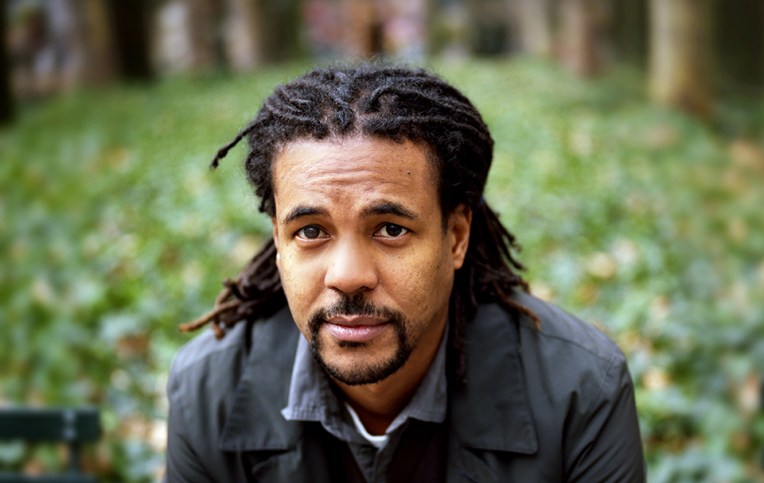
Colson Whitehead

I hadn’t connected with Cora because I was thinking of her as fictional victim of a real system, and what would be the point of connecting with her when there were so many real victims to grieve for first?  But, of course, I had completely missed the point: Cora is the fictional victim of a fictional system, the catastrophic future we avoided, but only just.  I needed to grieve Cora because of easily she might have existed.

And so, months later, I understood: the point of ‘The Underground Railroad‘ wasn’t to teach me that slavery was terrible – I know that, anyone who has morally developed past the level of a tadpole knows that.  ‘The Underground Railroad’ was trying to tell me that we cannot comprehend the institution of slavery if we negotiate with it as an evil that was – we must instead understand it as an evil that might still be, but for the narrowest of escapes.  Chance, the accumulation of millions of tiny historical accidents, pulled us away from evil – it was NOT our robust moral good sense, and so we must understand the evil as, in some sense, on-going.  Slavery was not given up unanimously and voluntarily, but had to be crushed by force of arms, and so, in some sense, it continues in the heart of our citizens.  

Which means that, in some sense, it continues.

Cora isn’t fictional, exactly – she just doesn’t happen to be real.  

I don’t know whether I love ‘The Underground Railroad: A Novel‘ now, but it has slowly hollowed me out over the past few months.  I have come around and stand a little in awe of it now – I feel as though I have been tossing around a toy grenade and someone just told me it was active, like I was being careless with something very powerful.

So ‘love’ isn’t the right word – ‘fear’ is.  I am afraid of ‘The Underground Railroad‘.  I sat and thought for months and discovered that I had been afraid all along.

The Bone Clocks

By David Mitchell

All Posts Contain Spoilers

Sometimes bad novels are so good.

I’ve just finished ‘The Bone Clocks‘, by David Mitchell.  It was a bad book, but not the sort of bad book that you resent having started.  It didn’t have the sort of badness which makes you angry at the author for trying, for his pretensions or mistakes.  It was the kind of bad book you love, that you tear through.  It was a Great Bad Book.

David Mitchell.jpg
David Mitchell

I’m not saying that David Mitchell is a bad novelist, or a bad writer (which are different things); he’s not necessarily either.  He’s definitely not a bad writer: his prose ranges from competent enough to ignore to quite good, depending on the book and the time.  I would say that he’s actually a decent writer.

And, though I have only read two of his other books, ‘Cloud Atlas‘ and ‘The Thousand Autumns of Jacob de Zoet‘, neither was a bad novel.  ‘Cloud Atlas’, it’s true, hovered around the same kind of badness that ‘The Bone Clocks‘ possesses, but was original enough that, I think, managed to just avoid the downward spiral of real badness.

And ‘The Thousand Autumns of Jacob de Zoet‘ was great.  It was a lovely novel, moving and human, one of the very few books that has ever made me cry.  I think, perhaps, the discrepancy between ‘The Thousand Autumns of Jacob de Zoet’ and both ‘The Bone Clocks‘ and ‘Cloud Atlas‘ has something to do with their genres.  ‘The Thousand Autumns’ is simply a little love story; it isn’t science fiction or fantasy, which the other two are.  I think that, perhaps, science fiction and fantasy (certainly fantasy) slide more easily into plotty badness.  Something about the genre tempts authors to the sort of over-written theatrics which make books bad but fun to read.  Novels grounded in reality tend to be a little bit tighter.

The Bone ClocksThe Bone Clocks‘ is, in many ways, ‘Cloud Atlas‘s half-baked little brother.  It is also a story which follows multiple characters, all supernaturally connected, through time.  But while ‘Cloud Atlas’ follows what seem to be incarnations of one or two people through many, many generations, ‘The Bone Clocks’ is about one long human lifetime, namely the life of Holly Sykes, as it is crossed, intersected over and over, by a, uh, group of reincarnating mystics at war over the harvesting of human children to feed their eternal lives.

It’s exactly the sort of grandiose and silly premise that Great Bad Books are made of.  ‘The Bone Clocks‘ is the story of a magical war between good and evil, and like all such stories, the joy of it is in the ludicrous, and yet somehow absorbing, details.

In the world of ‘The Bone Clocks‘, there exists a class of immortals, called Atemporals, souls which involuntarily reincarnate 49 days after their deaths into the body of a dying child.  One group of these Atemporals, calling themselves the Horologists, are at ‘psychosoteric’ war with the Anchorites.  The Anchorites were once just regular mortals, but they have used dark technologies, gifted to them by the Blind Cathar, to achieve immortality.  However, in order to achieve this, they must routinely sacrifice a child.

Holly Sykes is a psychic, and so her life becomes tangled up in this psychosoteric war.  ‘The Bone Clocks‘ takes places in six chapters over the course of her long life, starting in 1984 and ending in 2043, in a very different world than ours.

And it’s just silliness, from beginning to end: joyful, diverting silliness.  David Mitchell has great strengths as a storyteller: he has a gift for the demotic (his characters sound and act like people on TV), and he’s great at constructing the elements of plot: pacing, building to a climax.  He gives scenes texture, but doesn’t linger – he’s very plotty.

And he’s just the right amount trashy, at least in his sci-fi/fantasy novels.  A multi-generational war of magic between the Evil Anchorites and the Good Horologists, which will culminate in a battle in the Temple of the Blind Cathar?  Come on, that’s almost unspeakably cheesy!

You know what it made me think of?  Do you remember that South Park episode, ‘Cartman’s Incredible Gift’, from Season 8, where Cartman pretends to be a psychic and ‘battles’ a bunch of other fake psychics?  Where all the psychics stand opposite each other and touch their temples and go, ‘Wa na na na’?

The whole book is like that.

And it’s not that Mitchell is pretending that it isn’t cheesy – ‘The Bone Clocks‘ isn’t pretentious, not at all.  Rather, he simply doesn’t seem to care whether or not it’s cheesy, which means that, in a weird way, you don’t.  If he were looking down his nose, using the Anchorites and Horologists as some highbrow metaphor, then ‘The Bone Clocks’ would be insufferable.  But I, at least, didn’t get the sense that that was what he was doing.

Rather, ‘The Bone Clocks‘ feels like David Mitchell got a neat idea for a story and decided to tell it: wouldn’t it be kind of interesting if reincarnation were true, but only some people had the ability to do it?  And then some other people figured out how to do it, but they had to do something terrible in order to achieve it?

What terrible thing would you do to achieve immortality?  That is an old question, one that we ask ourselves over and over.  What price would be worth your boundless life?  At what point during that evil eternity would it cease being your life?  At what price, once paid, do you stop being yourself?

We are obsessed with that question not just because we are fixated on our own deaths, because we are devoted to avoiding them – we ask that question because it’s an essentially fun question to ask.  It’s a fun problem to think about, and it’s fun to think about it here.  It’s not sophisticated, it’s not ‘good’, but it is fun.

Sometimes, silly scenarios are the best way to explore the scariest and most important questions.  Sometimes, silly meditations are the best meditations.  But, honestly, it doesn’t matter, because they’re fun.

World War Z

An Oral History of the Zombie War

Max Brooks

All Posts Contain Spoilers

Any reader of books knows that the books you love, the books you proselytize, the books you recommend to people at parties and display proudly on your shelves, say almost as much about you as you might about them.  And, of course, some kinds of books are more rewarding, in terms of what they say about you, than others.

Masterpieces make for lousy social accessories.  These are the Books Everyone Thinks Are Great.  No matter how much you may love a classic, no one will think better of you for it, for the simple reason that they all also believe that they love the classics.  Loving these books is no feat, because it requires no personal judgement at all.  You won’t ever impress anyone by loving ‘Hamlet’.

Some books, it’s fun to love them because everyone knows that they ought to love them, but no one has actually read them.  We can think of these as the Books You Love So That You Can Show You’ve Read Them.  This is how people who actually like Proust get to feel all the time*.

*I’m not one of these people.

And then there are the books which no one expects anyone to enjoy, because they aren’t fun at all.  These are Books Which Show Character.  It’s really fun to love these books, because then people think that you have unexplored depths, that you must know something that they don’t know, or that you possess a tortured, artistic soul.  Imagine how fun it would be to announce that your favorite book was, oh, ‘The Anatomy of Melancholy’.

But my own personal favorite category, in terms of social accessorizing via reading list, is Secretly Great Books Everyone Else Thinks Are Trash.  I’m a little contrarian, so it gives me enormous (and, yes, extremely juvenile) pleasure to go to bat for books which everyone else thinks are Beach Reading, to argue that these books are, instead, Great Art.

World War ZSo here I go:  I think that ‘World War Z‘ is Great Art.

I’m not exaggerating for effect – I love this book.  I think it’s magnificent.  I’ve now read it three times, and I like it better every time I read it.  No, I love it better every time I read it, and I refuse to be ashamed of this fact.

World War Z‘ is, as advertised, the oral history of the Zombie War.  It is a collection of the personal reminiscences of the survivors, from all over the world, from the ordinary citizens who witnessed it to the presidents and generals who prosecuted it.  It covers the entire war, from the first few cases, the handling (or mishandling) of the outbreak by various nations, the desperate flight of millions of people from the cities, the overwhelming and near extinction of the human race, and the eventual beating back, the destruction, of the zombie menace.

I love this book.  I love this book because it is so smart.  It’s smart and it’s thorough, thought-out and careful and precise and imagined down to the last detail.

I’m going to land on this point with a little more emphasis, because I am sure that most people unfamiliar with this work (or, heaven forfend, people who saw the movie) would be surprised, perhaps, to hear ‘smart’ as the primary description of a book about, uh, zombies.  Literal zombies.

But that’s the thing about smart – it can work with anything, can make something brilliant out of starting material which is, well, stupid.

ZombieZombies have never been my favorite metaphor.  All the ghouls and goblins have their metaphorical purpose, the existential conundrum they were written to pose to us.  Vampires are about the price of immortality; werewolves are about our inner beasts.  Ghosts are about death (obviously).  Zombies are about humanity, what makes us human, whether it’s our bodies or our minds.  Zombies (usually) ask the essential question: when do our loved ones stop being themselves?  When can we let them go?  When are we willing to destroy them?  Could you shoot your mother in the face, to save yourself?  Your child?  Your spouse?

But that’s not what ‘World War Z‘ asks, not exactly.  ‘World War Z’ is a novel of geopolitics; it is a novel of logistics.  Its nearest analog, to my mind, is Asimov’s ‘Foundation‘ trilogy.  It’s a novel about how societies cope with unimagined and unmanageable threats, threats that come from within.  Arational threats.

I recognize that this is not ‘Walking Dead’-sexy, but it’s a lot smarter.  And it’s more interesting, more fun to read.  There aren’t any hand-to-hand battles with zombies here, no slow, wrenching transformations of loved ones.  This isn’t a book about people as individuals; it’s a book about people as nations, people as animals.

And it’s plausible, super plausible.  It’s the kind of the book that makes you feel as though, if a zombie apocalypse happens, it’ll look a lot like this.  Not the way it will look to you (or to a bunch of people way better-looking or tougher than you), but how it will look from above, how it will look on a grand scale.

Max Brooks
Max Brooks

This is so much more interesting than watching a bunch of grubby people scramble around in the woods.  Zombies just aren’t that interesting as an interpersonal problem, but as a logistical problem, they are fascinating.  They are both a disease and an enemy, a contagion and an infiltration.  And ‘World War Z‘ captures this so well, holding the problem up to the light and holding it this way and that, so that you can admire facets of it that you’ve never noticed before.

I’ll give you an example, perhaps my favorite example, of a really great tweak to the old zombie problem.  It comes in the middle of the book, as the tide begins to turn.

(Remember that the book is structured as a series of interviews)

“The biggest problem were quislings.

Quislings?

Yeah, you know, the people that went nutballs and started acting like zombies.

Could you elaborate?

Well, as I understand it, there’s a type of person who just can’t deal with a fight-or-die situation.  They’re always drawn to what they’re afraid of.  Instead of resisting it, they want to please it, join it, try to be like it…But you couldn’t do it in this war.  You couldn’t just throw up your hands and say, ‘Hey, don’t kill me, I’m on your side.’  There was no gray area in this fight, no in between.  I guess some people just couldn’t accept that.  It put them right over the edge.  They started moving like zombies, sounding like them, even attacking, trying to eat other people…Do you know that quislings were the reason some people used to think they were immune?…I think the saddest thing about them is that they gave up so much and in the end lost anyway.

Why is that?

‘Cause even though we can’t tell the difference between them, the real zombies can.  Remember early in the war, when everybody was trying to work on a way to turn the living dead against one another?  There was all this ‘documented proof’ about infighting – eyewitness accounts and even footage of one zombie attacking another.  Stupid.  It was zombies attacking quislings, but you never would have known that to look at it.  Quislings don’t scream.  They just lie there, not even trying to fight, writhing in that slow, robotic way, eaten alive by the very creatures they’re trying to be. (p. 198)

You have to admit, that is brilliant.  It’s better than brilliant: it’s correct.  It is a true observation about humans, but placed in an entirely fictional, terrifying, absurd context.  Or, to be more precise, it is an entirely fictional, terrifying, absurd context which draws your attention to a true observation about humans you had already made, but had never really understood.

That’s what science fiction is for.  That’s what it does: reteaches you things you already knew, or should have known.  This is also, by the way, what Great Art does.  And I will defend as Great Art any book which takes something you thought you knew, no matter how stupid, and then twists and turns it back around on you, so that you discover that you were looking at yourself all along.

The Power

By Naomi Alderman

All Posts Contain Spoilers

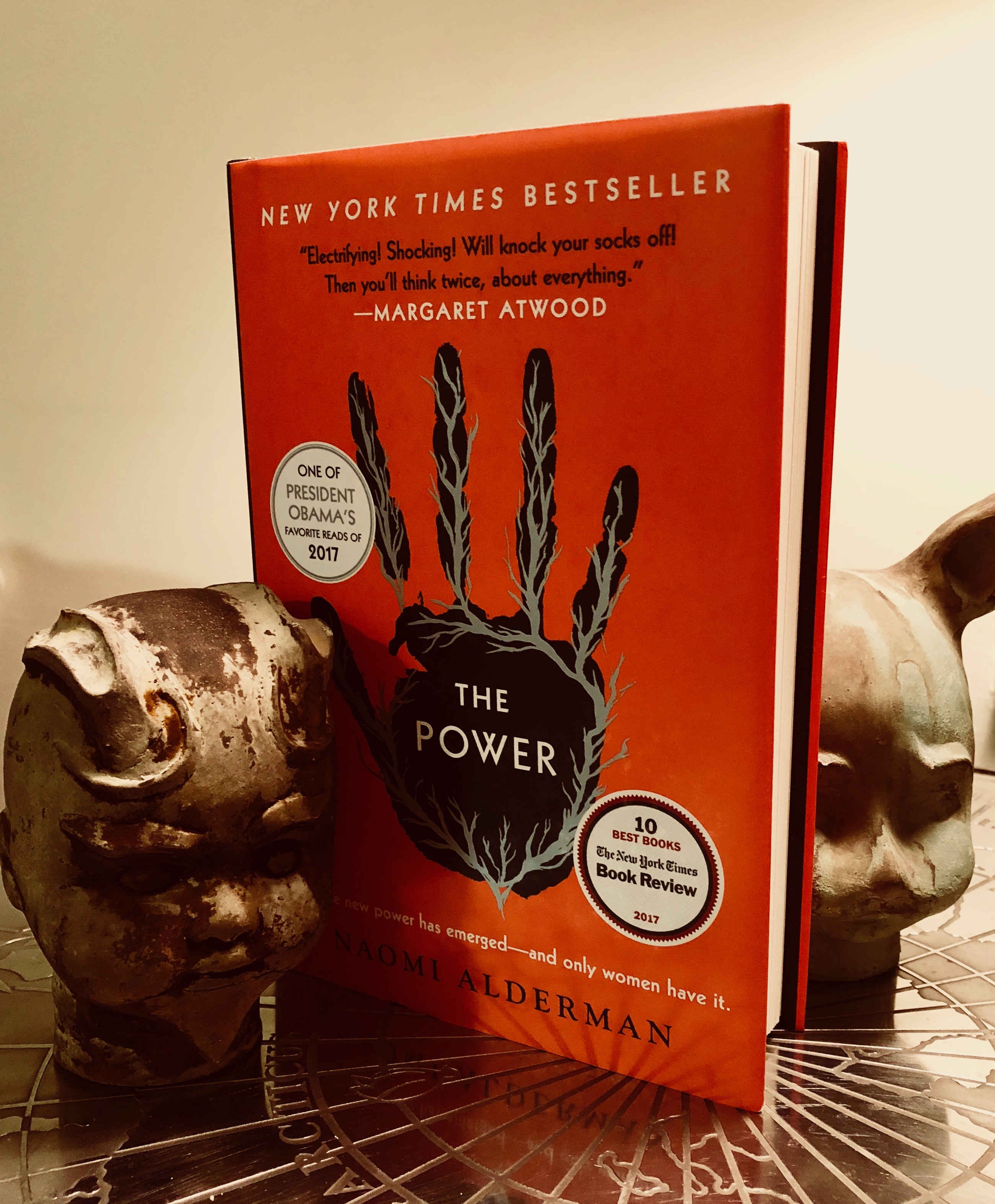
The PowerHere’s an unusual event: I’ve actually read the book of the moment within a calendar year of the moment itself!

I’m not a trendy soul, not in anything really.  My tastes have never been fashionable, not in music, not in clothes, certainly not in books.  My favorite authors are all dead: Graham Greene, Evelyn Waugh, George Orwell, writers who chronicled different times in old-fashioned language.

I tend to cast a leery eye on contemporary fiction.  To my mind, it has not yet been vetted, polished smooth by years of beloved readers, safely endorsed by generations.  It is risky, it has a too-high likelihood of wasting your time, and with so much to read in this world, I am loathe to waste my reading time on books which may turn out bad.

But every once and a while, (and quite a bit lately, it feels like) I end up picking up a new and trendy book.  And every once and a rarer while, I pick it up when it is still trendy.  And so it has turned out with ‘The Power‘, which I grabbed in the airport in a panic, worried that I was going through my other books too quickly and wasn’t going to make it through my vacation with enough to read (this is a particularly bad way to choose a book: airport reading, like airport eating, is almost always junky).

The Power‘ supposes that women a power.  It starts with young women, girls really, but young women can teach it to older women, and soon all women will have it.  This power, which originates in a new organ, a string of muscular tissue between their shoulder blades, allows them to send electrical current out from their hands, injuring and even killing other people with it.

This power will completely reorder the world.

First will come liberation, freedom from the restraints and authorities of men.

Then will come revenge: riots, gangs of women will swarm through cities, finding male offenders and brutalizing them.

Then, finally, will come control.  Women will take possession of a state, in Eastern Europe, and impose a set of state sanctions on men: all men must have an official female guardian, they will not have freedom of travel, they will have curfews.

I was deeply skeptical about ‘The Power‘ going in, and not just because it’s modern.  I don’t usually go for gender war stories – I tend to find them over-simplifying.  And ‘The Power’ threatened to simplify gender dynamics to the point of cretinousness: throngs of newly empowered women finding out men who traffic in sex slaves and roasting them alive.

But ‘The Power‘ is more than a novel of vengeance, more than just a imaginative bloodletting (although it does feel like that sometimes).  It is a meditation on power, and on gender.  It asks, and answers, the question, ‘Do men act brutally because they are men, or do they act brutally because they have power?’

Or, to put it another way, ‘Are men and women intrinsically different?  Are their differences differences of morals, or differences of strength?”

Or, “Are women really any better than men?”

The Power‘ answers this question clearly and emphatically in the negative.  Women in ‘The Power’ are no better than men, and, as they come to understand and coordinate their power, they will do to men, in short order, all the terrible things that men have done to them.

It’s always pleasant to read a book which agrees with your worldview.  This is not less true for me just because my worldview is dark, nihilistic and grim.  I like having my prejudices confirmed just as much as the next guy.  And so I enjoyed ‘The Power’ the way one enjoys seeing one’s own dire predictions played out in fiction.

As I mentioned, ‘The Power‘ isn’t subtle.  The metaphor is, well, it isn’t really a metaphor, is it?  It’s a parable, crystal clear and morally direct.  And I was prepared to be offended by the obviousness of the parable – I don’t like being talked down to by books.

Naomi Alderman
Naomi Alderman.  By the way, the Guardian has the best author photos.

However, sometimes the simpler a fictional moral problem is, the greater the force it has, and that is the case with ‘The Power‘ (this is also the case with the most rudimentary and effective moral tale of our time: ‘Star Wars’).  The truth is, despite my initial skepticism and my sense of being insulted, ‘The Power’ landed on me like a ton of bricks.  I didn’t even really notice how affected I was until I finished, until I put the book down and realized that I felt unsettled, implicated and guilty, contaminated by the things I had seen in the pages I just read.

I mean this as a compliment, an extremely high compliment.  The ability to elicit an emotional reaction from your reader is one of the reasons for a novel existing, and not all novels wish to make you feel good.  I feel pretty confident that Naomi Aldermen didn’t want me to feel good, maybe about anything, maybe ever again.

This is not a reason not to read her book!  On the contrary, it is a reason to read it right away!  Most grim-natured books don’t get it quite right, they aren’t emotionally effective somehow.  They either swing too hard at your fear, or yank too hard at your heart strings, or build a world too bleak, marked by violence too frenzied.

IMG_0014
One of the book’s rare illustrations (p. 180).  ‘The Power’ is science fiction, and part of the story takes place thousands of years in the future.

The Power‘ doesn’t do this.  It rarely over-plays its hand – there were only one or two moments in the entire book when I thought, ‘That might have been a little much’.  Mostly, the book communicates not through violence but through a sense of building dread, of disaster rolling inexorably toward you, a hope that humanity will save itself and a sure knowledge in the pit of your stomach that the hope is vain.  And when the storm finally breaks, you feel the confirmation as a low blow, not painful exactly, but dreadful.

Partly, Alderman does this through her use of spare, direct language.  The ridiculous blurbs on the back of the book say garbage things like, “gorgeously written” (Ayelet Waldman) and “Will knock your socks off!” (Margaret Atwood, to whom Alderman is being compared – I suppose the comparison to ‘The Handmaid’s Tale‘, which is facile, is too easy to resist).  This is nonsense – it is not gorgeously written – it is bleak, and effectively written, and that is much, much better:
“They start by rounding up the young man.  They go tent to tent, pulling them down or setting them on fire so the occupants have to run out or burn.  They’re not neat about it, not methodical.  They’re looking for any halfway-decent-looking young man.  She was right to send Tunde into the forest.  A wife, or perhaps a sister, tries to stop them from taking the pale-skinned, curly-haired man who’s with her.  She fights off two of them with precise and well-timed jolts to the chin and the temple.  They overwhelm her easily, and kill her with a particular brutality.  One of them grabs the woman by the hair and the other delivers a bolt directly through the woman’s eyes.  Finger and thumb pressed against her eyeballs, the very liquid of them scrambled to a milky white.  Even Roxy has to look away for a moment.” (p. 315)

As you can see, there is no hiding from prose like this.  It’s unrelenting, and at the end you feel as though you’ve been chased down and forced to look at something ugly, and real, and all the uglier for being real.

But it’s highly worth doing – I’m glad that I did it.  If there weren’t ugliness in the world, books like ‘The Power‘ wouldn’t have any effect at all.  And as long as they are effective, that is a sure sign that we should be reading them.

Seveneves

By Neal Stephenson

All Posts Contain Spoilers

It’s been a long time since a book has upset me this much.

I mean that as a compliment.  Novels elicit a very few, predictable emotional states from me: intellectual appreciation, amusement, the fun of learning something new, and sometimes, when they are really excellent novels, anger or sadness at the unfairness of the world, the cruelty of people.

But it is rare that a novel makes me feel the way ‘Seveneves‘ has: dreadful, afraid, oppressed, a little grief-stricken, and, I think, even rarer that the novel should be End-of-the-World science fiction, a genre which normally moves me little*.  Most apocalypse scenarios are far-fetched MacGuffins; they have very little emotional resonance in of themselves, at least for me.  You are meant to care about the characters – the apocalypse is there only to put them in extremis.

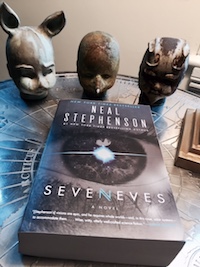
SevenEvesBut ‘Seveneves‘ is different.  The premise of this novel is that, one day, one normal day, in our world in our reality, a rapidly moving cosmic event, perhaps a small black hole, causes the moon to shatter into seven large pieces.  The pieces have the same center of gravity as the intact moon, and so remain in orbit around the Earth.  As they begin to collide with one another and fragment, astrophysicists figure out that their collision and fragmentation rate will accelerate.  Eventually, the pieces will begin to fall to Earth in an ‘Hard Rain’; they will super-heat the atmosphere, setting it alight, killing all life on Earth and boiling the oceans.  At the time of the initial event, the Hard Rain will begin in approximately two years.

Seveneves‘ is the story of humanity’s preparation for the Hard Rain, its desperate attempts to put as many people on the International Space Station as possible, and the sequelae, in space, of the extinction of life on earth.

Stephenson
Neal Stephenson

I’ve been trying to figure out why ‘Seveneves‘ is so effective.  It isn’t because it’s perfect.  Neal Stephenson has great strengths as a writer, and some weaknesses, most of which are on display here.

For example, he has trouble with endings, and the ending of ‘Seveneves‘ is emblematic: the book wraps up suddenly and anti-climactically after nearly 800 pages of vividly-imagined plot, as though Stephenson, after saying what he wanted to say, got bored and wandered away from his writing desk.

And not all of it is equally well-imagined.  Stephenson loves physics and engineering: there are pages and pages of loving, fastidious descriptions of orbital mechanics and robotics programming, so long and so detailed that they come to feel almost punitive.  No detail of physics is left unelaborated.

However, much of the second half of the book hinges on a small miracle of biology taking place, on a revolution in gene-editing technology which would require that genes work entirely differently than they, in fact, do work in real life.  The future of humanity relies on, and cannot be understood without, this miracle, but it receives only a paragraph of Stephenson’s attention.  He doesn’t even posit a mechanism of action – he simply asserts that genes work this way, and that scientists may manipulate them thus, with such and such results.

It goes like this:

“…the point is that I can get a digital record of its DNA.  Once that’s in hand, it turns into a software exercise – the data can be evaluated and compared to huge databases that shipped up as part of the lab.  It’s possible to identify places on a given chromosome where a bit of DNA got damaged…It is then possible to repair those breaks by splicing in a reasonable guess as to what was there originally…if it’s a disease – something on the books, defined in the medical literature as such – I will fix it…Once all that is done, each of us gets a free one…one alteration – one improvement – of your choice, applied to the genome of the fertilized ovum that will grow into your child.  And your child only….So, Camila, if you think it would improve the human race to get rid of its aggression, why then, I will search through the scientific literature for a way to reach your goal genetically.” (p. 552- 562)

Habitat Ring
A graphic from the novel – you can see that, when he cares to, Stephenson really thinks things through.

Maybe it’s because biology is my day job, but this unevenness bothered me.  The point of hard science fiction (well, one of the points) is the science; to just gloss over the parts you’re not interested in so you can rush back to describing robot movements cheats the reader.  This is especially glaring when they are crucial to the plot, when they represent far and away the most important scientific advance depicted in your science fiction book!

But this unevenness doesn’t blunt the emotional effect of this novel, which springs, I think, from two things:

  1. There is something viscerally upsetting about the disintegration of the moon.  The effect on the reader of imagining a moonless earth is primitive and unsettling and super-effective.  And Stephenson achieves it with very little fuss – there are no long passages of devotional description of the moon, no exploration of its place in our cultural imagination.  The novel begins when the moon ends, and, like the old cliche, you discover that you had been unaware of what you had until it was gone.
  2. According to Stephenson’s premise, humanity has two years in which to confront its own annihilation.  Some authors would have taken that opportunity to show a depraved humanity, a burning, anarchic world, man’s heart of darkness let loose.  Stephenson does not, and the mostly calm manner in which his world walks towards its own destruction is more affecting than mayhem and evil could have been.  Most people continue to live lives which very much resemble their old lives, but why?  What meaning can your routines possibly have when, in the near future, you and everyone you love will die in flames?  For that matter, what meaning do they have now?

I didn’t enjoy this book – that verb is inappropriate.  In fact, I spent much of it in the grips of a morbid agitation, unable to relax or be cheerful.  But I was completely glued to it; all my free time went to reading it.  If you’re looking for a feel-good romp, this is not your book.  But if you’d like to be freaked out, to work hard for the privilege of being unsettled, if you want to spend some time absorbed in a genuinely dark, movingly dark, future, this is your book.

*Although, now that I think about it, the only book which has unsettled me in this way in recent memory is, weirdly, also sci-fi: ‘The Reality Dysfunction‘, by Peter Hamilton, which describes a vision of the afterlife which made me want to run screaming into the nearest church.