The Shining Girls

By Lauren Beukes

ALL POSTS CONTAIN SPOILERS

This book wasn’t as bad as I thought it would be.

I’ll admit, I only read it because it’s been made into a TV show. When I see a new show (or movie) that has been adapted from a book, I feel peculiarly guilty about watching it if I have not first read the source material. I have a prejudice that, since the book was first, it is the “real one” and anyway it’s probably better. So, as soon as I heard about the TV show for ‘The Shining Girls’, I dashed out and bought the book.

Now, of course, genuinely shitty books do occasionally get made into better movies (ahem, ‘The Godfather’, ahem). And just because someone was willing to make a TV show of it does not necessarily mean the book was worth reading in the first place. But it does mean that someone took a look at the plot and thought it was interesting or cinematic enough to hold the attention of a TV audience. More, it means that someone thought it was interesting enough to put their money where their mouth is and make it.

And I was intrigued by the plot of this one. ‘The Shining Girls’ is a murder mystery about a time-traveling serial killer, and it sounded like it might just be crazy enough to work.

It’s a real thing, the Just So Crazy It Works Plot, but it’s rare. It needs beautiful execution: control, balance. It’s much more likely to work on screen, I think, but there are books that are completely captivating despite being impossibly outlandish: ‘And Then There Were None’ by Agatha Christie, for example (best murder mystery every written, in my opinion). Or, say, ‘The Life of Pi’ by Yann Martel. Or anything by Thomas Pynchon or Carl Hiaasen (a guilty pleasure writer of mine). Just because a plot is ludicrous doesn’t mean that the book will be bad.

And the plot of ‘The Shining Girls’ is ludicrous. As plots go, this one will not benefit from a synopsis, but I will provide one anyway. One day in 1931, Harper Curtis discovers a House. Though it appears derelict from the outside, the inside of the House is richly decorated, and upstairs, written on the walls, are the names of girls. Girls that shine, though with what, we will never quite learn: potential, life, energy. The House, Harper discovers, will allow him to travel to any time of his choosing (between 1929 and 1993, anyway). In exchange, all Harper has to do is kill the Shining Girls: to find them, whenever they live, and disembowel them.

Kirby is one of the girls. When Harper comes for her, in 1989, her dog manages to chase him off before he can finish the job, leaving her with horrible scars and a determination to find Harper, and to stop him.

My expectations were pretty low, going in. I expected the writing to be bad, and the plot to be stupid. I was wrong about the writing – Beukes only distracted me with clunky writing a few times, and it was usually in an attempt to do period-appropriate dialog that fell flat. Mostly, the prose held up: not annoying, not alienating, not confusing.

But the plot, the plot is another thing altogether.

Here’s the thing about wacky plots, I think: to pull them off, you really need to commit to them. If they rely on a crazy mechanic (time-traveling, a house that compels you to murder young women), you can’t flinch from it. You need to show it to the reader, let them look on it in full and at leisure. If you try to gesture at it and then move on, it will perversely only draw their attention to the fact that it makes absolutely no sense.

Beukes, I think, makes this mistake. The House, the girls, the time-traveling: none are explained, none are even well-described. Harper feels compelled to kill specific girls; he knows psychically where they are. He opens doors and finds himself in different decades. Bodies appear and disappear and reappear again – people who have been killed come back. Everything, we are told, is a circle, but we are never told what the hell that means. The entirety of this eccentric plot rests on a mechanic – a time-traveling murder house – that we do not understand at all. And, ultimately, that isn’t good enough.

It’s strange to complain, of a murder mystery, that there isn’t enough about the time-traveling house, but that’s what I’m saying. I suspended all my disbelief to read about a serial killer whose House makes him travel through the 20th century to murder certain young women, and if I’m going to suspend my disbelief that far, I want all the unbelievable info in return. And I was not satisfied.

I wish there had been more detail. I wish there had been more information. Beukes takes the entire novel at a sprint and it feels rushed. The chapters are too short. The perspective skips between multiple characters, and, because the chapters are so brief, the switching feels chaotic. You can’t settle into anything. Nothing was clear – nothing is resolved.

We never learn what the House is, how it travels through time, or why it does. We don’t know where it came from, who built it. We don’t learn what is special about the girls, whether it is something real or a delusion of Harper’s. We never learn why the House requires their deaths; we never really even learn if it actually does, or whether Harper simply wants it to.

Lauren Beukes

And it’s not that every single question needed to be answered in full. I get that there is a place in literature for mystery. There is a way to do magic without explaining magic, and sometimes that is the better option. In fact, it often is. We were all better off, for example, when the Force was just the Force, and no one had ever heard of midichlorians.

And there might have been a way to do ‘The Shining Girls’ without jilting the reader and without explaining the House. I don’t think it was just the lack of explanation that ended up being problematic for me; I think it was the combination of the lack of mechanistic insight, and the too-brisk pace that did it. It felt as though Beukes knew that the premise (time-traveling murder house) wouldn’t bear up to sustained examination. It felt as though she wanted to write this story, this plot, but she also felt insecure about it, so she rushed to get it over with. It felt like she didn’t believe in it, and that’s the kiss of death for a wacky plot.

You can’t write the time-traveling murder house and then flinch from the time-traveling murder house. You have to lean in to it, to own it, glory in it. I think, to make it really work, you need to be proud of the time-traveling murder house. It would have been difficult, I’ll grant you: it would have taken HUGE authorial balls. But I think she could have carried it off, though. She’s capable enough as a writer, and certainly doesn’t lack for imagination. I wish she had tried.

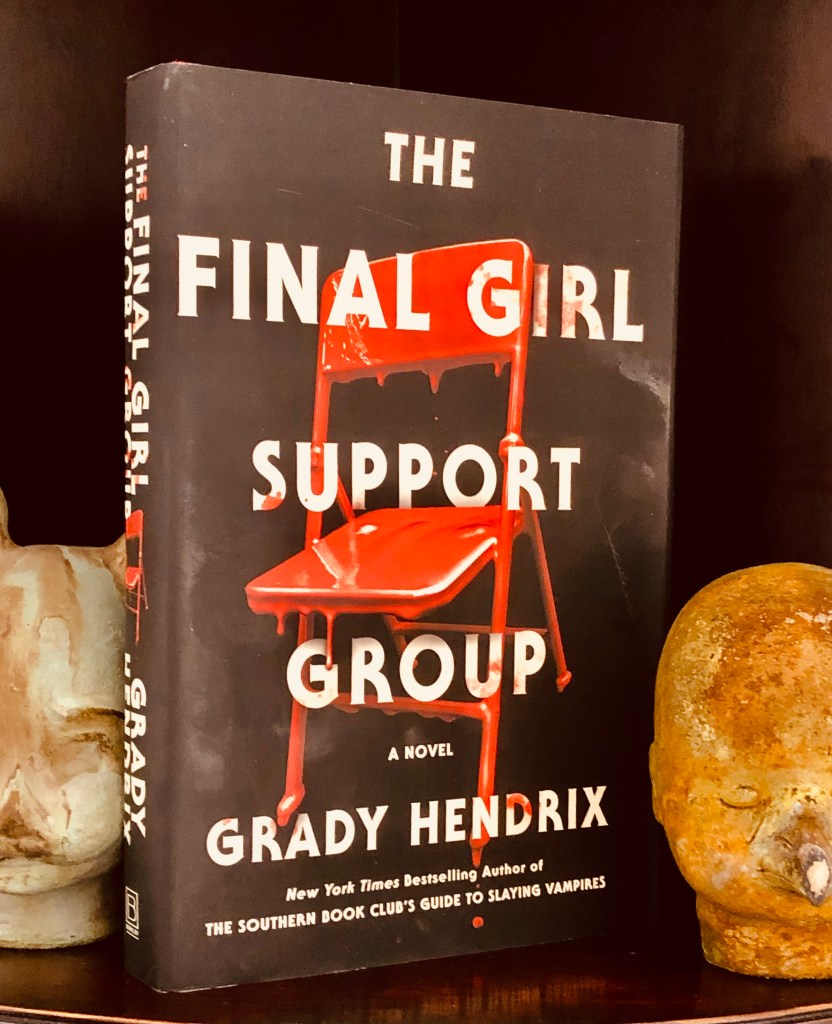
The Final Girl Support Group

By Grady Hendrix

ALL POSTS CONTAIN SPOILERS

At this point, everyone here knows that I am a sucker for a good premise. I’m too attached to them, I know – I can’t resist them, and I am often drawn into books which are clearly going to disappoint me simply because I am charmed by their premise.

My attachment also causes me to be disproportionately enraged when I feel a good premise has been wasted in poor execution. I am much angrier at a mediocre book with a great premise than I am at an all-out bad book with a bad premise, which is completely irrational.

The Final Girl Support Group‘ has a great premise. Lynette, Dani, Marilyn, Julia, Heather, and Adrienne are all Final Girls: the only survivors of deranged serial killers, the terrorized young girls who finally brought them down. They meet once a month in a support group, although over the decades since their victimization, they have become tired of each other. The need for the group has diminished and some of the members are hoping to disband until one of them, Adrienne, is murdered in exactly the kind of psychotic rampage that she avoided decades earlier. When Lynette is attacked next, it becomes clear that someone is hunting down Final Girls.

OK, yeah, it’s not High Art. But bear with me here:

At this point, I think it’s time for us all to admit that horror movies are a mature genre. And as a mature genre, they can be meta-analyzed: they can be understood as metaphors, they can be explicated, meaning can be distilled from them.

Not many people want to do this work, because horror movies are considered Low Art (if they’re lucky – many people just consider them trash). But, I would argue, people should do that work, because horror movies are important. They tell us something about ourselves, and our culture: they are instructive. There is always, always information in what scares us, and there is always, always information in whom we choose to inflict violence upon, whether it is real or imagined. Horror movies reveal something about us, and it’s worth looking at what that is.

Women (especially young, beautiful women) have a special role in horror movies, and that role is what ‘The Final Girl Support Group‘ is about. Women are the victims we save for the most imaginative and sadistic violence. That is what this novel wants, I think, to explicate: the pleasure we take in watching psychos brutalize young girls.

The problem is, there are two ways to for a novel to be “about” something. Novels can explicate things, problematize them, show them to us in a new light or from a different perspective. Or they can simply reiterate the problem, sometimes while exclaiming: Look at this problem!

This latter is what ‘The Final Girl Support Group’ does. I really do think that it was intended to be a problematization of the violence against women that is a mainstay of horror stories, but it basically just ends being a horror story featuring violence against women. The violence is specific, creative, brutal: all the things which characterize the very horror movies that Hendrix intends to lampoon.

And here, I’m afraid, we need to get a little into the nature of satire. Satire is deliberate exaggeration in order to expose something. By its very nature, it requires the thing to be shown: it is ridiculing through the showing of the thing.

Therefore, it necessarily runs the risk of being the thing itself – if the exaggeration isn’t clear, if the ridicule is not expressed, then it definitionally fails at satire. And, yes, satire can “fail” because the reader is simply stupid: misses the ridicule. That happens all the time, especially when we ourselves are the targets of the satire, and it must be maddening for authors, to watch their works be un-ironically embraced by the very people they are attempting to mock.

Grady Hendrix

I don’t think that I am missing the fact that ‘The Final Girl Support Group‘ is satire. I see that it is meant to be mocking – Hendrix isn’t applauding the brutalization of young women, that is clear. But I feel somehow that the satire is incomplete. Hendrix shows, clearly and excessively, the absurdity of the violence we imaginatively subject women to – he explicates the trope – but there are no conclusions. ‘Look,’ he seems to be saying, ‘This is kind of fucked up, no?’

And, yeah, it is fucked up. And maybe it’s enough to say so.

But I am experiencing the grief and frustration I always feel when a good premise has been misspent. When I first finished this book, I was pretty pissed. I had been really excited to read it – had been saving it for an un-virtuous little reading treat for myself – and I wanted better from it. I felt ready to love this book, and I was thwarted.

But my anger has cooled. In my thinking, I have been unable to pinpoint what I would change about ‘The Final Girl Support Group‘, and that has given me more respect for the difficulty of the task that Hendrix set out for himself. I feel ambivalent about this novel, but I am also absolutely certain that I couldn’t do any better. I feel, as I think Hendrix does, that there is a lesson that we should all be drawing from this particular horror trope, but I can’t explain what I think that lesson is any better than he does.

Perhaps I could not have done better with this set-up, but I think someone could have. I can’t recommend ‘The Final Girl Support Group’ – I think it was a pretty pointless read, in the end – but I’m not angry anymore.

Just disappointed.

My Sister, the Serial Killer

By Oyinkan Braithwaite

ALL POSTS CONTAIN SPOILERS

“All he wants is a pretty face. That’s all they ever want.” (p. 69)

There’s an idea (which I’m not sure that I totally believe but whatever) that you can only write what you know. And even if I don’t totally believe that that’s 100% true, it certainly makes sense that writers will be able to paint a clearer picture of something which they themselves have seen, describe more accurately something which they themselves have felt.

Which means, I’m afraid, that if you want to read about women’s rage, the deep, seething fury of women against men, you really ought to be reading things that women wrote.

I’m not sure that I would have described myself as wanting to read about women’s rage, but I have found that I resonate with books about it, that I recognize them and am interested in them. I resonated withDietland‘, another novel about the violence of male priorities and disproportionate female response to them. I think everyone resonated withThe Power‘, another revenge novel of female violence (actually, there have been kind a lot of these lately, huh?)

Korede and Ayoola are sisters. Korede is older: responsible, cleanly, fanatical about order and planning. She can cook and maintain a household. She is about to be made head nurse at the Lagos hospital where she works. She walks, virtuous and lonely, through her life, taking care of the sick. And she is in love, from afar, with Tade, the handsome doctor she works with. The only person in whom she feels she can confide is a coma patient in her ward.

Ayoola is beautiful. She has the kind of beauty that causes the men around her to behave like complete idiots. She has no job; rather, she designs clothing that she models on Instagram. She is the favorite of their mother, the favorite of every man in the Lagos area, the favorite. She is bright and funny and charming and brave and the world loves her.

She has also murdered her last three boyfriends.

Each time, Korede has helped her hide the body, wash away the evidence. Each time, she has believed Ayoola when her sister told her that the killing was done in self-defense. And though it has become harder to believe each time, she has continued to keep her sister’s secret.

Until, one day, Ayoola comes to visit Korede at the hospital, and snares Tade, the doctor whom Korede has loved for so long. And Korede, with her heart broken, has to decide whether Tade, whom she knows would never hurt a soul, is safe with her sister, or whether her sister might be a much different animal than she has allowed herself to admit.

I spent most of ‘My Sister, the Serial Killer‘ thinking that the story was pretty fucking obvious. This isn’t to say that I didn’t enjoy it – quite the contrary. The book is written in a wry, spare voice and parceled into short chapters with snappy titles (some of which are so short as to almost qualify as brutal prose-poems), the combined effect of which is suspenseful and almost bizarrely readable. This is the writerly voice that Bret Easton Ellis wishes he had.

But I thought I knew exactly what story I was reading, and I was wrong (this happens to me a lot, and I never, ever learn). I thought that this was a story about a woman facing the fact that her sister is a monster, about watching the evidence pile up and trying not to see it, but eventually confronting it when someone innocent, someone else she loves, is threatened. A pretty basic, totally fun story.

“Ayoola is wearing dungarees – she is the only person I know who can still pull those off – and she is licking ice cream, probably from the parlor around the corner. She pauses the licking, not because she is moved by Peju’s words, but because she is aware that it is proper to pause whatever one is doing when in the presence of someone who is grieving. I spent three hours explaining that particular etiquette to her one Sunday afternoon.” (p. 161)

That’s not what this story is. This is one of those stories where there isn’t only one monster, and the question that Korede will eventually have to answer isn’t whether or not her sister is one. It’s whether, in a monstrous system, there are any heroes. Whether men are capable of loving, really loving, a woman for who she is, and, if they aren’t, then whether they are worthy of being loved at all. And if they aren’t, if you cannot love men, who do you love? Whether, in a world where men will always objectify, use, and abandon you, the only real love that exists is the love between women. Whether the only love that lasts is family.

Ayoola is not the monster of ‘My Sister, the Serial Killer‘, despite the fact that she is a serial killer. The monster is Tade, the kind man who, at the end of the day, can only love a woman for her beauty. Who cannot be turned from beauty even if it means saving his friendships, or his life. Who believes that his love is sincere, premised on deep connection, while it is in fact only a response to how a woman looks in a skimpy dress. Who will forgive anything (literally, anything) in the woman he loves except ugliness.

Oyinkan Braithwaite

I love stories like this, stories where the serial killer ends up not being the bad guy. Although, of course, that’s an over-simplification: Ayoola is a very bad guy. But, at the end of the day, she is all that Korede has. And, Braithwaite seems to ask, what did you expect Ayoola to become? Brutalized by her father, every man she has met since has let her get away with anything she wanted, as long as they got to treat her like a beautiful thing. Why should she treat men as though they were people, when they have never, ever, done the same for her? Just because you worship an object doesn’t mean it’s not an object.

It’s a really good question, actually. I spent most of ‘My Sister, the Serial Killer‘ rooting against Ayoola. I think I was supposed to: she’s a gorgeous, gold-digging, man-stealing serial killer. It’s pretty breath-taking that Braithwaite can take you from really hating Ayoola (the way you can only hate a man-stealer) to understanding why we will always choose her. Why we, as women, have to always choose her.

It’s especially impressive because Braithwaite accomplishes this emotional allegiance-shifting without ever declaring anything. There are no manifestos here, no pedantic speeches or feminist rah-rahing. All you as her reader experience is the world through the eyes of one woman, Korede, and you and Korede must realize together why she is angry and at whom. Korede is angry because she isn’t beautiful, you both knew that, but you must realize together that being angry at Ayoola because she is doesn’t make any sense. Because the only reason that it matters, Ayoola’s beauty, is because men are too base, too primitive, too shallow, too evil, to see anything else.

At the end of the day, ‘My Sister, the Serial Killer‘ is about who deserves our care and who doesn’t. And, in a cold, dark world, we cannot afford to extend care to those who do not care for us, who do not honor our essential humanity. And in Braithwaite’s world, men, be they ever so handsome, ever so kind, be they doctors even, do not care for us. They do not honor our essential humanity if we are not beautiful, because they don’t see us. And they don’t see us if we are beautiful, because then our beauty is all they see. And if they cannot care for us, then we should not care for them. We must care then, as sisters, for each other, even if we are beautiful.