Devil House

By John Darnielle

ALL POSTS CONTAIN SPOILERS

A few weeks ago, I wrote about ‘The Final Girl Support Group’. I expressed disappointment, because it had not turned out to be the novel that I wanted to read. Not to be too blunt about it, but I felt it had wasted an opportunity to explicate a cultural phenomenon that needed explicating (final girls in horror movies). Ultimately, however, I was unable to articulate what I needed from ‘The Final Girl Support Group’ that the book failed to provide – I didn’t have the language to describe what I wanted.
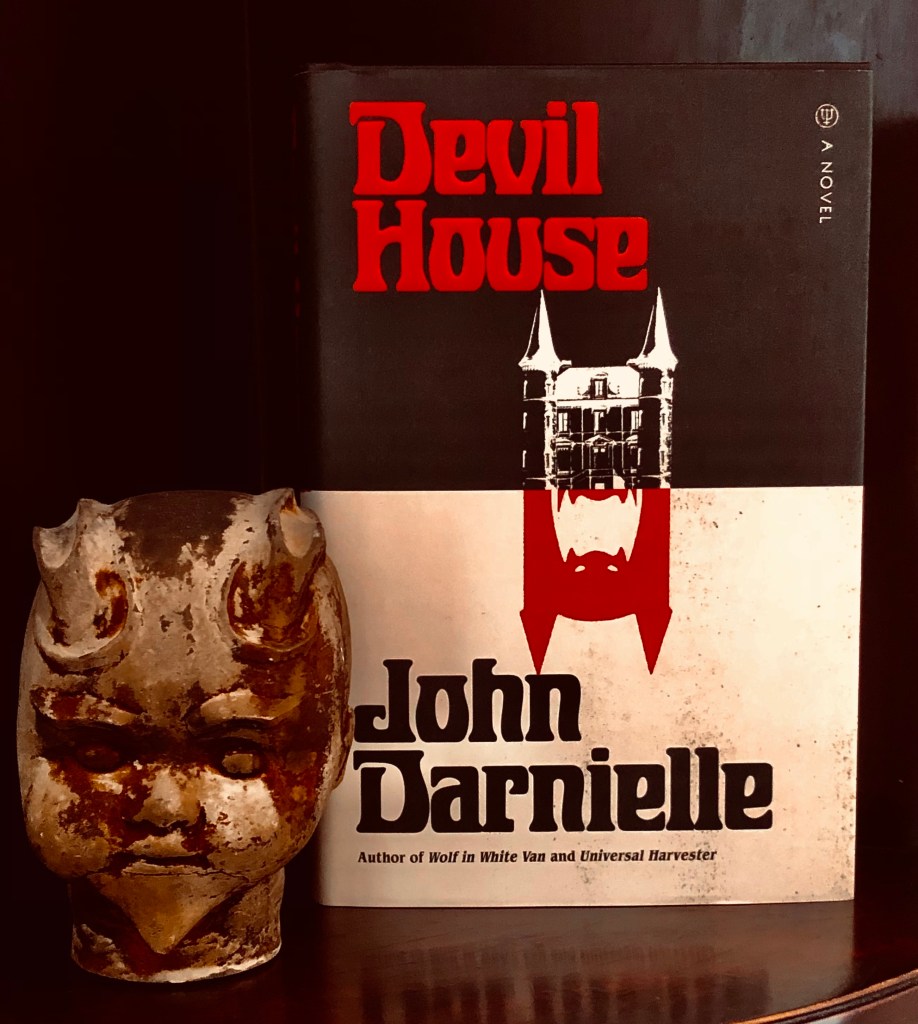
‘Devil House’ is what I wanted. ‘Devil House’ does for murder what I wanted ‘The Final Girl Support Group’ to do for horror. It is that very rare thing: a novel which is also an effective moral document, moving, smart, and not annoying.

I picked up ‘Devil’s House’ because it got really, really good reviews. More than that, it got those reviews from reviewers who seemed honestly surprised that the lead singer of the Mountain Goats actually turned out to be able to write good books (I am also surprised, because people aren’t usually good at multiple things). I get really excited when reviewers are surprised – it means they aren’t just rubber-stamping things based on cultural consensus. It means they actually liked the book they’re reviewing.

‘Devil House’ is, loosely speaking, a story about a True Crime writer named Gage Chandler who becomes professionally obsessed with a pair of grisly murders in Milpitas, California. The murders, believed to be the work of local teenagers, happened in an abandoned porn shop. The bodies, badly mutilated, were discovered amidst occult decoration, and local lore has sprung up that the culprits were a practicing Satanic cult. Chandler, who’s speciality is the extensive imagining of the spaces in which murders occur, moves into the porn shop, hoping to figure out what really happened there.

‘Devil House’ is about True Crime, as a genre, but what that really means is that it’s about our cultural relationship to murder. True Crime is, at the very least, a morally complicated phenomenon: ostensibly journalism, it also serves up actual murder as entertainment. The only reason, of course, that it can do that is because murder is already entertainment: grisly killing, under the guise of news, transfixes and obsesses us. As far as I can tell, it always has.

It’s this observation – that True Crime exists because we are fascinated, spellbound, by violent killing – that animates ‘Devil House’. By choosing a True Crime writer as his main protagonist, Darnielle risked reducing his book to a simple morality tale: crime writer gets obsessed, feels regret, bites the hand that feeds him.

This is not that novel – ‘Devil House’ is complex, and there is no such catharsis. Darnielle has chosen to write about one of the murkiest corners of our culture, and he isn’t going to resolve it for us. Instead, he asks us to think about why we spend so much time reading about the terrible things that happen to other people. Why is sexualized or occult violence more interesting? Why is a suburban domestic murder more likely to titillate us than a robbery/homicide in a dangerous neighborhood? Why are we excited by torture? Why are we excited by the deaths of people who look and act like us?

The first problem with True Crime is that is makes murder, the death of real people, into a spectator sport (or, as the book expresses in cutting epigrammatic fashion, “There aren’t any villains in a true crime book. There’s the hero, and there’s his victims.” (p. 61)).

The second problem with True Crime is that it feeds our prejudices, that we use it to confirm our interpretation of the world. We see villains where we wanted to see villains (teenagers, Satanists, the sexually abnormal), and so we miss the fact that villains are humans, too.

John Darnielle, taken from The Boston Globe

Darnielle, if ‘Devil House’ is any indication, is a great novelist. It’s really difficult to write a pedantic novel without being pedantic, to indict your reader without coming across like an asshole. I think Darnielle does it really, really well here. As a novel, ‘Devil House’ is wonderfully un-didactic: its thesis is never quite pronounced, and yet is beautifully humane: that murder is pain passed from one person to another. That the people who commit murders are, usually, individuals in some form of psychic agony (be it rage, psychosis, or desperation), and the act of murder is the explosion of that interior pain out into the world. That when we tune in gleefully to True Crime stories, we are turning pain into entertainment: the pain of the victims, and the pain of the murderers.

‘Devil House’ is the book I have been craving ever since I read ‘The Final Girl Support Group’. It is exactly what I wanted: a smart, unresolved explication of something so culturally ubiquitous that we have stopped noticing that it is completely fucked up. I don’t think Darnielle uses the word ’empathy’ once in ‘Devil House’, but empathy is the center around which the entire novel revolves: why we have it, why we lose it, and what it means when we find it again.

I don’t think Darnielle wants anyone to stop reading True Crime, by the way. He isn’t prosthelytizing. He’s running a thought experiment: what if the people we read about in True Crime books were real people? What if the person writing the True Crime book really connected with that fact, understand that his subjects (victims and murderers alike) were human beings? What would that do to him? What would it do to us, to remember that the people whose stories we read about in headlines, whose deaths we watch in docuseries, whose mysteries we try to solve in podcasts, that those are real people whose pain is equal to our own? Who were loved and cherished the same way we are loved and cherished, the same way we cherish our loved ones?

Would we be entertained then?

Djinn Patrol On the Purple Line

By Deepa Anaparra

ALL POSTS CONTAIN SPOILERS

So, one of the things that happens when you read a lot (like, a lot) is that you start to get a feel for stories.

Storytelling is like any well-developed art form: it has a sort of syntax all its own, with signifiers and allusions and conventions which become more and more familiar the more time you spend immersed in the medium.

Let me give you an example: you’re watching a horror movie. There are some teenagers, some are boys, some are girls. One of the girls is hot, blonde, and a little, er, wild. The group of teenagers all enter the haunted house/abandoned asylum/house of mirrors, and shortly thereafter the blonde girl sneaks off with a boy to screw around.

In that moment, you 100% know she’s going to die, horribly, very soon. Everyone knows she’s going to die, horribly, very soon, because that blonde girl isn’t actually a character – she’s a trope. She’s a signifier, a syntactical element, placed there in reference to a tradition (repulsive, reductive, misogynistic though it may be), placed there to orient you within the framework not of this specific story, but within all stories.

That’s a particularly unsubtle example, I know, but stories are filled with elements like this, and when you live, as I do, in stories, they become a second language. Familiarity with this language allows you to grasp, quickly, the dense web of references that most stories reside within, and, often, it can tell you, like Chekov’s Gun, what is going to happen long before it actually does.

If you get good at this language, you can often predict with eerie precision what’s going to happen in a book or movie. And, as in the case of our Slutty Blonde above, the more stereotyped a story is, the easier it is to spot the future coming.

I’m good at this language, and I’m rarely wrong about how a story ends, which is both fun and slightly boring.

Djinn Patrol on the Purple Line‘ positively bristles with signifiers. It’s incredibly obvious what kind of story it’s going be: everything about this book, the title, the cover art, the premise, promise you a funny, poignant, humane romp.

Djinn Patrol on the Purple Line‘ is the story of Jai. Jai is nine years old, and lives with his mother, father, and older sister in a sprawling Indian slum. Jai is undistinguished by any particular talent, he daydreams through school, lacks his sister’s athletic talent or his parents’ work ethic. But Jai nourishes a secret dream of being a television detective, and when children of the slum start disappearing, he decides he’s exactly the right person to solve the case, albeit with the help of his two best friends Pari and Faiz (and an adopted slum dog named Samosa).

A funny, poignant, humane romp, right?

The novel is written primarily in Jai’s voice. Or, to put it another way, it’s written in the voice of a nine year old boy. This device is usually extremely irritating, but Anaparra really pulls it off, and Jai is mostly a wonderful narrator: detailed, whimsical, bewildered, and funny. Really funny, actually – Anaparra captures very well the slightly misaligned certainty with which children interpret their world, the way that they come to very particular conclusions which are often a little askew, but reasonable based on the info they have. The workings of the world as seen through Jai’s eyes are arbitrary, magical, hilarious. Hilarious, at least, until, suddenly, they aren’t.

You know that old saw, that good literature shows, and doesn’t tell? Well, the dirty little secret is that almost everyone tells, at least a little. It makes sense – it must be nearly irresistible for authors to tell. Imagine it: you write this whole book, construct characters and metaphors and conflict and catharsis and you, presumably, do it for a reason – how can you resist pushing your audience in the right interpretive direction? Even just hinting at them what lesson they are meant to draw from your work?

Deepa Anaparra

Anaparra doesn’t tell, at all – she just describes. And she doesn’t provide catharsis, either, and it is perhaps this, more than anything, which takes her story and changes it into something else, a story I absolutely didn’t see coming. The deliberate lack of catharsis is, I think, exactly why she worked so hard to make ‘Djinn Patrol‘ look like a completely different kind of book than it is – it’s why she worked so hard to disguise it as a light-hearted mystery romp. Because mystery romps always, always get endings.

Think about it this way: imagine this premise (misfit detectives) in another setting. Imagine it, say, in a quaint English village in the 1930s – you’ve got Jeeves and Wooster. Or in a working-class Indiana neighborhood in the 1980’s – you’ve got ‘Stranger Things’. Or ‘Harriet the Spy’ or ‘The Adventures of Alex Mack’ or Hercule Poirot or Veronica Mars or any of the dozens and dozens of stories of unlikely people running circles around the actual police. This is one of the most beloved genres of stories that humans tell, and we know exactly how it’s supposed to end.

But ‘Djinn Patrol’ doesn’t end the way we expect it to – it doesn’t end at all. And that’s because what all the wacky detective stories you’ve ever read have had in common was this: the lives that they described were valued. But the lives of Jai and his friends (and his parents and his friends’ parents) aren’t valued, not by society at large. And so it’s not that their stories don’t end: all stories end. It’s that no one cares enough about them to figure out what the end is, and to tell it.

Djinn Patrol on the Purple Line‘ is NOT a funny, poignant, humane romp, NOT a zany, misfit detective novel. It’s actually a crushing demonstration of the disposability of human life, of how little human society values the lives of the poor, even if the lives in question belong to children.

I have come away loving this book, and not just because it surprised me. What I loved more is the way it manages to deliver a brutal message completely without pedantry. There is power in the juxtaposition that Anaparra sets up here: tropes badly misapplied, the total refusal to release her readers into the familiarity of an ending they expect. It’s breathtaking, it really is, and I know that sounds unlikely – I had this one pegged a beach read, too. But it’s not, and it’s so clever how she pulls it off. By denying you, her reader, the comfort of a resolution, she is showing you what the lives of her characters really lack: sufficient value, in the eyes of their fellow human beings, to get an ending.

Drive Your Plow Over the Bones of the Dead

By Olga Tokarczuk

ALL POSTS CONTAIN SPOILERS

“The fact that we don’t know what’s going to happen in the future is a terrible mistake in the programming of the world. It should be fixed at the first opportunity.” (p. 271)

There is a tricky kind of novel, rare and hard to pull off: the Novel of Dubious Guilt, First Person. ‘The Turn of the Screw‘ is this kind of novel; ‘Gone Girl‘ is this kind of novel; ‘His Bloody Project‘ is this kind of novel.

In novels of this kind, a protagonist, speaking directly to the reader, relates a series of events in which they are implicated without revealing the extent of their involvement. Usually, but not always, it is a murder. The trick of it is: the reader must not be able to discern whether or not their narrator is guilty or innocent. They must not be able to trust the narrative, even as they invest in it by reading further. They must keep always before them the possibility either that the narrator is lying, or that the narrator is mad.

It’s hard to pull this off. If you make a narrator too cagey, if they act suspicious to their reader, their guilt will become apparent. But too much information, or obvious psychosis, also destroys the ambiguity, and once a reader has “figured out” what really happened, the effect is ruined.

Shame on me, I had never heard of Olga Tokarczuk. This really isn’t forgivable – one of her previous novels, ‘Flights‘, won the Man Booker International Prize, and she herself won the Nobel Prize for Literature in 2018. But I had never heard of her: I picked up ‘Drive Your Plow Over the Bones of the Dead‘ solely because I found the title irresistible, and I have a sneaking suspicion that it is going to end up being the best book I read this year.

Janina Duszejko lives in rural Poland, near the Czech border. She is a teacher, an aging astrology enthusiast, an intense lover of animals. She has only a few friends, but she is known in her community: she cares for the summer dachas of the city people during the hard winters, and she has frequent confrontations with the local hunters. In her free time, she and her friend Dizzy translate Blake into Polish; she pores over the star charts of everyone she meets, a side project she has to prove her theory that the moment of a person’s birth contains, complete and unchangeable, the moment of their death. She had two dogs, her little girls, but they went missing the year before and she has never been able to find them.

One night in the middle of the winter, her neighbor Oddball comes to her house in the middle of the night to tell her that their mutual neighbor Bigfoot has died. He has choked on a bone from a deer that he poached, a habit for which Janina loathes him. As Oddball and Janina make the body decent for the police, Janina looks for Bigfoot’s papers – she wants to know his birthday, to draw his chart and add his death to her charts. She finds a photograph which shocks her; she does not tell us what is in it, but it sparks a series of events which leads to the deaths of four more men.

Over the next year, prominent men in the community begin to die in suspicious circumstances. The commandant of police falls down a well. A priest burns down in his own church. A fur farmer is found in an animal trap. The only thing that the men have in common: they were all hunters. Deer tracks are found near one body – fox tracks near another. Rumors begin to swirl around the community: the animals are taking their revenge.

Janina is a spectacular narrator: smart and observant and sad and sly and barking mad all at the same time. Tokarczuk, even in translation, is a beautiful writer, and this is prose like I’ve never quite encountered before. It’s a blend of real weirdness, humor, loneliness and wile. It’s pathos and bathos and rage.

“Spring is just a short interlude, after which the mighty armies of death advance; they’re already besieging the city walls. We live in a state of siege. If one takes a close look at each fragment of a moment, one might choke with terror. Within our bodies disintegration inexorably advances; soon we shall fall sick and die. Our loved ones will leave us, the memory of them will dissolve them in the tumult; nothing will remain. Just a few clothes in the wardrobe and someone in a photograph, no longer recognized. The most precious memories will dissipate. Everything will sink into darkness and vanish.” (p. 124)

Janina’s focus, her obsession, is animals. She has made what appears to be a small imaginative leap, but one which makes a permanent, wrathful outsider of her: she believes that animals are the moral equals of people. That they have souls, intelligences, if not identical to ours, like enough to warrant protections equal to the ones we offer each other. She views humans who kill, cage, or eat animals with the same revulsion you would feel for an unrepentant murderer. To a cannibal.

Olga Tokarczuk

“So I spoke, using wise words…

“”You’ll say it’s just one Boar,” I continued. “But what about the deluge of butchered meat that falls on our cities day by day like never-ending, apocalyptic rain? This rain heralds slaughter, disease, collective madness, the obfuscation and contamination of the Mind. For no human heart is capable of bearing so much pain. The whole, complex human psyche has evolved to prevent Man from understanding what he is really seeing. To stop the truth from reaching him by wrapping it in illusion, in idle chatter. The world is a prison of suffering, so constructed that in order to survive one must inflict pain on others…What sort of world is this? Someone’s body is made into shoes, into meatballs, sausages, a bedside rug, someone’s bones are boiled to make broth…Shoes, sofas, a shoulder bag made of someone’s belly, keeping warm with someone else’s fur, eating someone’s body, cutting it into bits and frying it in oil…Can it really be true? Is this nightmare really happening? This mass killing, cruel, impassive, automatic, without any pangs of conscience, without the slightest pause for thought, though plenty of thought is applied to ingenious philosophies and theologies. What sort of world is this, where killing and pain are the norm?” (p. 107)

Because Janina is so single-minded, ‘Drive Your Plow Over the Bones of the Dead‘ isn’t a true mystery. By the “reveal”, you have a pretty good sense of what’s going on, but, at that point, you’ve come far enough with Janina that you are thoroughly on her side.

The trick of those mystery narrators, those Did-I-Or-Didn’t-I novels, is how do you sympathize with narrator who might be a murderer? ‘Drive Your Plow Over the Bones of the Dead‘ is a neat twist on this: how do you sympathize with a narrator when you are both murderers, she in your eyes, you in hers? Can the charm of her prose, the righteousness of her cause, the clarity of her vision, bring you along with her, make you a kind of accomplice?

The answer is yes, emphatically yes. Janina is as winning a narrator as I have encountered in years; ‘Drive Your Plow Over the Bones of the Dead‘ is a great love. A book this good, the first thing I do is buy something else by the author. ‘Flights‘ won Tokarczuk a Man Booker – I’ll start with that. Books this good are rare – when you find them, follow them.

The Witch Elm

By Tana French

ALL POSTS CONTAIN SPOILERS

Things have been going well at work lately.

I had a particularly good week – good stuff with the team, good experimental results. It was a great week, actually, which is why I was surprised when I found myself having what felt like a minor panic attack yesterday.

It was puzzling – I am not prone to them, and I have nothing to be anxious about (or, at least, nothing to be acutely anxious about this week – the world is burning, but it has been for a while, I’ve acclimated). But even though everything was going well, I walked around all week with an uncomfortable tightness between my lungs, as though a balloon had been inflated inside my chest cavity and was pressing against my heart.

Catharsis was achieved on a red line train home from work. I was reading ‘The Witch Elm‘, and Toby, the main character, was starting to really unravel, his perspective, his sanity, was becoming less and less trustworthy. Meanwhile the danger around him was increasing, and I really needed to him to stay calm, keep a cool head, because he being framed for murder for fuck’s sake, and he just needed to open his eyes and figure it out and fucking handle it, and I noticed that I was freaking out on the train. Not about work, or something my mom said, or whether I had forgotten my anniversary again – I wasn’t freaking about my own life at all. I was freaking out about Toby. ‘The Witch Elm’ was so unsettling that it had anxiety-bombed my entire week.
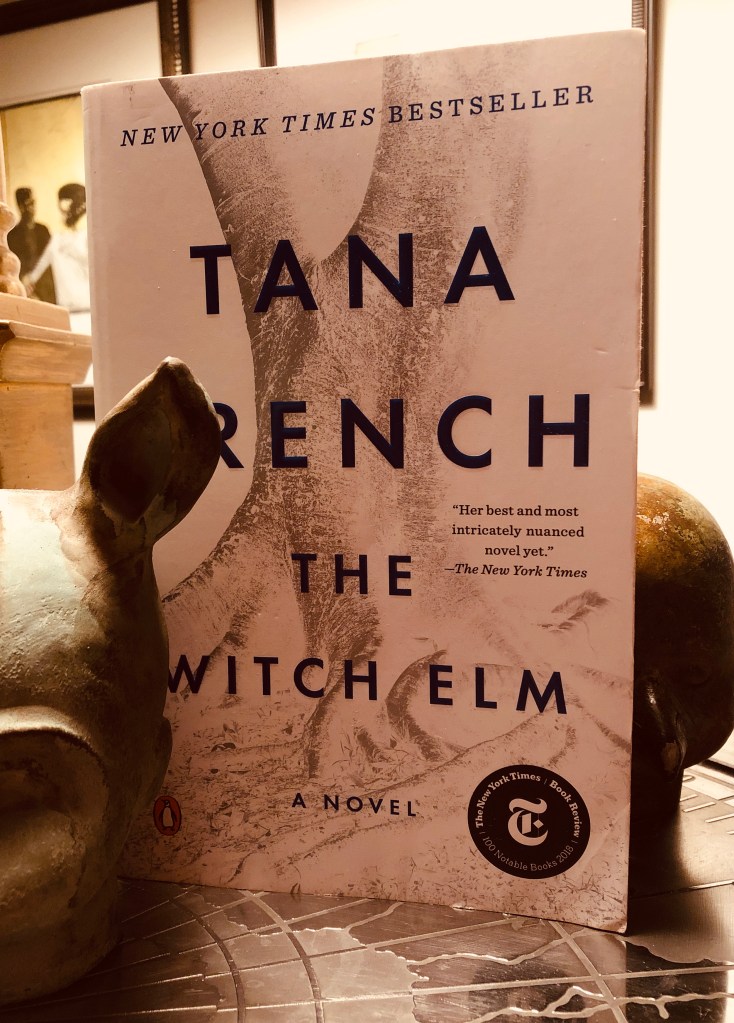
The Witch Elm‘ is Tana French’s latest novel. It is also her first novel which is not a Dublin Murder Squad novel, and so even those of us who love her (which is all of us, right?) viewed it with some slight trepidation. I’ve been very clear about how much I love Tana French. But until ‘The Witch Elm’, it would, technically, have been impossible to say whether it was Tana French I loved, or just the Dublin Murder Squad.

Don’t worry – ‘The Witch Elm‘ is a murder mystery. But it’s an unusual mystery, because it takes as its protagonist not a detective (or a coroner, or a reporter), not a victim, not even a murderer. It takes as its protagonist…a bystander?

There is a reason that most murder mysteries feature detectives – they are the participants in criminal dramas who most closely approximate an omniscient narrator. They are the ones who will eventually know everything, and that’s what we expect in exchange for reading a murder mystery: to eventually know everything, too.

That’s why, despite the fact that every murder mystery detective has crippling demons, they are also brilliant and intuitive and unerring. Despite being tortured, often in the grips of strong PTSD flashbacks, and always, always alcoholic, they approach omniscience. We need to trust them, in order to get what we came for: a solution.

Everyone else involved in a murder mystery is a flawed narrator. The job of a detective is, after all, to assemble complete knowledge. Everyone else has incomplete knowledge, a skewed perspective, their own motives. None of them are trustworthy, and one of them will turn out to be the murderer.

In ‘The Witch Elm‘, French leans into this untrustworthness, hard. Toby Hennessy is, well, a complete tool. He’s a handsome, happy-go-lucky Irishman, a thoughtless optimist who has always gotten his way. He has a good job in PR, good friends, a close family, and a great girlfriend to whom he is thinking about proposing when he surprises some burglars one night robbing his apartment. They beat him nearly to death and leave him with lasting brain damage.

A few weeks after being released from the hospital, Toby learns that his beloved uncle Hugo has been diagnosed with brain cancer, and that his case is terminal. Crippled, fractured, traumatized and spiraling into addiction and depression, Toby moves back to Ivy House.

Ivy House is the Hennessy family home. Purchased by his grandparents, it has been Hugo’s residence since their death. It is a beautiful, secluded old mansion with a long, walled garden. When they were children, Toby and his two cousins, Leon and Susannah, spent their weekends and summers there; it was in this private, lovely estate that they became like siblings.

Toby and his girlfriend move back to Ivy House to care for Hugo in his last days, and to let Toby heal. And so they are there when, one afternoon, Toby’s young nephew finds a skull in the Ivy House garden.

The Witch Elm‘ asks: Are you capable of murder? What if you had recently sustained a serious neurological injury? If your memory was damaged, if you could no longer focus, if you were having sudden, dramatic mood swings? Would you be capable then? And if you might be capable, and there were holes in your memory, would you ever be sure that you hadn’t killed someone?

Really, ‘The Witch Elm‘ is a novel about sanity and home. Specifically, about family homes, about how much the places where we happy as child matter to us, about we much we need them even as they haunt and hold us back. It’s about what we lose when we lose our past, and whether we can ever change unless we leave it.

This is a theme with Tana French: houses, houses that we love, homes (this is basically whatThe Likeness‘ was about). She has a good, visceral understanding of the way in which a beautiful place can became a physical embodiment of love itself, that losing a sense of the sacredness of a beautiful place is heartbreaking, like losing a person.
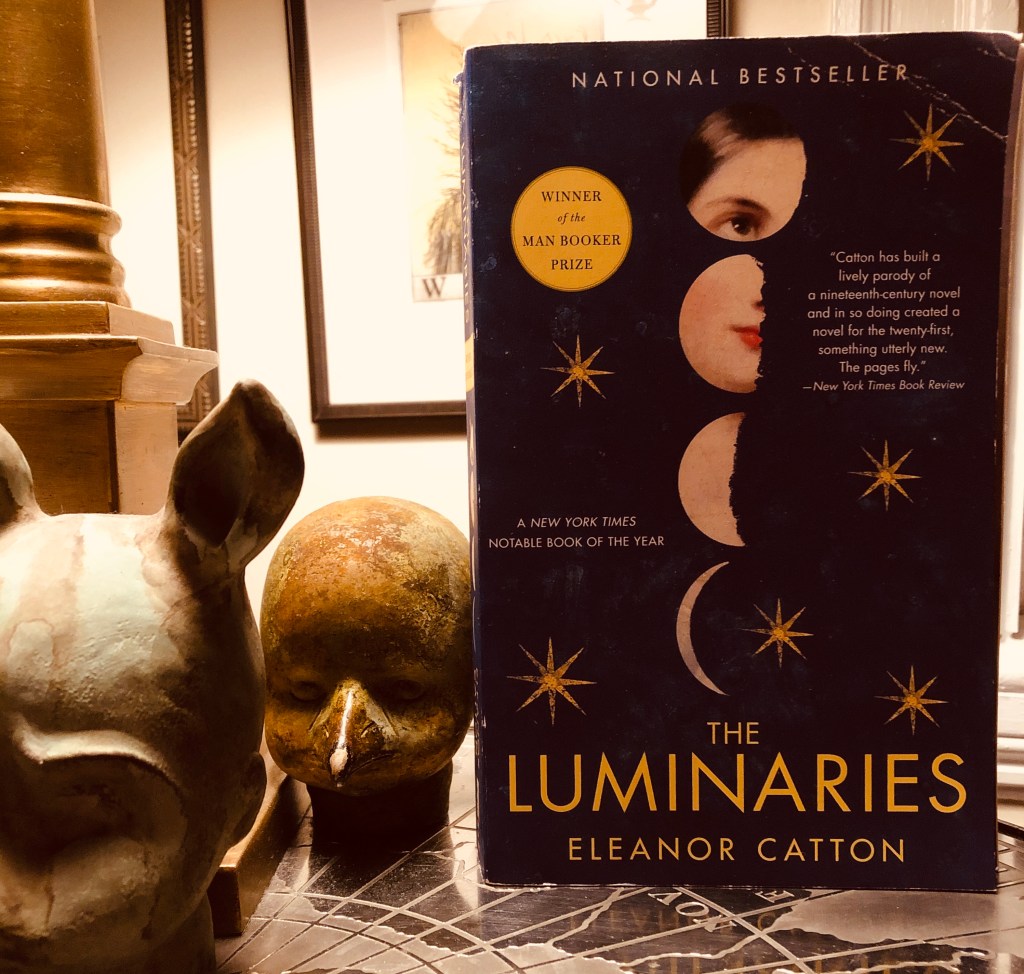
The Witch Elm‘ is really good. It’s good in all the ways that Tana French is normally good: it’s moody, atmospheric, richly detailed and absorbing. She’s a lovely writer; her prose is miles better than almost any other murder mystery prose (Benjamin Black is the only exception I can think of).

But it’s unsettling in a different way. Toby knows that he is in terrible danger, but he cannot discern whether the danger is from within, or from without. Unable to tell whether his family is trying to frame him, or whether he is, in fact, a murderer, he is excruciatingly vulnerable. This vulnerability will communicate itself to sensitive readers in the form of low-level anxiety and panic attacks on the red line.

For me, this is what sets Tana French apart from other mystery writers. Other authors are strong on plot mechanics, or on atmospherics, or on quiet menace; very few are strong on all of them. Tana French’s novels are so richly detailed that it becomes disturbingly easy to lose yourself in them.

It also makes her difficult to write about. I can’t communicate the anxious dread ‘The Witch Elm‘ made me feel. I felt like I was smothering when I was reading it, like I was in danger. This isn’t merely suspense – this is deep, subconscious identification, and it’s difficult to achieve when you read as much as I do. Tana French is special, and, at this point, I’ll read anything she writes – if she puts out a cookbook, I’ll read that cover to cover.

And, at this rate, it’ll probably scare the shit out of me.

The Luminaries

By Eleanor Catton

ALL POSTS CONTAIN SPOILERS

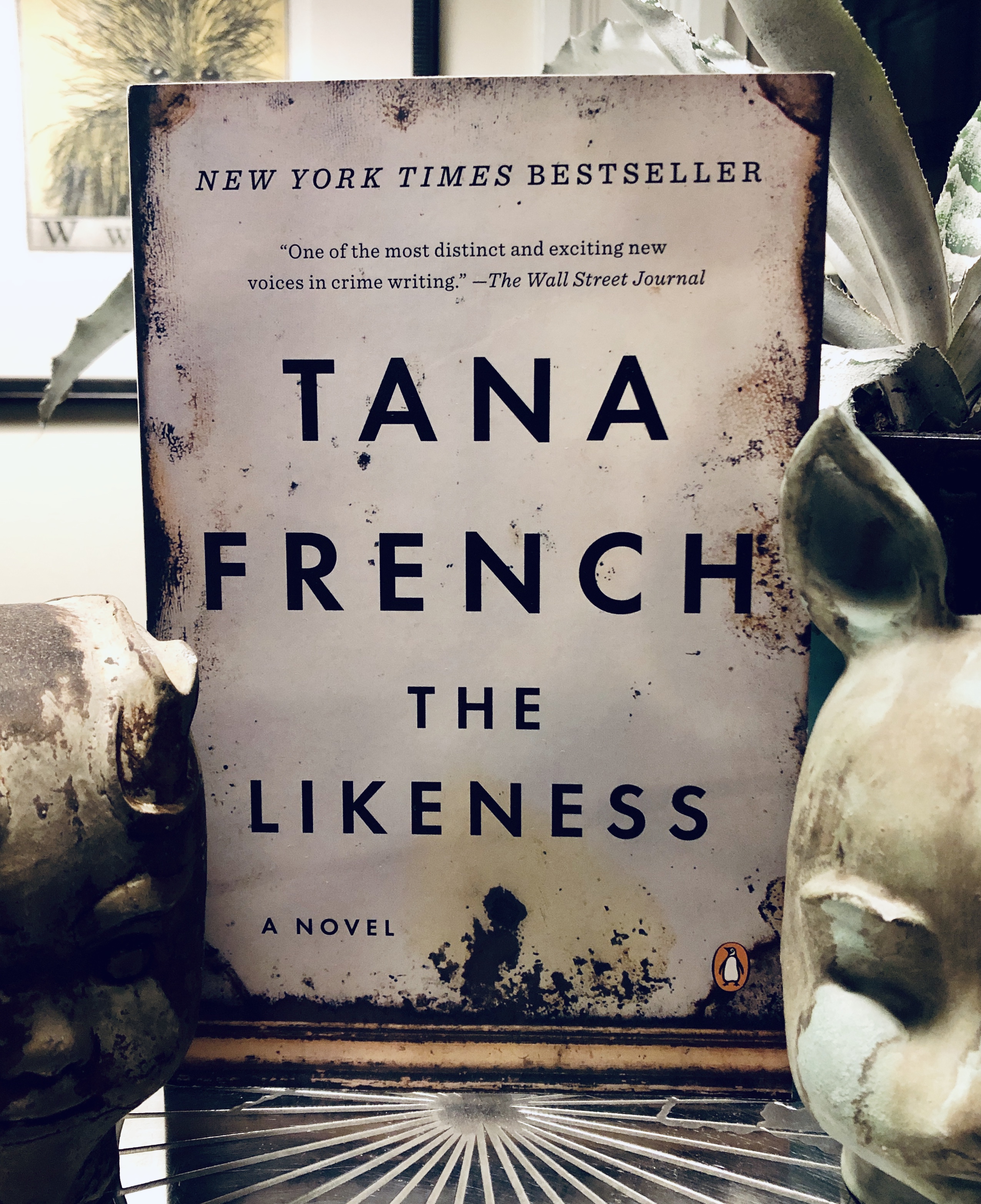
I was in the Harvard Bookstore a little while ago (which, like, I know I mention it a lot, but I spend a totally normal amount of time in bookstores, not a weird, excessive amount of time, at all…), sort of wandering around the Fiction and Literature section, and I noticed a very pretty book with a bright blue cover and yellow letters.

It was called ‘The Luminaries‘, and I had never seen it before, and it was a big book, a hundreds of pages, and the weirdest part: it had won the Man Booker prize. It won the Man Booker in 2013, when I was hypothetically paying attention.

To be clear: prizes aren’t that big a deal. Prizes are merely the opinions of people, and so, like other opinions of people, they are a mixed bag. Some are better, some are worse. As prizes go, I like the Man Booker, especially since they expanded eligibility to include all English-language novels. A prize is never a sufficient reason to read a book, but I think the Man Booker people reliably choose good and interesting books – I’m almost never left scratching my head over a Man Booker winner (which is NOT something can be said of the Pulitzer).

A prize is never a sufficient reason to read a book, but a Man Booker AND a really pretty cover? Why not?

So I bought ‘The Luminaries‘.

The Luminaries‘ is a murder mystery set in a gold rush town in the 19th century. En route to strike it rich in New Zealand’s gold rush, Walter Moody sees what he can only conclude is a ghost in a the hold of his ship the night before he makes land. Having a drink to calm his nerves in the smoking room of his hotel, he finds himself in the middle of secret meeting of local prospectors who have gotten together to puzzle over several strange, recent events.

Another local prospector, Crosbie Wells, a hermit working a useless claim, is found dead in his cabin, apparently of natural causes. However, when his cabin is examined, a fortune in pressed gold is found there. The richest man in town, Emery Staines, is missing. A prostitute, Anna Wetherell, has just tried to end her own life. And a gubernatorial candidate, Alistair Lauderback, seems to be in a dispute with the man who owns the very ship that Moody sailed in on. And the men in the smoking room of Moody’s hotel believe that all these events are connected.

If that sounds ornate and gothic, it is. Eleanor Catton has written a Victorian gothic novel, and then twisted it into something modern. She is clearly a student of the form – she clearly loves it – but her perspective is contemporary, and female.

She’s also a phenomenal writer. She’s got the gift of all great storytellers, the power of telling stories that make you completely forget that you’ve been sitting in your comfy chair in your jammies for two hours without moving and you can’t remember the last time you felt your legs and you have to pee. She has a particular gift for characterization: her character descriptions rise to the level of genius. They are complex and lovely and true-feeling, characters who seem somehow familiar while at the same time seeming unlike anyone you’ve ever met, someone utterly new and yet resonant.

“Walter Moody was not superstitious, though he derived great enjoyment from the superstitions of others, and he was not easily deceived by impression, though he took great care in designing his own. This owed less to his intelligence, however, than to his experience – which, prior to his departure for New Zealand, could be termed neither broad nor varied in its character. In his life so far he had known only the kind of doubt that is calculated and secure. He had known only suspicion, cynicism, probability – never the fearful unraveling that comes with one ceasing to trust in one’s own trusting power; never the dread panic that follows this unraveling; never the dull void that follows last of all.” (p. 18)

Eleanor Catton

“Shepard’s autobiography (a document which, if ever penned, would be rigid, admonishing, and frugal) did not possess that necessary chapter wherein the young hero sows his oats and strays; since his marriage, his imagination had conjured nothing beyond the squarish figure of Mrs. [Shepard], whose measures were so familiar, and so regular, that he might have set his pocket watch by the rhythm of her days. He had always been irreproachable in his conduct, and as a consequence, his capacity for empathy was small.” (p. 135)

“Quee Long was a barrel-chested man of capable proportions and a practical strength…The gaps in his smile tended to put one in mind of a child whose milk teeth were falling away – a comparison that Quee Long might well have made himself, for he had a critical eye, a quick wit, and a flair for caustic deprecation, most especially when that deprecation was self-imposed. He painted a very feeble picture whenever he spoke about himself, a practice that was humorously meant, but that belied, nevertheless, an excessively vulnerable self-conception. For Quee Long measured all his actions by a private standard of perfection, and labored in service of this standard: as a consequence he was never really satisfied with any of his efforts, or with their results, and tended, in general, toward defeatism.” (p. 258)

Maybe you didn’t think that the world needed an 800-odd page modern satire of a Victorian gothic murder mystery set in New Zealand and peopled with breathtakingly well-written characters – you were wrong. And here’s why:

Those old stories had one great virtue: they were entertaining. They were fantastically entertaining, which is perhaps the greatest virtue a story can have. But Eleanor Catton understands something about them: that underneath the entertainment they provided, those old stories missed so much about what was important about the world which was their setting.

They missed the lives of all the invisible people: all the poor people, the immigrants, the slaves, the ill, the whores, the women and children. All those people who just provide texture, color, to those old stories, who are just scenery. And that, even though those people never starred in those stories which we love, they were real, they had lives and feelings and hopes and griefs. And that, in any real world, they would also have stories.

And so she has written them in, not in an obnoxious, heavy-handed. PC sort of way, but the way the ought to be written: as a true and proper part of the world. And then, in the end, she reveals the whole point: that under the labyrinthine twistings of the plot, under the mechanisms and mysteries and villains and ghosts and buried treasures (and all those things are there, in this story), those humans, their human stories, were the point all along.

The Luminaries‘ is a love story which you don’t know is a love story until the very end. It’s a novel that reminds you that murders and thefts and betrayals and winfalls are all events that might happen in a life, but that the life is all that really matters. It’s engrossing through out, gorgeously written, sharp and funny, but, in the end, it’s beautiful, and I loved it.

The Likeness

By Tana French

All Posts Contain Spoilers

“This is Lexie Madison’s story, not mine. I’d love to tell you one without getting into the other, but it doesn’t work that way. I used to think I sewed us together at the edges with my own hands, pulled the stitches tight and I could unpick them any time I wanted. Now I think it always ran deeper than that and farther, underground; out of sight and way beyond my control.” (p. 3)

I wrote a few weeks ago about ‘In the Woods‘, the first book in Tana French’s Dublin Murder Squad series. I believe that I loved it very much; I think, in fact, that I did a crappy job reviewing it because I wanted to hurry up and read this.

The Likeness‘ is the second of the Dublin Murder Squad series. Detective Cassie Maddox, exhausted and heart-broken after the events of ‘In the Woods‘, has retired from the Murder Squad and has been hiding out in the Domestic Violence division. One day, she gets a call from her old mentor from Undercover, Frank Mackey, to come see a dead body. Confused initially, for she has left Murder behind her, the call becomes clear when she learns that the body is carrying ID which states her name as Alexandra Madison. Lexie Madison: that is the name of Cassie Maddox’s old undercover alias.

So who has adopted Cassie Maddox’s discarded alias? This new Lexie Madison is a graduate student. She lives in Whitethorn House, a old estate she shares with her four closest friends, also graduate students. It soon becomes clear that the most unusual thing about the already unusual victim is this incredible close friendship. These five students, outsiders, belong utterly to each other, share a bond which is more like a family than any friendship Cassie Maddox has ever seen. And now Lexie has been stabbed to death, and left in a cottage near Whitethorn House.

And when Cassie Maddox sees the body, she realizes that there is another reason she has been called to this particular crime scene: not only does Lexie Madison wear her name, Lexie is also wearing Maddox’s face. The two women could be twins, they look so alike.

In order to exploit the remarkable similarity in their appearances, Mackey convinces the press to suppress the news of the murder, and sends Maddox into Whitehorn House to live with Lexie’s friends, to learn her life, to discover who might have killed her.

The Likeness‘ is two mysteries rolled into one: the mystery of Lexie Madison’s death, and the mystery of Lexie Madison’s life. The solution to both of these mysteries lies somewhere in Whitethorn house, among the four friends who loved her so deeply.

Honestly, my expectations for this book couldn’t have been a lot higher. I loved ‘In the Woods‘, and I barely paused for breath before starting ‘The Likeness‘. I don’t think I’ve ever vaulted from one mystery novel to the second in such rapid succession – normally, I have rules about this sort of thing, and I like to make sure that I don’t read books by the same author in succession (I know, don’t I sound fun?)

High expectations are not, usually, a great way to go into a book. It’s a little like deciding that someone is your soulmate on first sight: you just don’t have the info you need, and you’ve now prevented yourself from appreciating any lesser, more normal outcome. In the end, I was not at all disappointed by ‘The Likeness‘, but, while ‘In the Woods‘ grabbed me immediately, it took me a little time to acclimate to this novel.

Settling into ‘The Likeness‘ meant willingly suspending some disbelief about the unlikeliness of the premise. All murder mysteries are, more or less, unlikely: the realism quotient of the genre is low. However, anyone who has ever had a friend, or a family member, or a romantic partner, will know that this premise is particularly outlandish. No matter how alike two unrelated people may look, they would never be able to fool an intimate. If your best friend walked out of the house one night, and was replaced by an undercover cop who looked like just them and had seen a few videos of them, do you really think they would fool you for more than a day? Come on…

But, of course, that is so much not the point. Weirdly, the murder also isn’t the point. The point of ‘The Likeness‘ (as in ‘In the Woods‘) are the relationships. As Cassie Maddox lives with Lexie’s friends, as she wears Lexie’s face, she falls in love with the group, with the house, that Lexie loved. And she almost gets lost.

So, yes, it took me a little while to settle into ‘The Likeness‘. My own high expectations and the outrageous premise worked against my enjoyment for a little while, until something else sank in: Tana French has a totally different project than any other mystery writer I’ve ever encountered.

Tana French

A theme is beginning to emerge from French’s works: they are about the souring of love. This is a brave and unusual theme for a detective novelist. Detective novels nod at the warmer human emotions – someone occasionally kills from jealousy, or spurned love. But, mostly, as in life, people in murder mysteries kill from baseness: from greed, or sickness, or alienated rage.

In Tana French, it seems, people kill from love. Her novels are studies in love, not in the ordinary, pedestrian, every day love we all know, but the rare, deep, once-in-a-lifetime loves which some of us are lucky enough to be defined by. Both ‘In the Woods‘ and ‘The Likeness‘ are about these loves, about what happens when they break, but even more about the way we grow around them, what they make us into, and why it is that, when they do break, the consequences are catastrophic for us.

I think that this focus, this obsession of French’s with deep love, is what imparts so much beauty to her books, more even than her creepy, adjectival Irish English. These are stories of relationships – the murders haunt the periphery of these stories. They are the lurking threat which accompany the love, and it is the love which really interests French.

And this theme works for me on a profound level. Don’t get me wrong: I’ll tear through a paperback about a sicko psychopath with a sex dungeon and a penchant for taunting the police. I’m not too fancy for sex crime novels, or greed crime novels, or labyrinthine revenge crime novels – I like those novels, too!

But there is something about the curdled love which seeps through Tana French’s novels that just holds me in place, roots me to the spot, until I finish them. I love these novels, and while I’m reading, I belong to them. I’m upset when they end. They make me uneasy in my soul. I’m going to read every single one.

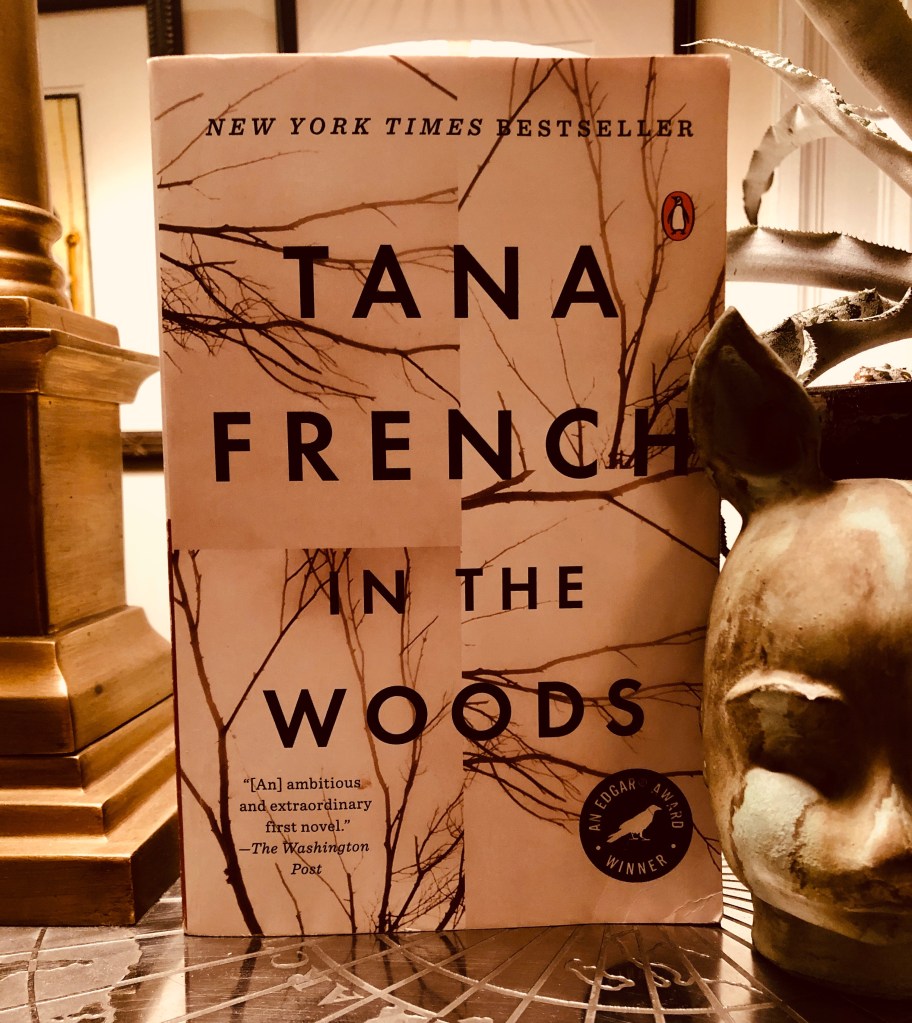
In The Woods

By Tana French

All Posts Contain Spoilers

“What I warn you to remember is that I am a detective. Our relationship with truth is fundamental but cracked, refracted confusingly like fragmented glass. It is the core of our careers, the endgame of every move we make, and we pursue it with strategies painstakingly constructed of lies and concealment and every variation on deception. The truth is the most desirable woman in the world and we are the most jealous lovers, reflexively denying anyone else the slightest glimpse of her. We betray her routinely, spending hours and days stupor-deep in lies, and then turn back to her holding out the lover’s ultimate Mobius strip: But I only did it because I love you so much.” (p. 3)

Perhaps no literary form elicits such universally strong feelings as the detective novel.

I know of no reader who is indifferent to the detective novel. Actually, I know of no reader who does not love them – the trouble is, we all love different ones.

And our preferences feel significant. Like our political affiliation, or the movies that make us cry, the kind of detective novel we love feels like it reveals a lot about what kind of reader we are.

Everyone, of course, admires Agatha Christie. She is the Shakespeare of detective stories: she may not move you, personally, but no one would deny her her exalted place, first in the canon.

But, beyond Agatha, what kind of detective story do you love? Do you prefer the cold, cryptic little tales of Sherlock Holmes? Do you like the gory, plotty American novelists, the elaborate sadistic murderers of James Patterson and Patricia Cornwall? The poetic, moody novels of Benjamin Black? The cerebral, funny British women: Josephine Tey, Dorothy Sayers?

Me, I like them all. But I love very few: ‘The Daughter of Time‘, ‘And Then There Were None‘, ‘Christine Falls‘, maybe. And no author has ever commanded urgency from me. Detective novels, for me, are treats, picked up once and a while, chewed through quickly, and then put down, left behind, details almost entirely forgotten. They are more an escape than a book; I inhabit them, but I don’t take them with me, and I don’t rush on to the next one.

This casualness in my relationship with detective novels is, in large part, the fault of the form. The great strengths of the detective novel are also their great weaknesses: they are highly circumscribed, formulaic. The genre has conventions which must either be observed, or else deliberately eschewed: either way, the conventions dictate the story.

The narrowness of these conventions make detective novels blend together. Which was that series, the one with the lone-wolf detective who doesn’t play by the rules? The one who has a substance-abuse issue and a troubled past? Oh, that’s right: every single one.

But this narrowness is also, I think, why people love these novels so much. The highly predictable nature of these novels make the small differences between them significant. They look so like each other, but when you spy a difference you love, you appreciate it all the more for its subtly.

I have found one that I love. In fact, I have found one that I love so much that I suspect that I may love the author and not just the novel. I have found one that I love so much that I ordered, in one burst, all the other books in the series, before I was even one third finished with it.

I’m not the only person who feels this way. Tana French has been blowing up my pop-culture recommendations lately. I’ve heard her name on every podcast I listen to, read it on every book club reading list that crosses my path. And, normally, this kind of ubiquity prejudices me against the object. I am perverse, and childish – I hate liking something that everyone else likes.

But Tana French is better than my immature contrarianism. ‘In the Woods‘ is the first of the six Dublin Murder Squad novels. That meta-title, ‘Dublin Murder Squad’, makes these novels sound macho, high testosterone and swaggering, in a way that ‘In the Woods’ is emphatically not.

In the Woods‘ is about the investigation of the murder of a little girl. The body of twelve year old Katy Devlin is found outside the housing estate where she lived; it is also the estate where Detective Rob Ryan lived, decades before, and from which his two best friends went missing one day, from the woods. They were never found, and Rob has no memory of that long-ago afternoon. Now, he and his partner Cassie Maddox have been sent back to find out what has happened to Katy.

Of course, the devil of the detective novel is in the details – you learn almost nothing from the premise. This premise, a murdered child, an unlikely coincidence, this could be any detective novel. But Tana French has written something beautiful, and strange, and she has managed to do so within the confines of this genre, which requires extra skill.

Bad detective novels are about crime – good detective novels are about people. ‘In the Woods‘ is about friendship. It is about the deep and abiding love that grows between people, and what happens when it is ruptured, or when it curdles. It is about friendship as a binding force, and about broken friendship as a denaturing force, deranging. It is about what is means to have a friendship so close that it is closer than family, and then to lose it. It about grief and how it hardens us.

Tana French

There is so much I admire about this book. I admire the story: it is subtle and careful. Most detective stories rush into plot – they are split between poor dialog and action sequences. It is a genre characterized by speed, and tidiness, which cannot bear a long pause, or a loose end.

French, on the other hand, is a patient author. She lingers with her characters for their own sake – they are the point of her novel, not the murder. Her world is not a tidy one, and not all crimes will be solved, not all motives answered. She is not dealing in archetypes here, but endeavoring instead to imagine people, and people are messy. They are not, like crimes, solvable, and so she does not solve them. Most detective novels are about one big mystery, and if there other mysteries, they orbit the main mystery and will be solved with it.

But, in French’s world, people are all mysteries, and so mysteries spring up between them, and a murder, or a disappearance, is just one of the many possible difficulties that might happen in the endless collisions between unknowable beings. And so most mysteries, in her world, will never be solved. And even if you learn who, when, where, and how, you will never really understand why.

And she is a lovely writer. I have a prejudice that Ireland produces especially beautiful writers of English, that the prose that they make has a particular lyrical quality which I have always loved. Detective stories are not the place for Joycean prose-poetry – those kind of verbal gymnastics would be, frankly, annoying – but you hear the poetic bent in French’s prose, in her descriptions, in the moody, creepy pall which hangs over her Dublin.

This book owned me completely, and so here is the plain truth of it: I don’t want to write anymore about ‘In the Woods‘ – I want to go read the next Dublin Murder Squad book, ‘The Likeness‘, which has already arrived and is hollering silently at me from my desk. This is the highest compliment I know how to give an author, really: I don’t have time to write about them – I have to go and read them.

Alias Grace

By Margaret Atwood

All Posts Contain Spoilers

I’m beginning to suspect that all Margaret Atwood’s books are really just about how terrible men are.

Certainly, that’s what ‘The Handmaid’s Tale‘ is about.  It’s pretty much what ‘Oryx and Crake‘ is about.  It’s kind of what ‘The Blind Assassin‘ is about, although I’ll grant that is a fuzzier case.

But it’s definitely what ‘Alias Grace‘ is about.

Alias GraceNot superficially, of course.  ‘Alias Grace‘ is the story of Grace Marks, convicted at the age of 16 of murdering her employer, Thomas Kinnear, and his head of household (and lover), Nancy Montgomery.  She allegedly commits this murder with the help of her lover, James McDermott, who is hanged for the crime.  Grace, in view of her youth, is given a life sentence.

Most of the novel takes place many years into her imprisonment, during her extended examination by Dr. Simon Jordan, who is a specialist in diseases of the mind.  It is the story of her life (from her questionable perspective), of her relationship with this doctor, of his obsession with her, and of the murders themselves.  It is a mystery of guilt or innocence.

But, really, it’s a long indictment of men, of male power and the abuses it rains down upon women who are powerless.  It is about doctors who grope during examinations, employers who rape their servants, institutions which incarcerate women who do not conform, men who defame women who will not sleep with them, abortionists who kill women without consequence.

It about the fact that, in a society where men alone are powerful, women are damned if they do, and damned if they don’t.

I’m not exaggerating this theme, and it is not subtle.  Take, for example, this discussion of quilts, which Grace is forever sewing and on which she is forever discoursing:

“…when we’d hung a half-dozen of them up on a line, all in a row, I thought that they looked like flags, hung out by an army as it goes to war.

And since that time I have thought, why is it that women have chosen to sew such flags, and then to lay them on the the tops of beds?  For they make the bed the most noticeable thing in a room.  And then I have thought, it’s for warning.  Because you may think a bed is a peaceful thing, Sir, and to you it may mean rest and comfort and a good night’s sleep.  But it isn’t so for everyone; and there are many dangerous things that may take place in a bed.  It is where we are born, and that is our first peril in life; and it is where the women give birth, which is often their last.  And it is where the act takes place between men and women that I will not mention to you, Sir, but I suppose you know what it is; and some call it love, and others despair, or else merely an indignity which they must suffer through.” (p. 161)

Check your privilege, Sir.

Margaret Atwood
Margaret Atwood

Of course, Margaret Atwood is a marvelous storyteller; she always has been.  She has an eye for detail, for immersion.  It’s easy to lose yourself in her books: I sat down and read ‘Alias Grace‘ in one long layover in Tokyo, and I was honestly in more danger of developing thrombosis from reading this book than I was in the 12 hour flight that followed it.  That’s a strong recommendation for any novel.

But there is something about Atwood which always makes my teeth hurt a little, something irritating right at the edge of her writing.  Perhaps it is a lack of irony.  There is a lyrical quality to her prose, a sort of sing-songing free association in her descriptions, which can be enormously effective, but which more often annoys me badly.

Here, for example, is a passage where I think that writing style works really well:

“The season has now officially changed: Lydia has burst into bloom.  Layers of pale floral ruffling have sprouted all over her, and wave from her shoulders like diaphanous wings.  Simon eats his fish – overdone, but no one on this continent can poach a fish properly – and admires the smooth white contours of her throat, and what can be seen of her bosom.  It’s as if she is sculpted of whipped cream.  She should be on the platter, instead of the fish.  He’s heard stories of a famous Parisian courtesan who had herself presented at a banquet in this way; naked, of course.” (p. 193)

Here, though, is an example of that writing style which makes me want to run screaming from the room:

“It’s the middle of the night, but time keeps going on, and it also goes round and around, like the sun and the moon on the tall clock in the parlour.  Soon it will be daybreak.  Soon the day will break.  I can’t stop it from breaking in the same way it always does, and then from lying there broken; always the same day, which comes around like clockwork.  It begins with the day before the day before, and then the day before, and it’s the day itself.  A Saturday.  The breaking day.”  (p. 295)

I understand that this passage is supposed to communicate the maddening monotony of an imprisoned life, but I’ve never really liked expression by reader-punishment like this – just because my protagonist is suffering should not mean that I must, too.

Or, perhaps, what annoys me is the vague sense of female grievance that lurks behind Atwood’s stories.  Yes, men can be terrible, but there is something flat, two-dimensional, to a world in which everything is explained by the fact that men are terrible, to a world in which all men are terrible in some way, a world in which you cannot have both a good nature and a penis.

And then there is the problem of the resolution.

[Warning: what follows is a very spoilery spoiler.  Very, very spoilery].

It’s always disappointing when endings and books don’t match, when a well-developed and richly imagined book purchases its end with implausible plot theatrics.

A general rule of mine: there are, I think, a few plot mechanisms which, if you find yourself using them, always mean that you need to re-think your storyline.  They signal lazy craft – they are cheap.

These plot developments include (but are not limited to): secret brother-sister incest (I’m looking at you, ‘August: Osage County‘, and you, ‘Crimson Peak‘), a secret twin (excusing ‘The Prestige‘, which pulls it off and (little known fact) is a book!), and a protagonist with undiagnosed Multiple Personality Disorder.

Alias Grace‘ strongly implies that Grace Marks, at the time of the murders, is under the control of an alternate personality, that of her dead friend, Mary Whitney, whose death (at the hands of a back-alley abortionist, of course) was traumatic for Grace.  And, just to add fuel to the trashy fire, this fact is brought to light while she is under hypnosis.

Resolving a murder mystery via multiple personalities is, in my opinion, totally bogus.  ‘Alias Grace‘ is a subtle, thorough story, based on a real person who almost certainly did not have multiple personalities.  Until that session of hypnosis, it was a complex novel about power, and rage, and friendship, and love, what it means to be guilty and whether we can ever see how the world looks through another person’s eyes and how slippery the truth can be.

And then it resolves all that lovely moral ambiguity with the sort of plot device that you expect to see in an episode of Criminal Minds.  It was very disappointing.

None of which, obviously, kept me from turning its pages like it was the last book on Earth.  That’s Atwood for you – whatever your complaints about her, she’s tough to put down.