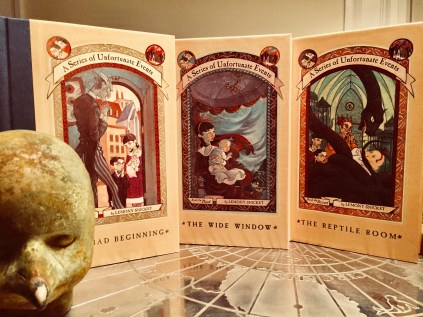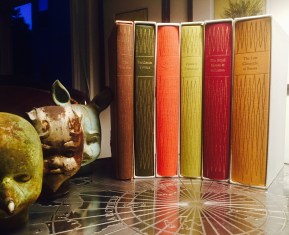
A Series of Unfortunate Events

I – The Bad Beginning

II – The Reptile Room

III – The Wide Window

By Lemony Snicket

All Posts Contain Spoilers

“If you are interested in reading a story filled with thrillingly good times, I am sorry to inform you that you are most certainly reading the wrong book, because the Baudelaires experience very few good times over the course of their gloomy and miserable lives.  It is a terrible thing, their misfortune, so terrible that I can scarcely bring myself to write about it.  So if you do not want to read a story of tragedy and sadness, this is your very last chance to put this book down, because the misery of the Baudelaire orphans begins in the very next paragraph.” (‘The Wide Window‘, p. 2)

Children’s stories should be twisted.

I believed this when I was a child, and I believe it now: children’s stories should be dark, and troubling.  They should deal with the frightening and dismal, the grotesque and the foul.  Children have a need for this subject matter, and a particular aptitude for it.  They inhabit a world full of menace over which they have no control, and their literature must help them confront and name this.  Children’s literature which ignores the monsters that lurk in the night is pointless and, worse, insulting.  I love, and have always loved, the books for children which belly up to the reality of a world of which death and terror are immutable characteristics.

And children themselves are not at all the precious, immaculate angels that forgetful adults like to imagine.  The same troubles obsess them that obsess us: death, destruction, mutilation and violence.  They are creepy little beings who, like adults, need literature to speak to them as they are, and not as we wish them to be.
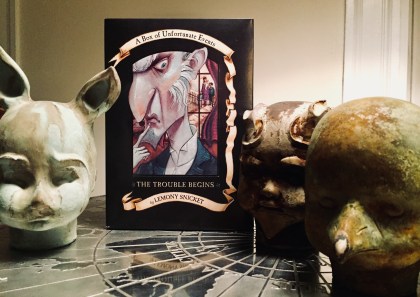
Trouble BeginsBy this measure, willingness to tell darkness plainly, Lemony Snicket’s ‘A Series of Unfortunate Events‘ might be the finest children’s books ever written.  They tell the story of the three Baudelaire children, Violent (age 14), Klaus (“a little older than twelve”), and Sunny (age 1).  The children of loving and wealthy parents, the Baudelaires are orphaned one day in a fire which destroys their family and their home, and put into the temporary care of Mr. Poe, a well-meaning banker and the executor of their parents’ will.

“”Your parents,” Mr. Poe said, “have perished in a terrible fire.”

The children didn’t say anything.

“They perished,” Mr. Poe said, “in a fire that destroyed the entire house.  I’m very, very sorry to tell you this, my dears.”

Violet took her eyes off Mr. Poe and stared out at the ocean.  Mr. Poe had never called the Baudelaire children “my dears” before.  She understood the words he was saying but thought he must be joking, playing a terrible joke on her and her brother and sister.

“Perished,” Mr Poe said, “means ‘killed.'””(‘The Bad Beginning‘, p. 8)

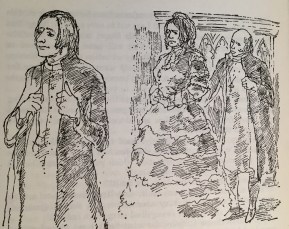
Count Olaf.jpg
Count Olaf’s shiny eyes.

That will states that they should be raised by a “relative”, and the relative that Mr. Poe first chooses is, disastrously for the Baudelaire orphans, one Count Olaf, a stage actor and thorough-going villain, whose only intention is to acquire the Baudelaire fortune for himself.  When his first plan, to force Violet into an under-age marriage and thus take possession of her inheritance, fails, Olaf goes on the lam.  In each successive book, he will hunt down the children, murder their new guardian, and attempt once again to seize their money.
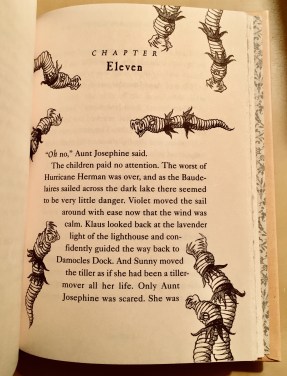
Leeches.jpg
The leeches by whom Aunt Josephine is devoured

And these are not mild, child-friendly deaths.  They are grisly, terrible ends, often coming to characters to whom the reader has become attached, like Uncle Monty, who is injected with snake venom, or Aunt Josephine, who is fed to carnivorous leeches.  Although the orphans themselves are not killed, they are subjected to terrible threats and ordeals, such as being imprisoned in a birdcage and dangled from an open window, or held at knife point, or forced to eat food to which they are allergic.  These children suffer.

I have a good reason for endorsing darkness in children’s books – I’m not just a terrible, child-hating sadist.  The world is a large and frightening place, full of dangers, and children are particularly vulnerable.  They are small, and naive, and powerless within the systems which govern human lives.  Children’s literature should prepare them for this, warn them about danger, and give them a way of understanding misfortune.  The sorrows of good children’s books have morals.

And the moral of ‘A Series of Unfortunate Events‘ is: Do not trust adults.  Count on your wits; count on each other.  Read, think, be brave, because no one is coming to save you.    Don’t count on adults.  They will fail you, either through corruption, or incompetence, or mortality.  Even the kind ones, the well-meaning ones, will not be able to save you when wickedness comes.  And wickedness will always come.

What a great moral!

One of the measures of a really good book is whether it can get you wound up even if you know what’s going to happen.  Each of the ‘Series of Unfortunate Events‘ that I have read so far (The Trouble Begins) adheres to a basic formula: meet a new guardian, lose the guardian to Count Olaf, escape Olaf’s clutches at the very last.

Zombie Snowman.jpgBut, despite my perfect certainty about what was going to happen, I found myself getting emotional, angry and scared, during each book.  Partly, this is because the consistent failure of the adults around the Baudelaires is hard to read about.  Each time that the children identify Count Olaf in disguise, and each time they are disregarded by their caretakers, you suffer with them a little.  You feel the rage of the child; you do not sympathize with the adults.  And the structures which bind them, like the law, like their parents’ will, which were designed to keep them safe, instead trap them and their guardians again and again.  These books are the best indictment of adulthood I’ve ever seen.

Most importantly, though: they are funny.  They are really funny, and weird.  They are studded all over with strange asides and examples, presented in the wry voice of an unknown narrator.

“Unless you are a lawyer, it will probably strike you as odd that Count Olaf’s plan was defeated by Violet signing with her left hand instead of her right.  But the law is an odd thing.  For instance, one country in Europe has a law that requires all its bakers to sell bread at the exact same price.  A certain island has a law that forbids anyone from removing its fruit.  And a town not too far from where you live has a law that bars me from coming within five miles of its border.” (‘The Bad Beginning‘, p. 153)

Series

“Dramatic irony is a cruel occurrence, one that is almost always upsetting, and I’m sorry to have it appear in this story, but Violet, Klaus, and Sunny have such unfortunate lives that it was only a matter of time before dramatic irony would rear its ugly head.

As you and I listen to Uncle Monty tell the three Baudelaire orphans that no harm will ever come to them in the Reptile Room, we should be experiencing the strange feeling that accompanies the arrival of dramatic irony.  This feeling is not unlike the sinking in one’s stomach when one is in an elevator that suddenly goes down, or when you are snug in bed and your closet door suddenly creaks open to reveal the person who has been hiding there.  For no matter how safe and happy the three children felt, no matter how comforting Uncle Monty’s words were, you and I know that soon Uncle Monty will be dead and the Baudelaires will be miserable once again.” (‘The Reptile Room‘, p. 32)

I loved these books.  I wish they had existed when I was a kid – I would have loved them then, too.  Dark, funny, weird: these are hard things to do well in children’s literature.  To do all three well at once is remarkable.

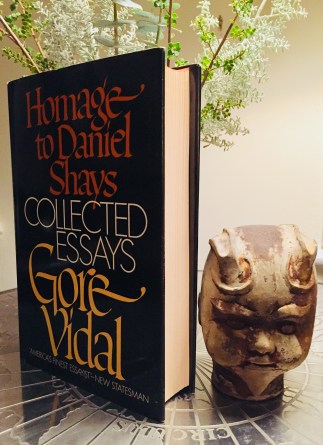
Homage to Daniel Shays

Collected Essays

By Gore Vidal

Homage to Daniel ShaysSome writers possess a quality which, as you read them, makes you long more than anything else to speak to them.

This is not the same as admiring them.  These will not necessarily be your favorite writers, or the writers of your favorite books.  These are writers who shine through their own words, whose force of personality is so clear and so strong that they essentially read their own books to you.  Grappling with them is so like being talked to by them that you want, sometimes quite desperately, to be able to answer.

Sometimes, of course, you do admire them.  Sometimes they are funny, or good – for me personally, David Foster Wallace has always had this distinction.  He is never far from his own work, even his fiction, and when I read him, I always wish I could just put the book down and query directly the mind which produced it.

But sometimes the writers are not admirable, not as a men at least, no matter their skills as writers.  Sometimes they are arrogant, or supercilious, off-putting in some way, and your desire to speak to them is essentially antagonistic: you want to be able to argue back.

And sometimes they are both: vain, haughty, but brilliant too, and if an author can win you over in this case, if their brilliance overwhelms their obnoxiousness, they are among the most joyful authors to read, because you feel as though you are indulging in a guilty pleasure: I know he’s an ass, but he’s just so good.

Gore VIdal
Gore Vidal when he was young and dreamy

H.L. Mencken is this sort of author.  Christopher Hitchens is this sort of author.  But, for me personally, the apotheosis of this category, writers whom you read for the sheer joy of agreeing with their meanness, is Gore Vidal.

Homage to Daniel Shays‘ is a collection of Vidal’s essays, published between 1952 and 1972.  These essays range enormously in content, but themes emerge: the future of the novel, other writers, politics, and sex all recur with some frequency.  Most of the essays are engaging and educating; a few are excruciatingly boring (‘French Letters: Theories of the New Novel’ is torture in written form).

Vidal is probably best remembered as a novelist (he certainly thought of himself as one), but I love him for his essays, his criticisms and his cultural commentary (he is a little like Orwell this way: remembered as a novelist, loved as a critic).  He had an excellent mind; he was brilliant, capable, especially, of summing up people or situations with devastating clarity and pith.

It’s rare that self-important men are also funny; he is an exception to this rule.  He is hilarious, usually in attack but not always.  He is crisp and can cut through hypocrisy as through butter.  More than that, the topic of the essay does not predict when humor will strike, so his wit is both amusing and surprising.  In fact, he is likelier to be funny on unfunny topics (‘Satire in the 1950’s’) than in essays in which one expects jokes (say, ‘Love Love Love’), which makes for lively reading.

“Every schoolboy has a pretty good idea of what the situation was down at Sodom but what went on in Gommorah is as mysterious to us as the name Achilles took when he went among women.” (‘Women’s Liberation Meets Miller-Mailer-Manson Man’)

“From the beginning of the United States, writers of a certain kind, and not all bad, have been bursting with some terrible truth that they can never quite articulate.  Most often it has to do with the virtue of feeling as opposed to the vice of thinking.  Those who try to think out matters are arid, sterile, anti-life, while those who float about in a daffy daze enjoy copious orgasms and the happy knowledge that they are the salt of the earth.” (‘The Sexus of Henry Miller’)

“A profound tolerance is in the land, a tolerance so profound that is it not unlike terror.  One dare not raise one’s voice against any religion, idea, or even delinquency if it is explicable by a therapist.” (‘Satire in the 1950’s’)

“It is well known that the Soviet has always had a somewhat mystical attitude toward that sine qua non of the machine age: the interchangeable part.” (‘Nasser’s Egypt’)

A large proportion of these essays are reviews of other works, and thank god: one of the best joys to be had in this collection, from the point of view of a book nerd, is reading Vidal’s opinions of other writers.  He is capable of summing up other artists in lethal epigrams which leave them not even a shred of dignity, but which are also inarguably (to my mind, at least) true.

About D.H. Lawrence:

“I have often thought that much of D.H. Lawrence’s self-lacerating hysteria toward the end of his life must have come from some “blood knowledge” that the cruel priapic god was mad, bad, and dangerous to know, and, finally, not even a palliative to the universal strangeness.” (‘Norman Mailer’s Self-Advertisements’)

About Graham Greene and Evelyn Waugh:

“Then there are the writers to whom neither sea nor boat exists.  They have accepted some huge fantasy wherein they need never drown, where death is life, and the doings of human beings on a social and ethical level are of much consequence to some brooding source of creation who dispenses his justice along strictly party lines at the end of a gloomy day.” (‘Novelists and Critics of the 1940’s’)

About F. Scott Fitzgerald:

“…F. Scott Fitzgerald, whose chief attraction is that he exploded before he could be great, providing a grim lesson in failure that, in its completeness, must be awfully heartening when contemplated on the safe green campus of some secluded school.” (‘Novelists and Critics of the 1940’s’)

About Anaïs Nin:

“There are two kinds of narcissist: objective and subjective.  The objective looks into the mirror and sees the lines, sees death upon the brow, and records it.  The subjective stares with rapture into the mirror, sees a vision no one else can see and, if he lacks great art, fails entirely to communicate it.” (‘The Fourth Diary of Anaïs Nin’)

Old Gore Vidal
Gore Vidal when he was older and still dreamy

Of course, an author’s greatness lies not just in language, but also in ideas.  Meanness aside, it slowly emerges from these pages that Vidal was also wise, and when he turns his mind from the petty to the existential, he produces material which is beautiful.  In these moments, his writing is so artful, so skillful and elegant, that I would stop and reread the same sentence several times, trying to understand exactly how he did it.  A few of the passages in this book, I could die happy if I had written even one of them:

“While it is perfectly true that any instant in human history is one of transition, ours more than most seems to be marked by a startling variety of conflicting absolutes, none sufficiently great at this moment to impose itself upon the majority whose lives are acted out within an unhuman universe which some still prefer to fill with a vast manlike shadow containing stars, while others behold only a luminous dust which is stars, and us as well.” (‘Novelists and Critics of the 1940’s’)

“It is natural for men to want power.  But to seek power actively takes a temperament baffling to both the simple and the wise.” (‘Barry Goldwater: A Chat’)

“Nor is it unnatural when contemplating extinction to want, in sudden raging moments, to take the light with one.  But it is a sign of wisdom to recognize one’s own pettiness and not only to surrender vanity to death, which means to take it anyway, but to do so with deliberate grace as exemplar to the young upon whom our race’s fragile continuity, which is all there is, depends.  I should have thought that that was why one wrote – to make something useful for the survivors, to say: I was and now you are, and leave you as good a map as I could make of my own traveling.” (‘John Dos Passos at Midcentury’)

“And those who take solemnly the words of other men as absolute are, in the deepest sense, maiming their own sensibilities and controverting the evidence of their own senses in a fashion which may be comforting to the terrified man but disastrous for an artist.” (‘Norman Mailer’s Self-Advertisements’)

You may not always agree with his conclusions (I didn’t), but he’s never, ever stupid, and he turns his critical eye on himself not infrequently.  In these essays, Vidal proves to be ahead of his time on many of issues which remain contentious today: feminism, gay rights, taxes, personal liberty, the military-industrial complex, the intelligence of the electorate.  I wish he were still here – he died in 2012, before I had really discovered him as a writer, and I wish that I had been quicker off the mark.  I need his eye now, to help me understand the world, as I need George Orwell’s.  In fact, this is the highest complement I can give a writer: I am lost without you.

But he’s gone, can’t be questioned, so all I can do is go back with him, rewind the tape, and watch his world through his eyes.

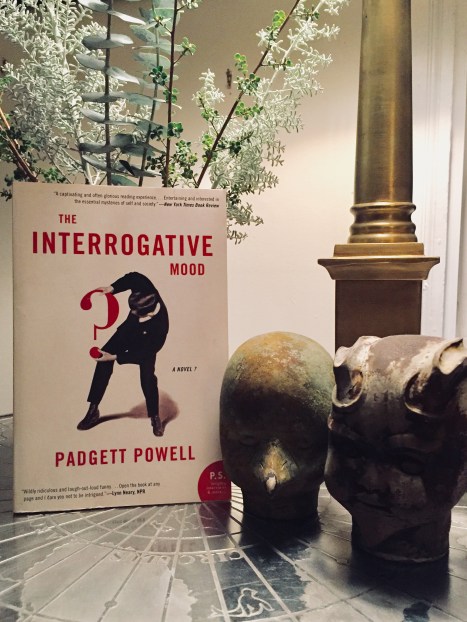
The Interrogative Mood

A Novel?

By Padgett Powell

All Posts Contain Spoilers

Some ideas sound better than they are.  I think we’ve all encountered this: some concepts, full of promise, fail in execution.

And some ideas are exactly the opposite: terrible sounding, but weirdly great in reality.  Sometimes, a premise which promises to be awful when described turns out to be persuasive in practice.

The Interrogative MoodThe Interrogative Mood‘ is a ‘novel’ composed entirely of questions.

And I do not mean that it is a novel with a plot which is expressed entirely in questions: Why did Jane choose today to go to the store?  If she had not, would she have ever seen Dick again?  And why, today, did she find him so oddly attractive?

The Interrogative Mood‘ is a “novel” only in so far as it imparts no factual information to the reader, and makes no argument.  It is, in fact, 164 pages of disjointed and unanswered questions.  It sounds like a terrible ordeal, but it is so much fun to read.

I am, in practice if not in principle, very much against novels which experiment with form.  I understand that artists must extend the boundaries of the possible, but I’m something of a traditionalist where literature is concerned.  I would not have picked up ‘The Interrogative Mood‘ for the world if it had not been for the recommendation of Nick Hornby, Traditional Novelist, who spoke highly enough of it in ‘Ten Years in the Tub‘ (a great source of book recommendations, by the way) that I decided to try it.

I loved it.

powell
Padgett Powell

It was a crazy fun read.  I read it all the way through, as though it were a traditional novel, but, really, one needn’t.  The questions are strange and funny and serious.  Some are mundane and some are simple and some are specific and some are convoluted.  Some are obvious and unmemorable, but some are laugh-out-loud funny and many, to borrow a regrettable and hackneyed expression, will make you think.

Some are odd, precise and beguiling:

“Do you quite credit that there are burrowing owls?” (p. 13)

Some are wise:

“Is it fair to say that the world comprises those who are politicians, those who are movie stars, those who get by, and criminals?” (p. 157)

Some are really just little vignette’s of the quirky way Padgett Powell’s mind works:

“If Jimi Hendrix walked into your room and said, ‘Sit tight there, popo, I shall play you one’ and affected to get out his guitar, what would you do?  Would you say, ‘Wait, Jimi.  You’re dead lo these forty years,’ or ‘Wait, Jimi, let me call up a friend or two – not a big party, mind you, but this is a special thing for me and I want to share it with others if it’s okay with you – is that all right?’ or ‘God, no, Mr. Hendrix, that shit would split my head open right now,’ or ‘Lay some weed on me before you rip it, bro,’ or ‘Okay, Jimi, but if the police come, please do not call them goofballs please’? (p. 160)

The questions are arranged, seemingly without order or reason, into paragraphs, and some of these flights of questions are so charming that they should really be taken as whole:

“Provided you were given assurances that you would not be harmed by the products of either, would you rather spend time with a terrorist or with a manufacturer of breakfast cereal?  What in your view is the ideal complexion for a cow?  Is there a natural law that draws a plastic bag to an infant similar to the law that draws a tornado to a mobile home?  Do you understand exactly what is meant by custard?  Would it be better if things were better, and worse if things were worse, or better if things were worse and worse if things were better?” (p. 6)

The questions make no over-arching point.  They tell no story.  ‘The Interrogative Mood’ really is just a long string of queries, but its effect is engaging and unlike anything I’ve ever encountered before.  It’s like the most interesting, varied personality test you’ve ever taken, but without answers, where the responses, highly personal and often significant, are unscored and unscorable and will never be known to anyone but you.

Perhaps what makes ‘The Interrogative Mood‘ so beguiling is that a question doesn’t have the same effect as its equivalent in statement form.  Questions make us complicit in their reasoning and conclusions.  They don’t set us up as recipients of wisdom; rather, they invite us to derive it with the questioner.  And so a novel made up entirely of questions can shape your thoughts in a way that a plot can only paint pictures for you.  It elicits a totally different kind of engagement, and when, as in ‘The Interrogative Mood’, the questions are creative and off-the-wall, so varied and well-mixed, the effect is sparkling.

Sparkling, and often surprisingly emotionally compelling:

“Do you trust or mistrust people who say “Candy is too sweet for me?” (p. 121)

“Do you regard yourself as redeemed, redeemable, or irretrievably lost?” (p. 101)

‘What today would make you cry?” (p. 126)

If you are like me, you have spent a great deal of time thinking about yourself over the years; however, I, for one, have never thought about myself in these particular ways.  These questions invite me to think about myself, or about the world, along new lines, sometimes specific, sometimes general, sometimes both.

And just because the invitation to thought takes the form of questions does not mean that you cannot be guided along to conclusions.  Powell makes what I came to think of as micro-arguments, a series of questions which end with your consideration of a conclusion, stated in question form.  Take this paragraph, for example:Interrogative Mood

“Are you curious to know what I’ll do with the answers you’ve given me?  Do you think I can make some sort of meaningful “profile” of you?  Could you, or someone, do you think, make such a profile of me from the questions I’ve asked you?  If we had these profiles, could we not relax and let them do the work of living for us and take our true selves on a long vacation?  Isn’t it the case that certain people are already on to this trick of posting their profiles on duty while simultaneously living private underground lives?  Can you recognize these profile soldiers by a certain, dismissive calm, a kind of gentle smile about them when others are getting petty?  Is it in fact the character of the profile-facade person not that which is called wise?  And is the person who is congruent with his daily self and who has no remote self not regarded as shallow?” (p. 70)

That is a great question!  Many of them are great questions, which means that ‘The Interrogative Mood‘ ends up being more interesting and more thought-provoking than most novels, which is bananas because it has no plot, and no characters (except ‘You’ and ‘I’, technically).  I can’t believe I’m recommending it, this book which is just questions, but I am.  It was more fun than it had any right to be, and I loved every page.

Northanger Abbey

Jane Austen

All Posts Contain Spoilers

There are times in one’s life which call for Jane Austen.

It’s a little difficult to define these times with precision (paradoxical, given that one of the great gifts of the author in question is precision).  They are the times in one’s life when things feel as though they might not work out, as though the world is not abiding by rules, when people feel coarse or evil, or when you are lonely, and the world feels large and empty around you.

In those times, this reader often turns to Jane Austen, to her small, orderly world with its essential kindness and small stakes.  Her attention is so fine that she justifies yours, and you feel completely vindicated in devoting emotional energy to courtships, and small slights of manners, and hattery.

Northanger AbbeyI should have read ‘Northanger Abbey‘ long ago.  I’ve read all the others, twice at least.  ‘Northanger Abbey’, Austen’s first complete novel and not published until after her death, has been a nagging hole in my education, and as the winter and the news and my own life converge to feel onerous, it felt like the right time to complete my relationship with her, and read her earliest work.
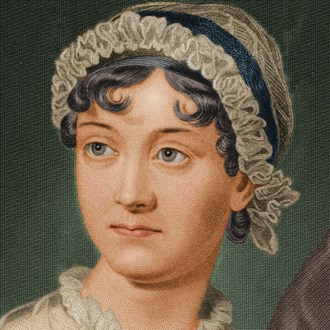
Northanger Abbey‘ is the story of Catherine Moreland, a young, good-natured, but otherwise totally unremarkable woman, her predilection for novels, and her courtship with one Henry Tilney.

Catherine meets Henry on a trip to Bath with her family friends, the Allens; he is assigned to her as a dance partner.  Normal Austenian hijinks ensue: Catherine’s brother will be thrown over by Catherine’s socially ambitious friend, who will in turn be thrown over by Henry’s caddish brother.  Catherine will befriend Henry’s saintly sister Eleanor, and there will be much muttering and misunderstanding about family incomes and marriage settlements.  All will come right for everyone who deserves it.

But ‘Northanger Abbey‘ is really a novel about novels, about our love of them, what they bring to our lives, the ways in which they affect our thinking, and why we publicly scorn the plotty ones that we secretly love best.  Catherine loves novels, particularly the chest-heaving Gothic romances, and her determination to find novelistic adventures in her own life leads her into one or two small scrapes (including the brief conviction that her future father-in-law has his late wife imprisoned in a wing of Northanger Abbey).  The whole novel is a tongue-in-cheek defense of novels, for even while Catherine fails to achieve Gothic adventure, she is, in fact, meeting and contending with villains, falling in love, and showing loyalty to friends and loved ones, the grand tropes of romance writ small.

Which, I think, is part of Austen’s point: novels are meaningful to us not because we are going to achieve the exact adventures which they portray, but because the emotions which animate their characters are the same emotions which animate us, and, within the literary arts, emotions are the special territory of novels.  Other forms may acknowledge or portray them, but only novels explicate them.

And this little conceit is charming.  But, let’s just be honest and upfront: ‘Northanger Abbey‘ is not Austen’s best work.  Which is fine, I mean, look at the competition: she wrote at least two novels of manners which are essentially perfect, and there’s nowhere to go from ‘perfect’ but down.  And this was, as stated earlier, her first attempt, so it’s not surprising that the learning curve should be visible.

Lismore Castle.jpg
In the 2007 PBS adaptation, the scenes in at Northanger Abbey itself were filmed in Lismore Castle, in Ireland.

But it is visible.  There are a few structural problems with ‘Northanger Abbey‘.  First of all, the pacing is odd.  Only about two fifths of the novel are even spent at Northanger Abbey itself.  Too much time is spent in Bath, with the Allens, and much of the later action is dispatched too quickly.  Significant characters, like the odious suitor John Thorpe, are dealt with off-screen, and one of the main characters, Eleanor Tilney, triumphantly marries a Viscount who is not only completely unknown, he is never even named!

A bigger problem is Catherine herself.  Some characters, it is true, do not age well, and the traits of heroines tend to be era-specific, but I suspect that Catherine was a complete drip even in Austen’s day.  She is, by the admission of her narrator, not very smart, only kind of good-looking, and lazy.  Certainly, she’s got all the social sense of a parsnip.  Even her eventual husband finds her lackluster:

“For though Henry was now sincerely attached to her, though he felt and delighted in all the excellencies of her character and truly loved her society, I must confess that his affection originated in nothing better than gratitude, or, in other words, that a persuasion of her partiality for him had been the only cause of giving her a serious thought.” (p. 168)

This is not the denouement of a romantic heroine, which, obviously, is Austen’s point.  But, alas, it also not the denouement of a particularly interesting heroine, and this presents something of a difficulty for the reader who wishes to be sympathetic with, or at all invested in, their protagonist.

Austen will, of course, perfect the heroine later, and the hero.  In the meantime, the other reason she is read, her razor-sharp prose, is the one part of this novel that does not suffer much by comparison.  She is almost as fine a writer of prose here as elsewhere; you never go wrong reading Jane Austen for language.

Jane Austen
Jane Austen

Indeed, Austen is one the few writers who is so excellent at prose-craft that she is both beautiful and funny, high-minded and devastatingly mean, with equal comfort.  But she is most loved for her arch observations of manners, the subtle and inescapable attention with which she observes her fellow man, and ‘Northanger Abbey’ contains some really sick Jane Austen burns.

For example, demolishing the social falseness of Catherine’s friend Isabella:

“It was ages since she had had a moment’s conversation with her dearest Catherine; and, though she had such thousands of things to say to her, it appeared as if they were never to be together again; so, with smiles of most exquisite misery, and the laughing eye of utter despondency, she bade her friend adieu and went on.” (p. 45)

Or pointing out the silliness of fretting too much about what to wear for a man one hopes to impress:

“This would have been an error in judgment, great though not uncommon, from which one of the other sex rather than her own, a brother rather than a great aunt might have warned her, for man only can be aware of the insensibility of man towards a new gown.” (p. 49)

Or, my personal favorite, gently reminding us all that women are thinking beings:

‘She was heartily ashamed of her ignorance.  A misplaced shame.  Where people wish to attach, they should always be ignorant.  To come with a well-formed mind, is to come with an inability of administering to the vanity of others, which a sensible person would always wish to avoid.  A woman especially, if she have the misfortune of knowing any thing, should conceal it as well as she can.” (p. 76)

I suppose, in summary, that the truth is this: ‘Northanger Abbey‘ is not Austen’s best, but Austen is a comfort even when she is under-performing.  Her excellent language, her wit, and her easy humanity all make reading her rather like coming home, and this is the last Jane Austen I will ever read for the first time.  I wish it had been better, but it was like enough to her great works that it gave me comfort, which is what I was looking for in the first place.

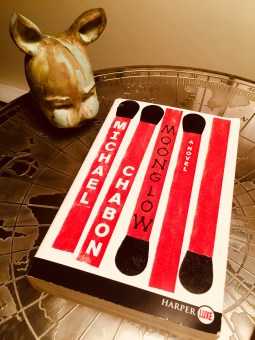
Moonglow

By Michael Chabon

All Posts Contain Spoilers

I am, essentially, an adult toddler.  I sleep whenever and wherever I please (I am particularly prone to falling asleep in moving vehicles); if permitted, I wear pajamas almost exclusively, and I routinely eat Oreos for dinner.

There are very few areas of my life upon which I choose to exercise any amount of discipline at all, but my reading is one of them.  And, like any disciplined person, I have goals which must be met, rules which must be followed.  One of the most important rules is this: if I start a book, I finish it.  It doesn’t matter how long the book is, or how much I hate it, or how bad I believe it to be – if I start reading a book, I must finish.

There are a number of reasons why I do this, why I believe that this makes me a better reader, but the most important is this: you just never know.  Books are like people: they surprise you.  Like people, some seem at first as though they are going to be your great and true friends, and then turn around one day and betray you with their badness.  And, like people, some books make a poor first impression, but turn out on longer acquaintance to be wonderful.

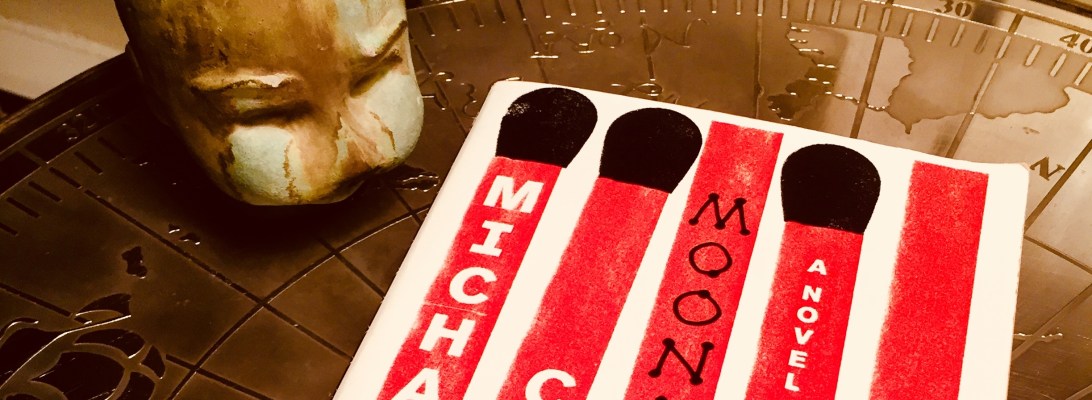
Moonglow.jpgEven allowing for this normal possibility, ‘Moonglow‘ is unusual.  It is rare that it takes me 575 pages to discover that I love a book.  But that was the case with this book, a book that I was only kind of enjoying until, on page 575, I was struck dumb with love, by a footnote of all things.  Perhaps the best way to describe it is: this book ‘When Harry Met Sally’ed me.  I thought we were just friends, and then, one day, on page 575, I discovered that I had loved it all along.

Moonglow‘ is a fictionalized memoir (it’s helpfully titled ‘Moonglow: A Novel’ to help you avoid confusion), an insipid genre which I usually avoid.  I made an exception because, as a younger reader, I really enjoyed a few of Chabon’s novels (especially his most famous, ‘The Amazing Adventures of Kavalier & Clay‘, which I believe I read three times between the ages of 12 and 15).  ‘Moonglow’ is the life story of the grandfather of a writer named Michael Chabon, revealed to the narrator in the last few weeks of his grandfather’s life and augmented by the narrator’s own memories and the reminiscences of his mother (oh, is that not clear?  That’s part of what I object to about “fictionalized memoirs”, the fact that they force you to contort in strange ways, to say things like “the grandfather of a writer named Michael Chabon” instead of just saying “Michael Chabon’s grandfather”, because apparently the “Michael Chabon” who narrates this book only shares a strange and mysterious, ‘fictionalized’, resemblance with the “real” Michael Chabon, which is completely daft).

Chabon
Michael Chabon

Lives aren’t really “about” anything, but memoirs are, and ‘Moonglow‘ is about love and horror and madness and war.  It’s about Chabon’s grandmother, the faithful devotion of his grandfather to her and the psychosis which dogged her to her own death, and it is about his mother, the ways in which her upbringing hardened her.  It’s about fear and insanity and the ways in which we can pass these along to each other, in our genes and in our love.

And then, sometimes, at its periphery or in strange, short bursts, it’s about Chabon (“Chabon”) himself.

It is during one of these moments that I realized that I loved this book.  When his mother had a miscarriage, Chabon went to stay for a few days with his grandparents, whose house terrified him at night because of the presence, in a hatbox in the closet, of a set of French hand puppets.  Chabon believed, apparently quite literally, that these puppets meant him harm, and their presence in the house oppressed him (I do not mean to deride this belief in any way – puppets are sinister and I wouldn’t sleep in a room with them now).  Chabon is, nevertheless, quite funny on the point, even while he describes “the raucous voice”, in his imagination, of the puppet telling him that his mother has surely died.

Then, in a footnote, he says,

“I still hear that raucous voice; I hear a hatbox full of voices.  They bubble up from a crack in my brain, dark mutterings, shouts, and low reproaches that fall just short of sense, intruding on my thoughts almost any time I’m alone in a quiet room, working on a task that requires a certain focus – when I’m drawing, cooking, soldering a circuit, assembling a toy.  When I’m writing, I never hear the hatbox voices; I hear some other voice.” (p. 575)

And, when I read that, several things happened to me all at once.

  1. The four lives braided together in this book became, in an instant, one story, blended and coherent and moving, and convincing whether or not they are “true”.
  2. I connected with Chabon the narrator in a way which would not have been possible if he were entirely fictional.  That’s a little convoluted, so let me put it another way: that foot-noted moment, that present-tense interjection, caused me to feel that I understood and cared about the person I believed was the author of this book, in the present, because I believed that he was a real person.  And I believed that because I believed, in some fundamental way, that that footnote was true.
  3. I realized that this is why people like fictionalized memoirs, or faux-autobiographies, or whatever you want to call this kind of book: they allow you to connect with a human story as though it were real without troubling yourself about verifiable specifics.  My heart could hurt for the mad grandson of a mad woman without needing to know whether Michael Chabon is that grandson, because madness is real and inheritance is real, too, and there is a madman somewhere to hurt for.

575 pages is, I am aware, quite an investment to make on faith.  And I don’t mean to imply that ‘Moonglow‘ is boring up to page 575 – it isn’t at all.  On the contrary, it is entertaining and absorbing, well-structured and unusual.  This won’t surprise anyone who has read Chabon’s other books – he’s a very good storyteller, has a real knack for pacing and character.  There was no reason he would not bring these skills to bear on his “memoir”.

If you had asked me on page 574, I would probably have recommended ‘Moonglow‘ in a yeah-why-not sort of way.  I would have said that it was pretty good, not as good as ‘Kavalier & Clay‘ or ‘Wonder Boys‘, but not at all dull, worth the time.

But I wouldn’t have said that it was beautiful, or moving, and now, after page 575, I believe that it is those things.  Or, at least, it is those things for me.

American Gods

By Neil Gaiman

All Posts Contain Spoilers

It’s so sad to see a good premise wasted.

‘Wasted’ is perhaps too strong a word.  It’s sad to see an execution which fails to live up to its premise.

In fairness to Neil Gaiman, this doesn’t always happen because the execution is terrible; sometimes it happens because the premise is so good that almost no execution could justify it.  Sometimes, a premise is so excellent that even a good execution is disappointing.  That’s probably the case with ‘American Gods‘: the execution of this novel is decent, totally solid.  But the premise is awesome, and so decent just won’t do.

American GodsWhen the protagonist of ‘American Gods‘, Shadow Moon (this terrible cliche of a protagonist is one the things dragging down the execution of this novel) is released from prison, he is offered a job by a man who calls himself Mr. Wednesday.  Moon’s beloved wife has just been killed, and, having nothing else to live for, he accepts the strange offer.  As it turns out, Mr. Wednesday is none other than the Norse god Odin, and Shadow is now his body man.  Shadow learns that the gods of the Old World have been carried with each wave of American immigrants to the New.  These transplant gods have been slowly forgotten as their worshippers have Americanized or died and so they are left to wander, shrinking and predatory, in the modern American landscape.  Every manner of mythical or supernatural creature is here: gods, fairies, furies, djinn, leprechauns.  If someone once believed in them, they are among us, scraping to get by.  And they are about to go to war with the new gods, the gods of modernity and technology, to fight one last battle, to see who shall rule America once and for all.

It’s a magnificent premise, and credit should be given to Gaiman for coming up with it at all.  I mean that honestly and without the slightest sarcasm: most writers will go their whole lives without coming up with one story idea that has this much juice.  And ‘American Gods‘ is…readable.  I don’t mean to damn with faint praise – it is a difficult book to put down; the pages seem to turn themselves.

Neil Gaiman.jpg
I’m really not being fair here – there are many pictures of Neil Gaiman where he doesn’t look posed and pretentious (he actually looks rather lovely and likable in most of them), but I’ve chosen this one, from variety.com

And maybe I should leave it there, declare that ‘American Gods‘ is a great beach read and call it a day, but I’m not going to.  Because I have the sneaking suspicion that Gaiman would be offended to hear ‘American Gods’ called ‘beach reading’, or ‘genre fiction’.  I might be wrong, but that’s my hunch.  Perhaps it is the long dream sequences*; perhaps it is the easy metaphor of the old gods battling the new; perhaps it is the pedantic obviousness of the character names (Mr. Wednesday, Shadow Moon), but something tells me that Gaiman has aimed higher than he ought.  I don’t think he meant to write a great yarn; I think he meant to write a Great Novel.  And not just any Great Novel – I think he meant to write a Great American Novel.

Now, it’s not really fair game to blame novelists for what you think they’re going for.  You don’t really know – it’s usually better to take the novel as you found it, not judging it against the novel you imagine the novelist intended.  However, a novelist will occasionally communicate ambition.  They do this any number of ways: explicitly, in interviews, or implicitly, through heavy-handed metaphor or prose, elaborate and abstruse plot.  And when that happens, when you can see the self-satisfaction of the narrator peeking through the finished work, it’s difficult not to hold the it against them.

I think that Gaiman wants to have his cake and eat it.  He’s tried to write a novel that is both cool and deals in Big Important Themes.  It’s really difficult to do (I’ve never done it, for sure), and he hasn’t pulled it off.  Or, rather, he has technically pulled it off, but not well.  His novel is cool, and it does touch on Big Important Themes, but it hits you over the head with them.  You’d be happy riding along on a road trip with some fun old gods, but you will never be allowed to forget that America Is An Immigrant Nation.  You might have enjoyed a neat fight scene among mythical creatures, but, no, this is a battle between The Culturally Rich Past and The Bleak, Impersonal Techno-Modernity.

But, so what?  A lack of subtly isn’t the end of the world.  But really great novels don’t teach you your lesson; they tell you the story which will allow you to learn it.  There’s a big difference between those two things.  And ‘American Gods’ doesn’t really give you the room to discover anything for yourself; the take-home messages are there waiting for you, gift-wrapped, at the door as you enter.

Which, at the end of the day, does not stop ‘American Gods‘ from being enjoyable reading.  It’s a little furry around the edges, a little obvious; there are, honestly, too many dream sequences.  But it’s a fun read, and because reading is ultimately about having fun, ‘American Gods’ is worth reading.  Maybe I’m wrong about Gaiman’s intentions – maybe he wasn’t shooting for Greatness.  Maybe he just wanted to entertain me, and, if that’s the case, he knocked it out of the park.  I was entertained; I was absorbed.  So, don’t punish Gaiman for failing to live up to the goals I imagine he had; read a book that I enjoyed despite that (imagined) failure.  It’s a good read.

And it’s a great premise.

*An aside: it is my personal belief that dream sequences are a sign of weakness in writing; they are self-indulgent and lazy, and their presence in a plot almost always suggests that someone is taking a short cut.  Another plot event like this: secret brother-sister incest.  When two characters who are sleeping together discover that they are secretly related, I know someone in the Writers Room was phoning it in.

And The Band Played On

Politics, People, and the AIDS Epidemic

By Randy Shilts

All Posts Contain Spoilers

Sometimes, it’s tough to belly up to a big, heavy history book.

You know the kind of book I mean: a magisterial, dense tome dealing, in depth, with some somber human chapter.  Hundreds of pages on a topic about which serious adults always seem to know more than you.

You feel that you should read them, the way that you should eat well and exercise, but every time you contemplate actually cracking them open, you think, ‘Yikes, I’m not going to laugh once during this,’, and so go and watch another episode of ‘How To Get Away With Murder’ instead.

And The Band Played OnAnd the Band Played On‘ has been weighing on my conscience for a year or so now, squatting on my ‘To Read’ shelf and glowering at me.  Every time I reach for a novel, it’s red-letter title gleams at me, as though it were asking, ‘Do you really need to read another Graham Greene novel?  Don’t you care about the victims of the AIDS epidemic?’

Well, I do care about the victims of the AIDS epidemic, and I’ve run out of Graham Greene novels, and so I finally buckled down and read ‘And the Band Played On‘.

First of all, let me say that ‘And the Band Played On‘ is not what I thought it was going to be.  It is not a dry, magisterial history; rather, it’s part narrative history, part journalism, part advocacy.  It does endeavor to tell the story of the AIDS epidemic in the United States (and a little in Western Europe), but it does not pretend to objectivity.  It has a viewpoint, and it is forthright in assigning blame and giving praise.

Shilts.jpg
Randy Shilts

Randy Shilts was a reporter at the San Francisco Chronicle during the 1980s and, as the epidemic developed, he became one of the first reporters in the country to cover AIDS as a full-time beat.  San Francisco did not have the largest absolute number of AIDS cases in the United States (New York City did), but it did have the largest and most civically powerful gay male population, and the largest number of cases per capita.  Shilts was therefore witness at one of the population centers hardest hit, and most responsive, during the early years of the AIDS epidemic, and he manages to imbue his book with the sense of creeping dread and unnameable fear that he himself must have felt.

It’s not a book for the faint of heart, or for the easily outraged.  If Shilts is to be believed*, then the unfolding of the AIDS crisis in America was a clusterfuck of every kind of human recalcitrance, incompetence, and malevolence.  Racism, classism, homophobia, cowardice, complacence, narcissism, over-weaning ambition, and bureaucratic inertia all combined to slow realization of, and effective reaction to, the crisis.  And many, many people died because of it.

That is the most difficult part of ‘And the Band Played On‘: most of the characters to whom you are introduced, the real people for whom you root and to whom you become attached, perish.  They die, slowly, and in agony, and there is nothing you can do to help them.  You, from your vantage of thirty years on, know exactly what’s killing them, but there is no way to alert the people around them, to persuade them to abandon their biases and their prejudice and to see what’s really happening.  It’s heart-breaking, because so few of the obstacles in the way of an effective response to the AIDS crisis in the United States were, in hindsight, legitimate.  Most stemmed from human bungling, callousness or, worse, evil.  And this powerless on your part to alter the past makes the reading of this book claustrophobic, and very upsetting.

This is not a book which will leave you with good feelings about your fellow man.  Of course, it’s not a chapter in our history which was going to leave you feeling good about your fellow man, and you probably knew that going in; I certainly didn’t expect this to be a fun read.  Nevertheless, there are details in here which are so dismal, petty and caustic to the soul, that they will stay with me for the rest of my life.  This, for example:

‘Haitian Americans suffered multiple indignities in the two cities where they were most concentrated, Miami and New York.  Just trying on a pair of shoes in Florida sometimes became a traumatic experience, because salespeople declined to let anyone who looked Haitian near any merchandise.’ (p. 322)

Or this:

‘The guide to British aristocracy, Burke’s Peerage, announced that, in an effort to preserve ‘the purity of the human race,’ it would not list any family in which any member was known to have AIDS. (p. 565)

Or this:

‘Two AIDS sufferers were scheduled to be part of an ‘A.M. San Francisco’ segment whose goal was to ‘demystify’ AIDS and calm the fears.  However, the two patients couldn’t appear on the show because studio technicians refused to mike them.  Then, cameraman said they would not shoot the show if they had to walk onto the same sound stage as the two gay men.  The two patients instead talked through a telephone in a separate room.’
(p. 321)

Larry Kramer
Larry Kramer, an early and controversial AIDS activist, features prominently in the text.  He was one of the founders of the Gay Men’s Health Crisis and is the author of, among other things, ‘The Normal Heart’.  As of writing, he is still alive.

But just because something is emotionally difficult to read isn’t an excuse for avoiding it.  It’s important to know about our national moral failures as well as our glorious successes.  And I would argue that, if you’re determined to learn about the AIDS crisis, or about modern epidemics in general, this is a good book to read.

There are arid portions – there is a lot of policy building, lots of CDC budgets, which will alienate non-wonks – but, for the most part, Shilts has made this subject matter as riveting as possible.  The focus is almost entirely on individuals, which, while distressing, will help you stay focused.  It is exhaustive; there is an astonishing amount of information in this book – the amount of reporting work Shilts must have done boggles the mind.  In that sense alone, it really is a colossal achievement.

But though it has a clear point of view, I think that the best compliment that I can give this book is this: I did not even suspect until I looked him up when I finished – it didn’t even occur to me to ask the question – that Randy Shilts was a gay man.  He refused to be tested for the AIDS virus until he had completed this book, fearing that a positive diagnosis would compromise his objectivity.  He tested positive in March, 1987.

Randy Shilts died of AIDS complications in 1994.  He was 42.

*I don’t mean to imply personal disbelief; I mention it only because I am aware that there has been some controversy surrounding the book.  As I understand it (and my understanding is superficial at best), the controversy involves Shilts’ treatment of Gaetan Dugas, a gay man who came to known, in part because of Shilts’ work, as Patient Zero of the AIDS epidemic.  Genetic studies conducted nearly 30 years after his death exonerated Dugas.

Barchester Towers (The Chronicles of Barsetshire)

The Chronicles of Barsetshire: Second Volume

By Anthony Trollope

All Posts Contain Spoilers

Barchester Towers‘ is the second novel in Anthony Trollope’s ‘Chronicles of Barsetshire’.  The first, ‘The Warden‘ (reviewed here), is the short little tale of Septimus Harding, a kind-hearted Anglican clergyman, and how he came to resign his post as warden of Hiram’s Hospital.  The end of ‘The Warden’ found Mr. Harding poorer in his income but clearer in his conscience, and his beloved daughter Eleanor married to John Bold, the man who unfortunately instigated Mr. Harding’s removal.

As I mentioned, ‘The Warden‘ was low-stakes and leisurely, a sweet story about sweet people who all mean well.  There were no villains, and no true fools.  It was difficult to sustain a sense of outrage against anyone when Mr. Harding himself couldn’t, and no character who would not be welcomed to tea by any other.  Everything ended well, and everyone was forgiven.

This second novel is made of stiffer stuff.Barchester Towers

Barchester Towers‘ opens with two deaths.  The Bishop Grantly of Barchester has died; he was the best friend of Septimus Harding, and the father of his son-in-law, the Archdeacon Grantly of Plumstead.  The Archdeacon was a figure of minor dramatic tension in ‘The Warden’ – he will become a hero in ‘Barchester Towers’.  He is married to Mr. Harding’s elder daughter.

Meanwhile, John Bold, major protagonist of ‘The Warden’ and married to Harding’s younger daughter Eleanor, has been summarily snuffed out between books.  I’m not sure that we are even told how he perished; all that matters now is that Eleanor is a young, attractive widow of means, vulnerable to the unscrupulous.

And the unscrupulous are upon us.  ‘The Warden‘ was villainless; ‘Barchester Towers‘ has two villains, both brought by the new Bishop of Barchester: the unctuous and despicable chaplain Mr. Slope, and his patroness, the over-zealous, over-bearing harridan wife of the new Bishop, Mrs. Proudie.

Proudie Slope
A moment of dramatic tension between Mr. Slope and Mrs. Proudie: “May God forgive you, madam, for the manner in which you have treated me,’ said Mr. Slope, looking at her with a very heavenly look.’ (p. 450)

Barchester Towers‘ ostensibly continues to follow the travails and fortunes of the Hardings: whether Mr. Harding will be re-appointed to the wardenship of Hiram’s Hospital and whom Eleanor will remarry.  However, the novel’s heart really lies in the battle between it’s two new Goliath’s: Archdeacon Grantly and Mrs. Proudie.  They are the standouts here, the best-drawn characters by far, and clearly the favorites of their author.  Take, for instance, this quietly magnificent passage about Archdeacon Grantly:

‘Now there was something peculiarly unorthodox in the archdeacon’s estimation in the idea of a round table…He connected them with what he called the nasty new fangled method of leaving a cloth on the table, as though to warn people that they were not to sit long.  In his eyes there was something democratic and parvenue in a round table.  He imagined that dissenters and calico-printers chiefly used them, and perhaps a few literary lions more conspicuous for their wit than their gentility…”A round dinner-table,’ said he, with some heat, “is the most abominable article of furniture that ever was invented”.’ (p. 180)

Or this aside about Mrs. Proudie:

‘It is ordained that all novels should have a male and a female angel, and a male and a female devil.  If it be considered that this rule is obeyed in these pages, the latter character must be supposed to have fallen to the lot of Mrs. Proudie.  But she was not all devil.  There was a heart inside that stiff-ribbed bodice, though not, perhaps. of large dimensions, and certainly not easily accessible.’ (p. 227)

These are expert characterizations: efficient and droll.  Trollope lives in his characters; in fact, he has imagines them so richly that he has come to love them.  I think that is why (by his own description above) he writes no truly evil villains: he can’t write someone and not forgive them, not offer them redemption.  But this emotional investment means that he is really at his best when he leans into character development, when he gives his characters time and space to display themselves and all their strange idiosyncrasies fully.  This makes him less quotable than other writers of his ilk, though he is just as witty; he only occasionally produces the arch epigrams for which English writers are so well known. When he does produce them, though, they are excellent:

‘There is, perhaps, no greater hardship at present inflicted on mankind in civilised and free countries, than the necessity of listening to sermons.’ (p. 53)

‘A man must be an idiot or else an angel, who after the age of forty shall attempt to be just to his neighbours.’
(p. 328)

However, despite the fact that ‘Barchester Towers’ has both heroes and villains, it doesn’t have much in the way of plot.  As mentioned above, there is the minor drama of Eleanor’s second marriage; there is the vague menace that she will be somehow tricked in marrying the odious Mr. Slope, but no one believes that she will and no one (including, I suspect, Trollope) really cares.  Most of the action of the book centers around the goings-on of our two new villains, Mr. Slope and Mrs. Proudie, their clerical battle with the Archdeacon, and their integration into the quiet community of Barchester.

This plotlessness didn’t really detract from my enjoyment of the back.  In fact, I liked ‘Barchester Towers‘ a lot more than I liked ‘The Warden‘.  The first was a very earnest book about goodness and conscience; the second is a book about manners, and wickeder entirely.  ‘Barchester Towers’ is the funnier of the two, by far, and has the superior cast of characters.

Which is not to say that it lacks sweetness.  While ‘The Chronicles of Barsetshire’ are satires, they are very gentle, and they are, after all, about a group of English clerics endeavoring to do their best.  And Trollope himself is prone to small moral excursuses which, in my opinion, are humane and charming:

‘How much kinder is God to us than we are willing to be to ourselves!  At the loss of every dear face, at the last going of every well beloved one, we all doom ourselves to an eternity of sorrow, and look to waste ourselves away in an ever-running fountain of tears.  How seldom does such grief endure! how blessed is the goodness which forbids it to do so! ‘Let me ever remember my living friends, but forget them as soon as dead,’ was the prayer of a wise man who understood the mercy of God.  Few perhaps would have the courage to express such a wish, and yet to do so would only be to ask for that release from sorrow, which a kind Creator almost always extends to us.’ (p. 25)

BarsetshireThere are six Chronicles; I am now through one third by volumes (though, like all good series, each volume is longer than the previous, and some of the later volumes are pretty honking big).  I really did likeThe Warden‘, but ‘Barchester Towers‘ has drawn me all the way in, won me over completely.  I’m enjoying my time in Barsetshire; I’m ready to go back.

The Warden (The Chronicles of Barsetshire)

The Chronicles of Barsetshire: First Volume

By Anthony Trollope

All Posts Contain Spoilers

I have been longing for a project lately.  I want a long, slow walk through a complete world.  I want to immerse, to invest, in something.  I want to climb a mountain, literarily speaking.

And so, recently, when I was in my favorite used book store in Boston, Brattle Books, and saw a complete Folio Society printing of Anthony Trollope’s ‘Chronicles of Barsetshire’, you may appreciate how I felt: as though my mountain had chosen me.

BarsetshireThere are six Barsetshire novels: ‘The Warden‘, ‘Barchester Towers‘, ‘Doctor Thorne‘, ‘Framley Parsonage‘, ‘The Small House at Allington‘, and ‘The Last Chronicle of Barset‘.  Anthony Trollope is right in my sweet spot: prim, English authors whose novels satirize polite society in impeccable prose (don’t I sound fun?).  Once one of the most famous authors in the English-speaking world, he seems to have been largely forgotten.  When I told even my bookish, nerdy friends what I was planning to read next, the modal response was, ‘Who?’.

Trollope
Anthony Trollope

Part of the problem is that he wrote a lot – something north of 45 novels – and they all tend to blur together.  He is most famous for his two series, ‘The Chronicles of Barsetshire’ and the Palliser novels, and for the single novel, ‘The Way We Live Now‘.  ‘The Chronicles of Barsetshire’ are the thing for which he was first known, and ‘The Warden‘ therefore his first commercial success.

The Warden‘ is our introduction to Mr. Septimus Harding.  He is the warden of Hiram’s Hospital, which is an almshouse endowed hundreds of years before by one John Hiram.  The endowment (this is important) is meant to support 12 bedesmen which the community selects.  It also provides for the wardenship, which when the novel begins supports Mr. Harding very comfortably, to the tune of 800£ per annum plus his lovely house, where he lives with the younger of his two daughters, the cherished Eleanor.

The WardenTrouble arrives on the scene in the person of John Bold.  Bold is a handsome young man whose independent means allow him to zealously pursue the interests of the poor, and he has decided that it is a scandal that the warden of Hiram’s Hospital should have 800£ a year – surely, Hiram intended his bequest to be split more equitably between the warden and his bedesmen.  To that end, Bold initiates a legal examination of Hiram’s will.

This is deeply distressing to the clerical residents of Barsetshire.  The archdeacon, who is Septimus Harding’s son-in-law by his elder daughter, feels that the entire Church of England is under assault, and wades into very polite battle.  Mr. Harding, on the other hand, is upset not by the threat to his living, but by the idea that he has been profiting by that to which he was not entitled.  He is sent spinning into a moral crisis which is only exacerbated by the fact that his daughter Eleanor is in love with John Bold.

Pages
What an orderly little world.

The second loveliest thing about ‘The Warden‘ is the way in which the stakes feel simultaneously so low and so high.  Barsetshire is a fictional place, but it is deeply plausible.  It is also completely coherent: the people within it are imperfect but well-meaning.  They may be officious, misguided, or bombastic, but they will never be evil.  It is an impossibility here.  Thus, while our protagonists experience this kerfuffle over Hiram’s bequest as a moral emergency, and while you feel for them in their extremis, you are aware that it is not an emergency, not really, that whatever the outcome, Barsetshire will endure.

The first loveliest thing about the novel is the language.  Trollope is especially good at wielding that peculiar weapon of English satirists: parsimony, the gift of saying a great deal in very few words.  It allows him to describe people or situations perfectly, as here:

“Dr Grantly is by no means a bad man; he is exactly the man which such an education as his was most likely to form; his intellect being sufficient for such a place in the world, but not sufficient to put him in advance of it.” (p. 40)

Or here:

“And with a volley of impassioned love, John Bold poured forth the feelings of his heart, swearing, as men do, some truths and many falsehoods; and Eleanor repeated with every shade of vehemence the ‘No, no, no,’ which had had a short time since so much effect; but now, alas! its strength was gone.  Let her be never so vehement, her vehemence was not respected; all her ‘No, no, no’s’ were met with counter asseverations, and at last were overpowered…and so at last, all her defences [sic] demolished, all her maiden barriers swept away, she capitulated, or rather marched out with the honours of war, vanquished evidently, palpably vanquished, but still not reduced to the necessity of confessing it.” (p. 137)

I’ll throw down this bet: fifty bucks says that there is no better, pithier encapsulation of the tricky ardor of men than “swearing, as men do, some truths and many falsehoods”.  Or a better description of the moment you know you’re going to say Yes and not No than that you “marched out with the honours of war, vanquished evidently, palpably vanquished, but still not reduced to the necessity of confessing it.”

The Warden‘ is the shortest of the six volumes; some of the later volumes could easily be used to club someone to death.  But I’m excited – I think I’ve chosen my project well.  Barsetshire is low stakes, but it suits me: a small, ordered, and lovely world, where the troubles of men are worked out under an unsparing, and yet ultimately forgiving, eye.